
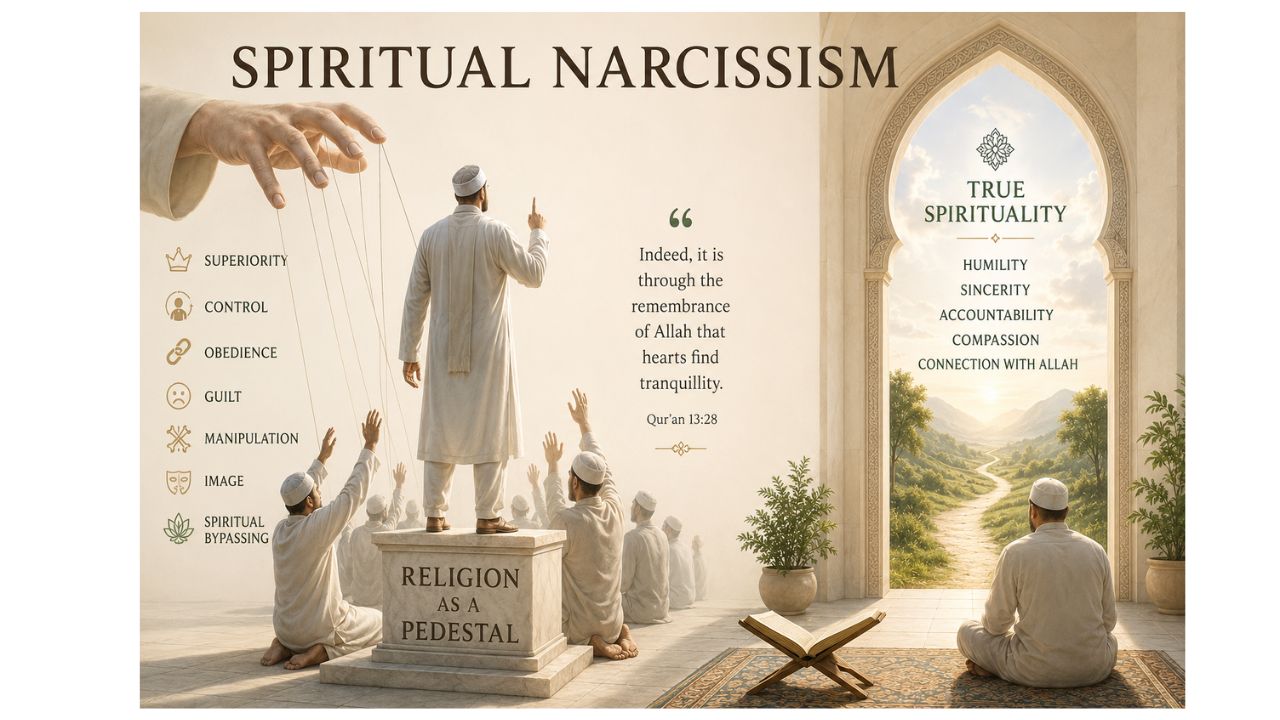
Spiritual narcissism and Islam
When religion becomes a tool for ego, control, and self-glorification
Religion is meant to soften the heart. It should humble the soul and draw a person closer to Allah Almighty. True spirituality increases sincerity, mercy, self-awareness. It instills khawf (a deep awareness of standing before Allah). The more a person truly knows Allah, the more they recognise their own weakness, dependence, and need for His mercy. But like many powerful things, religion can also be misused.
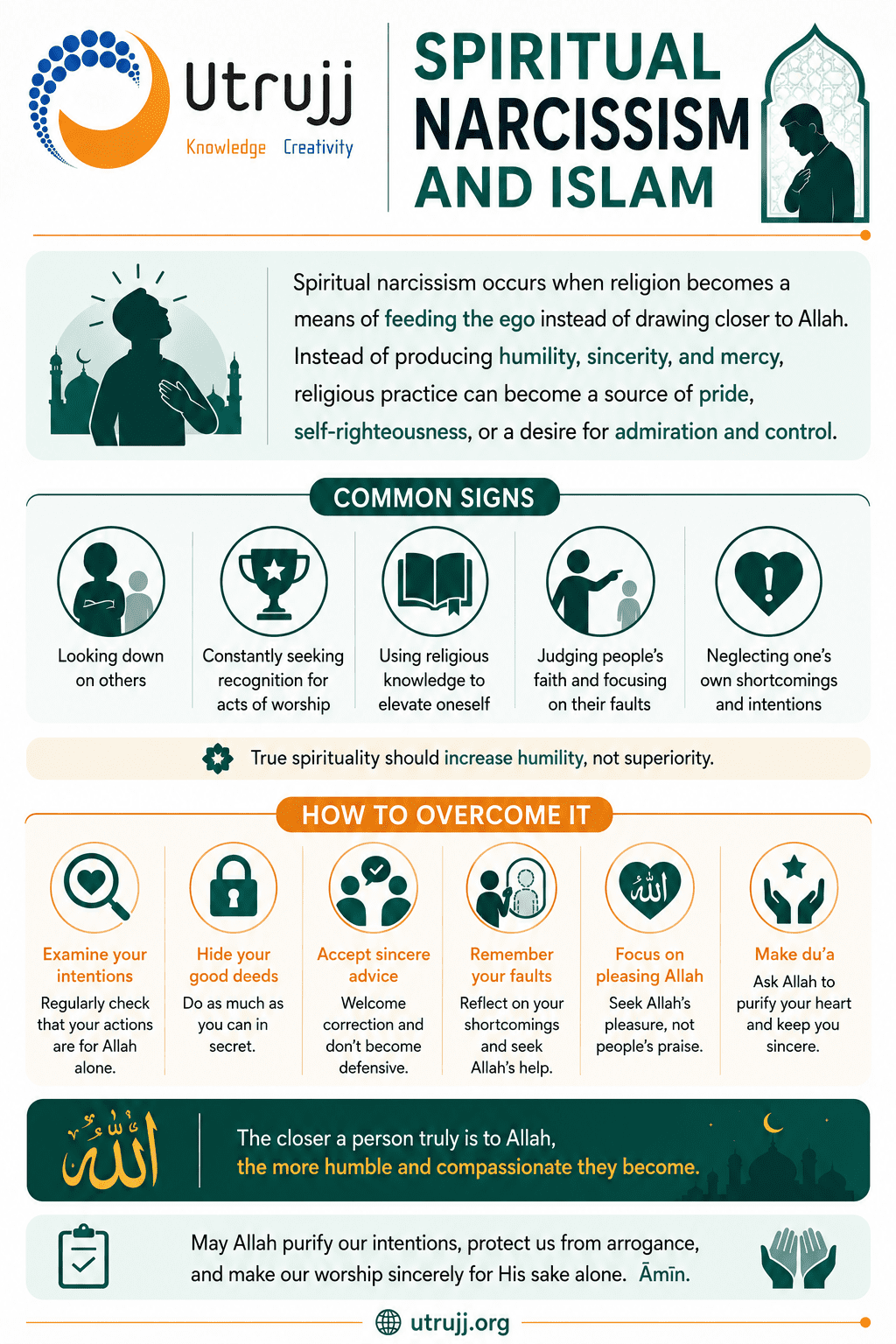
Throughout history, people have sometimes used religious language, knowledge, status, or spirituality not to serve Allah, but to serve the ego. This may appear in the form of arrogance, control, self-righteousness and manipulation. They can aslo present as an obsession with image, or demanding admiration from others in the name of religion. Today this is sometimes described as “spiritual narcissism.”
This does not mean that every religious person who is confident, knowledgeable, strict, or influential is narcissistic. Nor does it mean that giving advice, correcting mistakes, teaching Islam, or holding authority is inherently abusive. Islam requires scholarship, leadership, and sincere nasiha (advice). The issue is when the ego attaches itself to religion and begins using it as a means of superiority and domination, or self-admiration and emotional control.
This topic therefore requires balance, fairness, and caution. We should neither become naive about genuine spiritual manipulation nor become cynical and suspicious of practicing Muslims, scholars, teachers, spouses, or community leaders.
What is spiritual narcissism?
“Spiritual narcissism” is not a formal clinical diagnosis. Rather, it is a term used to describe narcissistic traits that become expressed through spirituality or religion.
This may include:
- using religion to dominate others
- presenting oneself as spiritually superior
- demanding excessive admiration or loyalty
- weaponising guilt, sabr, obedience, or religious language
- humiliating others under the guise of nasiha (sincere advice)
- treating disagreement as disrespect towards Islam itself
- discouraging questions or accountability
- using piety as a tool for image, control, or emotional influence
At its core, the problem is not deen itself. The problem is ego hiding behind deen. A person may outwardly speak constantly about sincerity while inwardly craving praise. They may speak about humility while becoming defensive when corrected. They may demand obedience from others while refusing accountability for themselves.
This is why spiritual narcissism can become especially confusing and painful. The manipulation is not always wrapped in obvious cruelty. Sometimes it is wrapped in Qur’anic verses and Islamic reminders, which create emotional guilt, disguised as religious concern.
Islam already warned against this
Although the modern terminology is new, the spiritual disease itself is ancient. The Qur’an repeatedly warns against self-righteousness, arrogance, showing off, and using religion for worldly status. Allah Almighty says:
فَلَا تُزَكُّوا أَنفُسَكُمْ ۖ هُوَ أَعْلَمُ بِمَنِ اتَّقَىٰ
“So do not claim yourselves to be pure. He knows best who truly has taqwa.”
(Surah an-Najm 53:32)
Allah Almighty also says:
أَرَأَيْتَ الَّذِي يُكَذِّبُ بِالدِّينِ
“Have you seen the one who denies the religion?”
(Surah al-Ma‘un 107:1–7)
Then Allah mentions harshness, neglect of others, and showing off in worship.
One of the most frightening hadiths in Islam is the hadith about the first people judged on the Day of Resurrection. Among them are the scholar, the martyr and the wealthy donor. Outwardly, their deeds appeared righteous. But inwardly, they sought reputation, praise, and status rather than Allah alone.
I heard the Messenger of Allah ﷺ say: The first of people against whom judgment will be pronounced on the Day of Resurrection will be a man who died a martyr. He will be brought and Allah will make known to him His favours and he will recognize them. [ The Almighty] will say: And what did you do about them? He will say: I fought for you until I died a martyr. He will say: You have lied – you did but fight that it might be said [of you]: He is courageous. And so it was said. Then he will be ordered to be dragged along on his face until he is cast into Hell-fire. [Another] will be a man who has studied [religious] knowledge and has taught it and who used to recite the Quran. He will be brought and Allah will make known to him His favours and he will recognize them. [The Almighty] will say: And what did you do about them? He will say: I studied [religious] knowledge and I taught it and I recited the Quran for Your sake. He will say: You have lied – you did but study [religious] knowledge that it might be said [of you]: He is learned. And you recited the Quran that it might be said [of you]: He is a reciter. And so it was said. Then he will be ordered to be dragged along on his face until he is cast into Hell-fire. [Another] will be a man whom Allah had made rich and to whom He had given all kinds of wealth. He will be brought and Allah will make known to him His favours and he will recognize them. [The Almighty] will say: And what did you do about them? He will say: I left no path [untrodden] in which You like money to be spent without spending in it for Your sake. He will say: You have lied – you did but do so that it might be said [of you]: He is open-handed. And so it was said. Then he will be ordered to be dragged along on his face until he is cast into Hell-fire. (Muslim)
The difference between healthy religious leadership and spiritual narcissism
Islam encourages leadership, scholarship, teaching, and giving nasiha. The Prophet ﷺ himself corrected people, instructed people, and held authority. So the issue is not authority itself. The issue lies in character, humility, and intention. A sincere teacher points people towards Allah. A narcissistic personality gradually points people towards themselves.
A sincere leader welcomes accountability and fears oppressing others. A narcissistic personality often reacts to correction with rage, humiliation, denial, or blame-shifting. A sincere scholar reminds people of Allah while remaining humble about their own status. A narcissistic personality may slowly cultivate dependency, admiration, emotional control, or unquestioning loyalty.
The Prophet ﷺ warned against exaggeration in praise. He said:
لَا تُطْرُونِي كَمَا أَطْرَتِ النَّصَارَى ابْنَ مَرْيَمَ
“Do not exaggerate in praising me as the Christians exaggerated regarding the son of Maryam.”
(Bukhari)
This hadith protects the Muslim community from personality cults and unhealthy spiritual dependency. No human being should become the centre of emotional or spiritual worship besides Allah Almighty.
When religion is used to control
One of the most harmful aspects of spiritual narcissism is the use of religion to pressure, silence, or control others.
This may happen when someone uses:
- “obedience” to justify domination
- “sabr” to silence legitimate pain
- “respect” to prevent accountability
- “husn adh-dhann” to dismiss serious concerns
- “lowering the wing” to demand emotional submission
- religious guilt to keep people trapped in unhealthy situations
This can occur in families, marriages, friendship groups, religious circles, or positions of authority. Sometimes a person is made to feel that disagreeing with a religious figure is equal to disagreeing with Islam itself. This is dangerous.
Islam honours scholars and teachers, but scholars themselves repeatedly warned against blind following and against attaching hearts to personalities rather than truth. Imam Malik famously said:
“Everyone’s statement may be accepted or rejected except the occupant of this grave,”
while pointing to the grave of the Prophet ﷺ.
True Islamic scholarship teaches humility before revelation, not emotional domination over people.
The pedestal problem
Some unhealthy religious environments place people onto impossible pedestals. Charisma becomes confused with righteousness. Confidence becomes confused with knowledge. Intensity becomes confused with sincerity.
This can create dangerous dynamics where:
- questioning becomes taboo
- criticism becomes betrayal
- emotional dependency increases
- image becomes more important than truth
- victims feel unable to speak
Islam protects against this by constantly redirecting hearts back to Allah Almighty. The believer respects people, benefits from them, and learns from them, but ultimate dependence belongs only to Allah. One of the signs of unhealthy spiritual dynamics is when fear, validation, emotional stability, or self-worth become excessively attached to a human being rather than to Allah Almighty.
Wisdom, not cynicism
At the same time, this topic must not become a reason for paranoia or suspicion towards practicing Muslims. Not every strict parent is spiritually narcissistic. Not every teacher who corrects mistakes is manipulative. Not every religious disagreement is abuse. Not every confident speaker is driven by ego. Sometimes people today misuse psychological language to avoid correction, discipline, or accountability. This is also dangerous.
Islam teaches believers to be balanced and fair.
Allah Almighty says:
وَلَا يَجْرِمَنَّكُمْ شَنَآنُ قَوْمٍ عَلَىٰ أَلَّا تَعْدِلُوا ۚ اعْدِلُوا هُوَ أَقْرَبُ لِلتَّقْوَىٰ
“Do not let hatred of a people cause you to be unjust. Be just; that is nearer to taqwa.”
(Surah al-Ma’idah 5:8)
The goal is therefore not suspicion, but discernment.
Protecting yourself spiritually and emotionally
The believer should not become emotionally naive. The Prophet ﷺ himself recognised personalities and dealt with people differently according to wisdom. In one narration, he described a man as “an evil man among his people,” yet still spoke to him courteously when he entered. When Aisha (may Allah be pleased with her) later expressed surprise, the Prophet ﷺ explained that among the worst people are those avoided because of their foul behaviour. This shows that good character does not always mean unrestricted trust or emotional openness.
A Muslim should strive to remain courteous and principled without becoming emotionally exposed to manipulation. Wisdom sometimes means being careful about how much emotional access you give to people who repeatedly distort, guilt, or weaponise vulnerability. This may involve seeking trusted counsel, staying emotionally composed, and recognising that protecting your heart is not the same as becoming harsh.
Counsellors often observe that highly empathetic people can become trapped in unhealthy dynamics because they constantly hope they can heal, rescue, or change the other person through patience and sacrifice. Islam encourages mercy and compassion, but every quality must remain balanced. When empathy turns into complete self-neglect, a person may slowly harm their own emotional, mental, and spiritual wellbeing. This too can become a form of dhulm (oppression) against oneself. Islam does not ask believers to destroy themselves in the name of helping others.
Inner peace and worship
One of the aims of Islam is sakinah (tranquillity) and steadiness of the heart through closeness to Allah Almighty.
Allah Almighty says:
أَلَا بِذِكْرِ اللَّهِ تَطْمَئِنُّ الْقُلُوبُ
“Indeed, it is through the remembrance of Allah that hearts find tranquillity.”
(Surah ar-Ra‘d 13:28)
Constant emotional manipulation, guilt, confusion, and psychological chaos can slowly erode a person’s inner peace and ability to worship with presence. Peace and security are an essential component of worship. When a person lives in constant fear, anxiety, or emotional instability, it becomes harder to connect deeply with Allah Almighty.
Protecting one’s emotional and spiritual wellbeing is therefore not selfishness. It can be part of preserving the heart’s ability to worship Allah sincerely.
Coercive family members
In some families, religion may be used by parents or elders in a coercive or emotionally manipulative way. Concepts such as obedience, sabr, family honour, or fear of Allah may be used to silence a child’s legitimate pain, dismiss emotional harm, or pressure them into unhealthy compliance. Islam greatly honours parents and commands kindness, respect, and maintaining family ties. But parents are not infallible, and Islam does not permit anyone to use deen as a tool of control, humiliation, or oppression.
Forced marriages, forced divorces, unreasonable expectations, or excessive interference in a person’s marriage and private affairs are not justified simply because they come from parents or elders. Respecting parents does not mean surrendering every personal decision, nor does it mean tolerating emotional manipulation in the name of family honour or obedience.
If a parent behaves in this way, the child should try to maintain adab and avoid unnecessary harshness, but this does not mean they must surrender all emotional boundaries or silently accept ongoing harm. Sometimes wisdom means limiting emotionally charged conversations, refusing guilt-based manipulation calmly, seeking support from trustworthy and knowledgeable people, and creating healthier distance where needed while still maintaining basic respect and ties.
A believer should also remember that Islam itself is not represented by the unhealthy behaviour of individuals, even if those individuals use religious language. True Islamic guidance brings a person closer to Allah. It should not leave a person living in constant fear, confusion, shame, or emotional exhaustion.
Spiritual narcissism is not about religion itself. It is about the ego attaching itself to religion.
The danger is not sincere scholarship, leadership, or piety. The danger is when sacred things become tools for self-glorification, emotional control, superiority, or domination. True spirituality does not make a person obsessed with themselves. It makes them humble before Allah.
Related posts
Be good to your relatives
Parents and in-laws: what does Islam ask of us?
Latest Blogs
- The seven instructions of the Prophet ﷺ
- Healing from the Quran and Sunnah (part 6) – wellbeing (afiya) practices and environment
- Healing from the Quran and Sunnah (part 5) – physical health, sleep and strong emotions
- Healing from the Quran and Sunnah (part 4) – prophetic food
- Healing from the Quran and Sunnah (part 3) – the holistic approach, ruqya, fasting and moderation