

Who is a mahram?
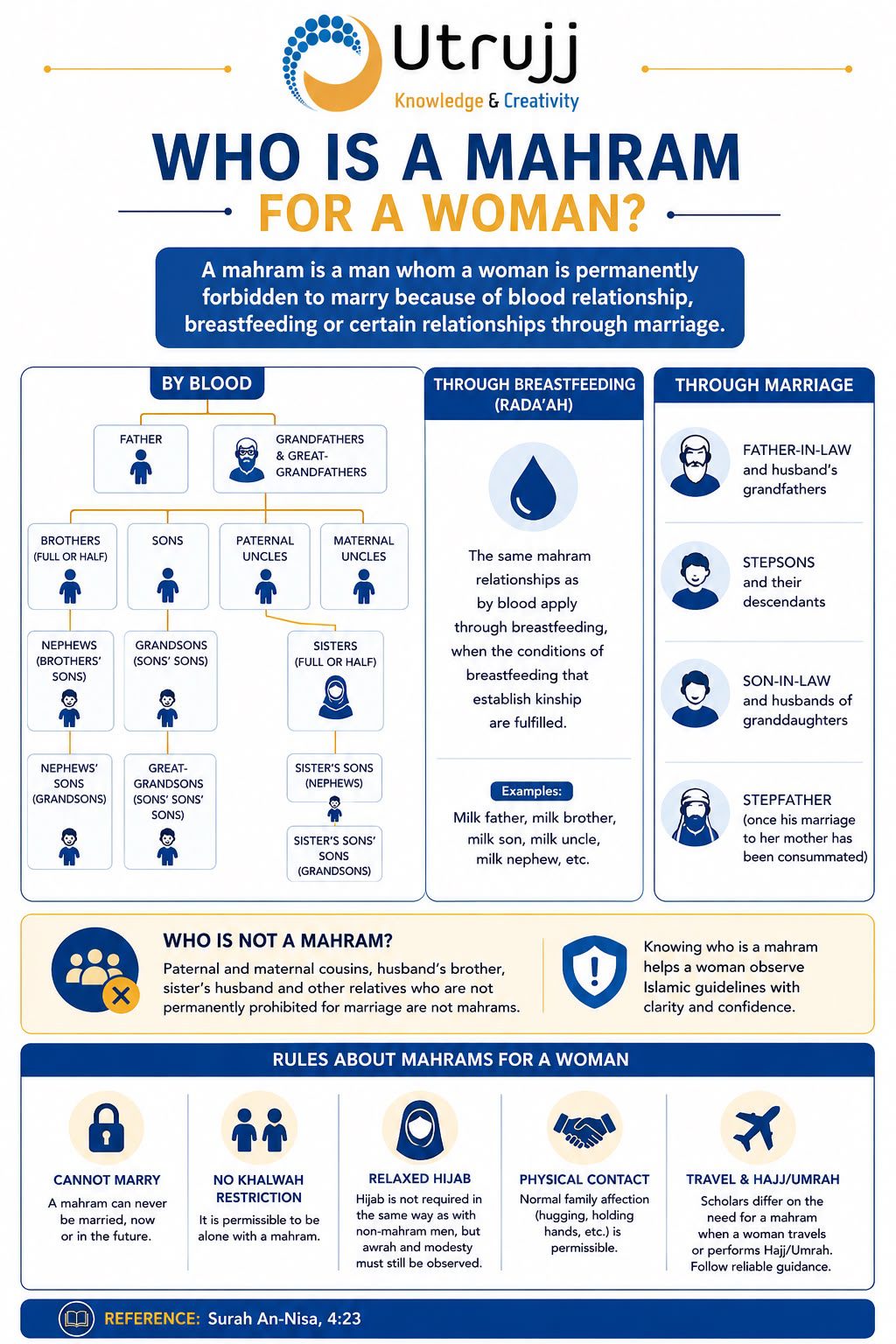
A mahram is someone whom a woman is permanently forbidden to marry because of a blood relationship, breastfeeding or certain relationships created through marriage.
The important word here is permanently. Someone does not become a mahram simply because he is a relative, an in-law, elderly, or regarded as part of the family. If marriage to him could become permissible in different circumstances, he is not a mahram.
Mahrams by blood
For a woman, her mahrams by blood include:
- Her father and male ancestors, including her grandfathers and great-grandfathers on both her mother’s and father’s sides.
- Her sons and male descendants, including her grandsons and great-grandsons.
- Her brothers and half-brothers, whether they share the same father or the same mother.
- Her nephews, meaning her brother’s sons and her sister’s sons, as well as their male descendants.
- Her paternal and maternal uncles, including the uncles of her parents and grandparents. For example, her father’s or mother’s uncle, and her grandfather’s or grandmother’s brother, are also her mahrams. (However, her paternal and maternal aunts’ husbands are not her mahrams).
These relationships continue through the generations. For example, a great-grandfather is a mahram just as a grandfather is, and a brother’s grandson is a mahram just as a brother’s son is.
Mahrams through breastfeeding
Mahram relationships can also be established through breastfeeding (rada’ah) when the conditions required for breastfeeding kinship are fulfilled.
The Prophet ﷺ said:
“What becomes unlawful through breastfeeding is what becomes unlawful through birth.”
Therefore, breastfeeding can create relationships such as a milk father, milk brother, milk son, milk uncle or milk nephew.
The detailed conditions for establishing rada’ah differ between the schools of Islamic law, so an individual case should be checked if there is any uncertainty.
Mahrams through marriage
Certain relationships created through marriage also result in a permanent prohibition of marriage.
These include:
- Her father-in-law and her husband’s male ancestors, including his grandfathers and great-grandfathers.
A father-in-law becomes her permanent mahram as soon as the nikah takes place. Consummation is not required. He remains her mahram even if she later divorces his son or her husband dies.
- Her stepsons, meaning her husband’s sons from another woman, and their male descendants.
Her husband’s son becomes permanently prohibited from marrying her through her marriage to his father. Consummation is not required, and the mahram relationship remains even if her marriage to his father later ends.
- Her son-in-law, meaning her daughter’s husband, as well as the husbands of her granddaughters and further female descendants.
This relationship is also permanently established through the marriage.
- Her stepfather, meaning her mother’s husband, once he has consummated his marriage with her mother.
This is different from the father-in-law and stepson relationships. If a man marries a woman but the marriage ends before consummation, her daughter does not become permanently prohibited to him merely because of the marriage contract.
Allah sets out the principal relationships permanently prohibited in marriage in Surat al-Nisa 4:22–23.
Who is not a mahram?
Not every male relative is a mahram.
A woman’s paternal and maternal cousins are not her mahrams, even though they are blood relatives, because marriage to them is permissible.
Her husband’s brother is not her mahram. The same applies to the sons of her husband’s brothers and sisters.
Her sister’s husband is also not her mahram. A woman cannot marry her sister’s husband while he is married to her sister, but this is a temporary prohibition rather than a permanent one. The normal rulings concerning a non-mahram therefore continue to apply to him.
The husbands of your maternal or paternal aunts are not her mahrams; the mahram relationship is through blood, not through marriage to her aunt.
Similarly, someone does not become a mahram simply because he is commonly called an “uncle”, is a close family friend or has known the woman since childhood.
An adopted son does not automatically become a mahram either. Adoption does not change biological lineage in Islamic law, although a separate mahram relationship could exist through breastfeeding or another recognised relationship.
The key distinction is simple: a mahram is someone whom she is permanently forbidden to marry. A temporary prohibition on marriage does not make someone a mahram.
Mahram rulings
Being a mahram has a number of practical consequences.
Hijab: A woman does not have to observe the same level of hijab in front of her mahrams as she does in front of non-mahram men. However, the rules of awrah, modesty and appropriate dress still apply.
Khalwah: A woman may be alone with her mahram. Khalwah, meaning seclusion with a non-mahram member of the opposite sex, is prohibited.
Physical contact: The rules prohibiting physical contact between unrelated non-mahram men and women do not apply in the same way between mahrams. Normal family affection is permissible, provided there is no desire or inappropriate behaviour.
Marriage: Marriage between mahrams is permanently prohibited. This is what distinguishes a mahram from someone whom a woman is only temporarily unable to marry.
Travel: The presence of a mahram has traditionally formed part of the Islamic rulings concerning a woman’s travel. There is scholarly detail and difference of opinion concerning when a mahram is required, particularly in relation to safe modern travel.
Hajj and Umrah: There are also differences between the schools of law regarding whether a woman must travel with a mahram for Hajj or Umrah, so this should not be presented as an absolute rule without qualification.
Permanent and temporary prohibition
This distinction helps avoid much of the confusion around mahrams.
A father-in-law remains a mahram permanently, even if the marriage ends in divorce or the husband dies.
A stepson also remains a mahram permanently once the relationship has been established through the nikah to his father.
By contrast, a sister’s husband is not a mahram. Although a woman cannot marry him while he is married to her sister, the prohibition is temporary. The rulings of hijab, khalwah and physical contact with a non-mahram therefore still apply.
The primary Qur’anic basis for the permanently prohibited relationships is found in Surat al-Nisa 4:22–23, while Surat al-Nur 24:31 is particularly relevant to the rules concerning a woman’s adornment and those before whom it may be shown.
Related posts
What beauty treatments are permissible in Islam?
Fade hairstyles, tatoos and piercings