Lessons from the Seerah – what was Arabia like pre-Islam?

Alhamdulillah, it is a great honour to talk about the Prophet ﷺ and to learn from his seerah, his life and biography. In the previous article, we looked at why we study the seerah, what we gain from studying it, and the connection between the life of Prophet Muhammad ﷺ, the Qur’an and our own reality.

Though we prefer to jump straight into the story, we need to set the scene. If you want to understand the seerah properly, you need to understand the world in which the Prophet ﷺ lived -you need some idea of the geography, the social structure, the trade routes and the alliances between different tribes. Otherwise, you will read an incident in the seerah but not fully understand why it happened.

Why was the tribal system so important? Why did one tribe have an alliance with another tribe? Why, when Prophet Muhammad ﷺ returned from Ta’if, did he seek the protection of Al-Mut’im ibn Adi, even though Al-Mut’im was not a Muslim? This is where understanding the system makes a big difference.

When Prophet Muhammad ﷺ returned from Ta’if, he could not simply walk back into Makkah as though nothing had happened. His position had become vulnerable. He therefore sought the jiwar, the protection, of Al-Mut’im ibn Adi. Al-Mut’im agreed and gave him his protection, allowing Prophet Muhammad ﷺ to enter Makkah safely.

The Prophet ﷺ never forgot this favour. Years later, after the Battle of Badr, when Al-Mut’im had already died, the Prophet ﷺ said regarding the prisoners of Badr:

«لَوْ كَانَ الْمُطْعِمُ بْنُ عَدِيٍّ حَيًّا، ثُمَّ كَلَّمَنِي فِي هَؤُلَاءِ النَّتْنَى، لَتَرَكْتُهُمْ لَهُ»

“If Al-Mut’im ibn Adi were alive and spoke to me concerning these prisoners, I would have released them for him.” (Bukhari)

Look at this. Al-Mut’im was not Muslim, yet Prophet Muhammad ﷺ remembered what he had done for him. This tells us something about the character of the Prophet ﷺ as well. He did not forget someone’s kindness simply because that person was not Muslim.

But to understand why Al-Mut’im’s protection mattered in the first place, you have to understand how Arabian society worked. This is why the classical books of seerah normally have a section on Arabia before Islam and before the birth of the Prophet ﷺ. You find this in Ibn Ishaq, in Sirat Ibn Hisham and in the other major works of seerah. Even many modern books of seerah give some background before beginning the story.

If you look at Ibn Hisham, for example, there is a lot of detail about the tribes and their relationships. It can become very complicated. I am not going to take you through every branch of every tribe, otherwise you might get lost, and probably I will get lost with you!

What we need is the bigger picture.

Once you understand the relationships between the tribes, many events in the seerah begin to make much more sense. You understand why certain people supported one another, why particular alliances mattered, what happened during the Hijrah, and why events unfolded differently from one place to another.

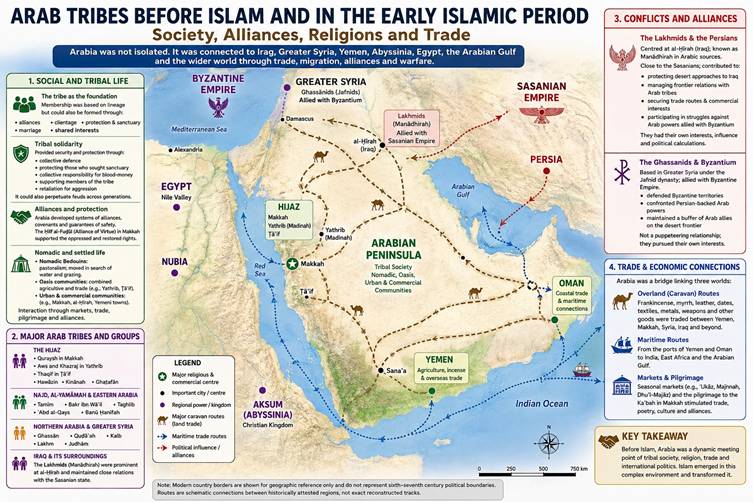
So inshaAllah, I want to give you an overview of the geography, the trade routes, the markets, the religions that existed in Arabia and the political and tribal relationships surrounding it.

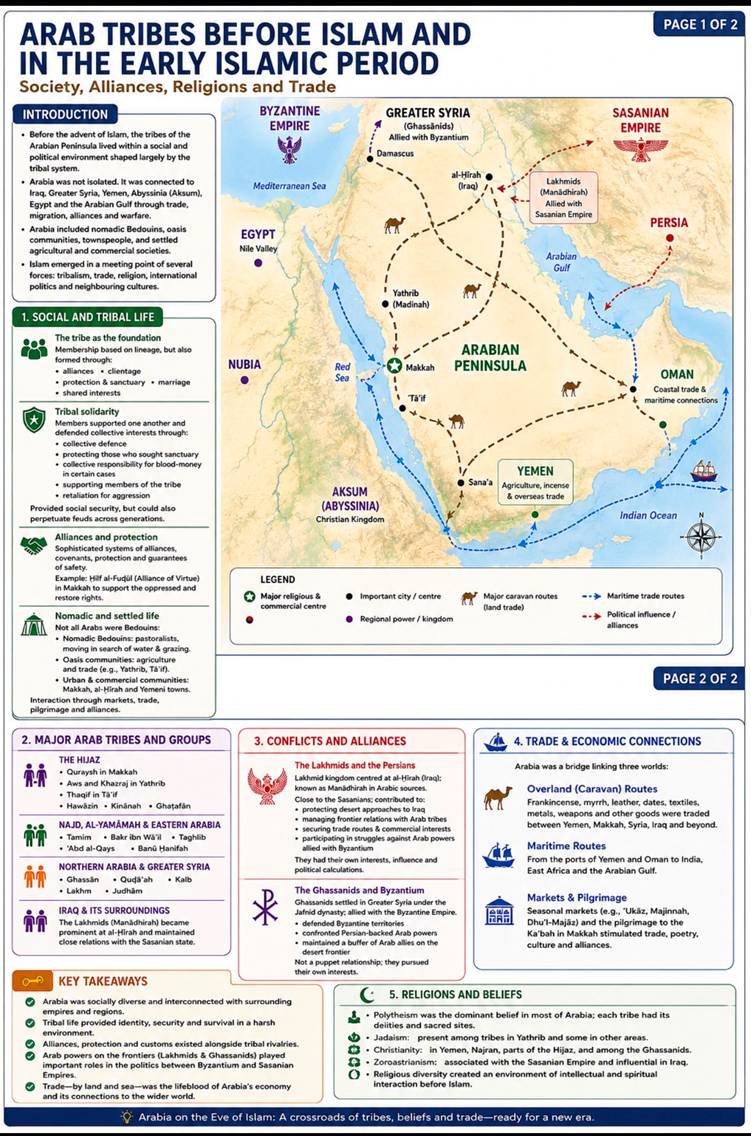
I have actually done around fifty pages of research on this and then tried to squeeze it into one infographic. So instead of giving you the fifty pages, alhamdulillah, I will give you the map!

If you look at the Arabian Peninsula, Makkah is here and Yathrib, which later became Madinah, is further north. Yemen is in the south. To the east you have Persia, and to the north you have al-Sham.

When we say al-Sham in the classical books, we do not mean only modern Syria. The historical region of al-Sham broadly includes what we now call Syria, Lebanon, Palestine and Jordan.

Then you have Ta’if, close to Makkah. This is the city Prophet Muhammad ﷺ travelled to when he was looking for support for the message. He was rejected there, abused and pelted with stones. When he returned, as we mentioned, he eventually entered Makkah under the protection of Al-Mut’im ibn Adi.

Around Arabia you also had two enormous powers.

To the north, the Byzantine Empire dominated much of the region around al-Sham. To the north-east was the Sasanian Persian Empire, whose influence extended into Iraq and parts of the Gulf.

Across the Red Sea was Abyssinia and the Kingdom of Aksum, in the region of modern Ethiopia and Eritrea. This will become very important later when some of the Muslims migrate there to escape persecution in Makkah.

To the south was Yemen, and the Arabian Gulf opened Arabia towards the Indian Ocean, East Africa and India.

So Arabia was not simply an empty desert cut off from the rest of the world. Sometimes people imagine it like that: a few tents, a few camels and nothing happening. No. Arabia was connected.

There was trade. There was migration. There were political interests. There were different religions. People travelled, goods travelled and ideas travelled.

You can see this particularly clearly in the trade routes running through Arabia. Makkah itself had no great agricultural wealth, but because of the Ka’bah, its position and the commercial networks developed by Quraysh, it became an important centre of trade.

Allah Himself refers to the trading journeys of Quraysh:

لِإِيلَافِ قُرَيْشٍ ۝ إِيلَافِهِمْ رِحْلَةَ الشِّتَاءِ وَالصَّيْفِ

“For the accustomed security of Quraysh, their accustomed security in the journeys of winter and summer.” (Surat Quraysh, 106:1–2)

The winter and summer journeys were part of this commercial network. So when we study the seerah, we have to remember that Makkah was connected to a much wider world.

Now let us come to the structure of Arabian society itself.

Islam did not arrive among people who had no social structure. There was already a well-established system. The foundation of much of that system was the tribe.

Allah refers to people being organised into different peoples and tribes:

يَا أَيُّهَا النَّاسُ إِنَّا خَلَقْنَاكُمْ مِنْ ذَكَرٍ وَأُنْثَىٰ وَجَعَلْنَاكُمْ شُعُوبًا وَقَبَائِلَ لِتَعَارَفُوا

“O humanity! Indeed, We created you from a male and a female, and made you into peoples and tribes so that you may know one another.” (Surat al-Hujurat, 49:13)

In Arabia, your tribe gave you your identity and your place within society. The larger and stronger your tribe was, generally the more protection and influence you had.

You can compare it, in a very loose way, to relationships between countries today. A small country may seek an alliance with a much more powerful country because that alliance gives it security. You have alliances between America and different countries, Britain and different countries, and so on.

Arabia had something similar, but on the level of tribes.

A powerful tribe could offer protection to another tribe or to an individual. This protection was taken seriously. There were also alliances based on shared interests, agreements, trade and marriage.

Marriage was particularly important.

Sometimes an alliance between two groups could be strengthened through marriage. Once you married into a tribe, you were no longer simply an outsider. There was now a relationship between you.

This is also one part of the wider context in which we should understand some of the marriages of Prophet Muhammad ﷺ. His marriages had different circumstances and different wisdoms behind them, but some also created or strengthened important social and tribal relationships.

In a tribal society, being someone’s son-in-law meant something. You had entered their family network. A tribe which might previously have looked at you as an outsider now had a direct connection with you.

So these relationships mattered enormously.

The tribe also provided an individual with social standing and collective defence. It offered protection and carried certain responsibilities on behalf of its members.

One very important example was blood money. If someone accidentally killed another person, for instance, responsibility did not necessarily fall on that individual alone. The wider tribal structure could share responsibility for paying the blood money.

This is the kind of society into which Islam came. And once we understand how that society worked, many details of the seerah which otherwise seem strange begin to fall into place.

There’s a blood money, blood money, 100 camels. It’s a big, hefty bill to pay as an individual who will help you, your tribe. Yes. And you will see this happened in Medina. In Medina. Yes. So there’s a blood money to be paid. And those who were who signed on the


the document of Madinah, when Prophet Muhammad ﷺ entered into Madinah, he created like the constitution of Madinah, which we call it وَثِيقَةُ الْمَدِينَةِ or the document of Madinah. So those who did sign on the document, they have to pay the blood money. And some of them did refuse and this did cause a war between Prophet Muhammad and them ﷺ.


So again, you see here a valid point you couldn’t understand without getting into the system. So we have the economic and social support from the tribe. So the tribal solidarity will provide security in the absence of central government. There is no central government in Arabia.

Makkah was an important centre, but it did not have a central government. Nothing like that existed in Arabia at the time. Later, when Prophet Muhammad ﷺ established the Muslim community in Madinah, we begin to see a central authority developing, which eventually extended across Arabia. But before Islam, the system was very different.

People relied on their tribes and on alliances.

There were different ways of entering an alliance. Sometimes it was through a covenant. Sometimes it was through marriage, as we mentioned. Sometimes protection could even be given in return for money. If you were weak and another tribe was powerful, you might pay them for protection.

But there were also alliances formed for a good purpose, to protect people who were being treated unjustly.

A famous example is Hilf al-Fudul, the Pact of Virtue. This was formed in Makkah before Islam after a merchant was wronged and had no powerful tribe to defend him. A number of the Makkan clans came together and agreed that they would stand against injustice and help anyone who was oppressed.

Prophet Muhammad ﷺ witnessed this pact when he was still a young man, before prophethood. Many years later, after Islam had come, he still spoke very highly of it. He said:

«لَقَدْ شَهِدْتُ فِي دَارِ عَبْدِ اللَّهِ بْنِ جُدْعَانَ حِلْفًا مَا أُحِبُّ أَنَّ لِيَ بِهِ حُمْرَ النَّعَمِ، وَلَوْ دُعِيتُ بِهِ فِي الْإِسْلَامِ لَأَجَبْتُ»

“I witnessed in the house of Abdullah ibn Jud’an a pact which I would not exchange for red camels, and if I were called to such a pact in Islam, I would respond.” (al-Bayhaqi; also reported in the works of seerah)

This is very interesting. It happened before Islam, and the people involved were not Muslims, but Prophet Muhammad ﷺ approved of it because its purpose was good. It was about defending the vulnerable and standing against oppression.

So Islam did not come and say that everything which existed before Islam had to be thrown away. If something was based on justice and goodness, Islam affirmed it.

Now let us look at some of the major tribes, because their names will keep coming up throughout the seerah.

In the Hijaz you have Quraysh in Makkah. In Yathrib, which later became Madinah, you have the two famous tribes of Aws and Khazraj. Around Ta’if you have Thaqif. You also come across names such as Hawazin, Kinana and Ghatafan.

Some of these names will already be familiar to you because you meet them later in the battles and political events of the seerah.

For example, during the Battle of the Ditch, or al-Ahzab, Quraysh, Ghatafan and their allies came together against Madinah. This was a huge coalition. They surrounded Madinah with the intention of destroying the Muslim community, but Allah protected Prophet Muhammad ﷺ and the believers.

In Najd and al-Yamamah, in central and eastern Arabia, you have other major tribes: Banu Tamim, Bakr ibn Wa’il, Taghlib, Abd al-Qays and Banu Hanifa.

Banu Tamim, by the way, is my tribe. So I have to mention them!

Further north you have Arab tribes such as Ghassan, Quda’a, Kalb, Lakhm and Judham.

And this is another point which is useful to understand. When we speak about al-Sham, we should not imagine that everybody there was non-Arab. There were large Arab populations living in the region alongside other peoples.

Some of these Arab tribes were closely connected to the great empires around them.

The Ghassanids, for example, were Arabs connected politically with the Byzantine Empire. On the other side, in Iraq, the Lakhmids, also known as al-Manadhirah, had close relations with the Sasanian Persian Empire.

So Arabia was sitting between two superpowers.

If you want a modern comparison, think of two great international powers competing with one another, each with its own allies. Sometimes they fight directly. Sometimes the struggle takes place through their allies. Human beings haven’t changed that much!

At that time, the two major regional powers were the Byzantine Empire and the Sasanian Persian Empire. Their rivalry had a major effect on the lands around Arabia.

This wider political picture will matter later in the seerah, particularly when Islam begins to move beyond Makkah and Madinah.

Religion in Arabia

What about religion? Was everybody in Arabia worshipping idols?

No.

The majority were pagans, certainly, particularly in Makkah and much of central Arabia. But Arabia contained a mixture of beliefs.

Among the most famous idols were al-Lat, al-Uzza and Manat, and Allah mentions them directly in the Qur’an:

أَفَرَأَيْتُمُ اللَّاتَ وَالْعُزَّىٰ ۝ وَمَنَاةَ الثَّالِثَةَ الْأُخْرَىٰ

“Have you considered al-Lat and al-Uzza, and Manat, the third one?” (Surat al-Najm, 53:19–20)

These were among the major objects of worship in Arabia.

But there were also individuals who rejected idol worship and searched for the pure religion of Ibrahim (peace be upon him). They are often referred to as hanifs. They believed that these idols were not gods and that worship belonged to Allah alone.

One important person we meet at the beginning of the seerah is Waraqa ibn Nawfal, the cousin of Khadijah (may Allah be pleased with her).

Waraqa had rejected the idolatry around him, and the authentic narration tells us that he had embraced Christianity and had knowledge of the Gospel. When Khadijah (may Allah be pleased with her) brought Prophet Muhammad ﷺ to him after the first revelation, Waraqa immediately recognised what had happened.

He said:

«هَذَا النَّامُوسُ الَّذِي نَزَّلَ اللَّهُ عَلَى مُوسَى»

“This is the same angel whom Allah sent to Musa.” (Bukhari; Muslim)

He believed what Prophet Muhammad ﷺ told him and recognised his prophethood. Some scholars therefore counted Waraqa among the Companions, although the discussion around his classification is not completely straightforward.

There were also well-established Jewish communities in Arabia, particularly in Yathrib, Khaybar and Wadi al-Qura, as well as a Jewish presence in Yemen.

Christianity had a strong presence further north in al-Sham and among some Arab tribes, and there was an important Christian community in Najran in the south.

There were also smaller communities influenced by Zoroastrianism, particularly in areas affected by Persian rule and Persian culture.

So Arabia was not religiously uniform. The majority were pagans, but Jews, Christians, monotheists outside these communities and people influenced by Persian religion were all present.

In Makkah itself, however, paganism was overwhelmingly dominant. There were a handful of individuals who had rejected idol worship, but there was no large Christian or Jewish community comparable to what we find in some other parts of Arabia.

Why Makkah mattered

Makkah occupied a special position because of the Ka’bah.

The Arabs respected Makkah because it contained the Sacred House, and this gave Quraysh enormous prestige. Quraysh were responsible for serving the Ka’bah and looking after the pilgrims, so they were among the most respected tribes in Arabia.

And Prophet Muhammad ﷺ came from Quraysh.

This did not mean Quraysh ruled Arabia. Remember, there was no central government. But they had status. Their name carried weight.

Trade strengthened that position even further.

This is another reason why we need to understand the trade routes when studying the seerah. People travelled constantly along them. They stopped at particular towns and markets. They met different communities. News, ideas and goods moved along these routes.

Makkah itself is a barren place. It is not like Madinah, with its date palms and agriculture, or Ta’if, which has fertile land and produces fruit.

The Qur’an itself records the dua of Ibrahim (peace be upon him):

رَبَّنَا إِنِّي أَسْكَنْتُ مِنْ ذُرِّيَّتِي بِوَادٍ غَيْرِ ذِي زَرْعٍ عِنْدَ بَيْتِكَ الْمُحَرَّمِ

“Our Lord, I have settled some of my descendants in a barren valley near Your Sacred House.” (Surat Ibrahim, 14:37)

That is Makkah: a valley without cultivation.

So how did people survive?

Trade.

They had to bring things in. Makkah depended heavily on buying, selling, importing and exporting.

And, of course, they had something very valuable: the pilgrimage.

Hajj brought people from across Arabia to Makkah. And wherever thousands of people gather, you have a market. That was true then and, if we are honest, it is still true today! Hajj and Umrah are enormous economic activities as well as acts of worship.

Quraysh therefore developed extensive trading networks. Allah refers to their famous journeys:

لِإِيلَافِ قُرَيْشٍ ۝ إِيلَافِهِمْ رِحْلَةَ الشِّتَاءِ وَالصَّيْفِ

“For the accustomed security of Quraysh, their accustomed security in the journeys of winter and summer.” (Surat Quraysh, 106:1–2)

They travelled south towards Yemen and north towards al-Sham, carrying goods in both directions.

And through the wider trade networks of the Red Sea, the Arabian Gulf and the Indian Ocean, products could reach Arabia from much further away.

Goods from India reached Arabian markets. Spices came from the east. Fine cloth came through Yemen and other trading centres. Products from even further east could move through long chains of merchants before eventually reaching Arabia.

So when we read the seerah and find references to particular fabrics, weapons, perfumes or spices, we shouldn’t be surprised. Arabia was connected to international trade.

It doesn’t mean that every Makkan merchant personally jumped on a camel and went all the way to China! Goods can travel much further than the merchant who eventually sells them.

From al-Sham they could bring agricultural products which simply did not grow in Makkah: different foods, fruit and olive oil.

Allah describes the olive as a blessed tree:

يُوقَدُ مِن شَجَرَةٍ مُّبَارَكَةٍ زَيْتُونَةٍ

“Lit from the oil of a blessed olive tree.” (Surat al-Nur, 24:35)

Olive oil was one of those products which came from the more fertile lands to the north.

And I can tell you, I am from al-Sham. We have plenty of fruit! Different kinds of fruit which you simply cannot grow in Makkah.

So imagine these caravans.

They would prepare for a major journey. Camels would be loaded with goods. Merchants would invest money into the caravan. Some people were very wealthy businessmen, others had smaller amounts to invest, and of course there were poor people who did not own these businesses at all.

The caravan would travel, sell what it carried, purchase other products and bring them back.

This was not a small part of Makkan life. It was one of the main ways the city survived.

Alongside this international trade, there were also local markets and seasonal markets.

Some markets operated regularly. Others were associated with particular seasons of the year. And then, of course, there was the great annual gathering of Hajj.

Before the pilgrims arrived, merchants had to prepare. Food had to be available. Clothes had to be available. Animals, equipment and other goods had to be available. People were arriving from all over Arabia, so it created a huge seasonal market.

Umrah also brought visitors at different times of the year, with Rajab having particular significance among the Arabs, although Umrah itself was not restricted to Rajab.

All of this helps us build the picture.

When you read that someone travelled north, you understand where he was going. When you hear that a caravan was returning from al-Sham, you know why that caravan mattered. When a tribe makes an alliance, you understand what that alliance means. When we later meet Jewish tribes in Madinah or Christian Arabs in the north, they no longer appear suddenly from nowhere.

You begin to see the world in which Prophet Muhammad ﷺ actually lived.

And once you can see that world, the events of the seerah begin to connect.


Yes? This is why later you will see in Badr when Prophet Muhammad ﷺ want to get their money back which they have stolen from them and seized their assets in Mecca. So he wants to get his money back and his companions’ money back as well. So they did want to take the caravans of Quraysh which has plenty of money and this will be their money.


it didn’t happen but what happened was they did fight against each other and you know the rest of the story Prophet Muhammad was victorious although he did not go to fight he did only go to seize the money which they have taken from them in Mecca but Allah’s plan was beyond our comprehension Subhanahu wa ta’ala so


So you have these markets and these routes. So for instance, we have as well special seaports they used to use in order to go through the sea from Bahrain, from Jeddah, from Iraq, from


Syria from Gaza, by the way, one of the ports, sea ports, was in Gaza. And one of the local, very important stations for business was Gaza. Yes? No wonder. May Allah give relief to the people of Gaza, Ya Rabb. So when you read in the Sira, you read, they used to go to Sham, they used to go, yeah. And Sham,


In our terms today, it’s Palestine, Jordan, Lebanon, Syria. This is Sham. And from Sham, they will go to Palestine, all the port Palestine. And it’s on the sea side.


Palestine yes as Lebanon we are on the seaside Beirut on the seaside Saida on the seaside Sur and so on and so forth Tripoli Tarablos and all on the seaside yeah but they have access as well from the land so they have that double routes the land route and the sea route and


So the main products which they used to have, like spices, perfumes, leather, textiles, grain, olive oil, metals, precious stones, ivory, gold, silver, so on and so forth. Yeah. So they have nothing of this stuff in Arabia. They will import. Yes.


And they have made a big fortune, many of them. Some tribes even will allow poor people to contribute or, let’s say, to share their big businesses with some capital. You have a small capital. You want to buy some stuff.


Then you can go to the businessman who’s running this caravan this month. For instance, among the businessmen was Usman. So he used to have his caravans. He used to run his own business. Among the business women was Khadija. And this is where Prophet Muhammad did work for her.


yes so people if they want to make business with small capital they have they will go for instance to Khadija and say please I have this money I want to buy some stuff and grow my capital yes so they will have an agreement okay I’ll take your money and I will buy one two three with this money and the profit will be


let’s say 50-50, 80-20, 70-30, whatever they decide. It’s under Mudaaraba, which is somebody will put money, somebody will put expertise, or somebody will put expertise and his own money, as it happened many times. So they will have an agreement.


And then they will take the money of 2, 3, 10, 20 people. God knows. Depends. Yeah. Of course, they have the choice to refuse if they don’t trust this person, if they don’t want to deal with this person. Or they can accept. So it’s not obligatory on the businessman to accept the contribution of a capital from somebody. Yeah.


So they did know this kind of business. And people will probably save some money and try and improve their capital and grow their capital and their money through business, through trade, even local businesses like having a stall and selling some stuff in the market.


as it happened with Prophet Muhammad in the beginning so they have some stable and local markets and they have some seasonal markets and they have the input export market as well on the land and in the sea so among the seasonal markets we have


the Aukav market which is well known in the Sira and among Arabs and Majana market and Dhul Majaz market in Suk Aukav by the way the market of Aukav


Yes, it wasn’t just a market for business. It was a seasonal market. And as we see today, for instance, let’s say we have a big event for Islamic products and stuff and what have you.


On the side of this event, big market, you have some lectures happening, you have some entertainment happening, you have some other stuff happening. It’s not just selling and buying, yeah? Similar stuff. In Ukaz, yes, it was mainly for business buying and selling, yes? But in that very market, they used to have…


uh what we call the poem competition seasonal every year once a year yes so the poet will prepare for next year a poem and they will come and compete and you have like a panel of judges sort of


they will hear the poems and they will select the best of these poems and the winner his poem will be honored by being hanged on the Kaaba to that extent yeah


And in our literature, we have something we call المعلقات السبع. We did study in Arabic literature, even in English literature, those who did study this, they will teach them as well about the Arabic literature and the seven hanged poems.


Yes, so each year one poem will win. The best of poems will be hanged on the Kaaba. So they call it Al-Muallaka. Muallaka, the one that’s hanged. Yeah, so we have seven. Yeah, so it was like social media platform, the poems. And if someone wants to be…


famous he might pay a poet to praise him and his name will be on the social media everywhere and he will be famous or it can be the opposite you hate somebody and he’s an evil you might pay some poets to insult him and it will follow him to his grand grandchildren the insult


Because the Arab is just the news everywhere. And they will memorize it and recall it. Yeah. And this was a platform for Dawah as well. Later we’ll see this was a platform for Dawah. Poems and so on. Hassan bin Thabit, the poet of Prophet Muhammad ﷺ and Prophet Muhammad used him in defending the Dawah and attacking Quraysh as they are attacking him and so on and so forth. Yeah.


So we have the market of was famous not only for business, as well for poems and competition and so on and so forth. Yeah. Mecca, they have created something which the Quran mentioned, and I’m pretty sure you are familiar with.


So Allah is saying they are familiar with the journey of winter and journey of summer. Journey of winter was to Yemen. Journey of summer was to Sham.


mainly but it’s not restricted to these two locations they have done plenty of other trips to Persia to other places Abyssinia as well the companions were familiar with Abyssinia this is why Prophet Muhammad did send them to Abyssinia because they used to go and trade and business to Abyssinia yeah


So Allah is mentioning ilaf. So this journey, it was, again, it’s good to give you a very quick overview. The trade route wasn’t safe. So you have


Plenty of tribes around the trade routes and they can get easy money without doing any job, anything. They can come and attack the caravans and take the money and run away.


So what to do? Along the routes you have different tribes and then Quraysh went through these routes and made alliances with these tribes on the routes to get protection and they will have in return


they will have, it varies from source to another. Some sources says Quraish in order to do these alliances, they said, look, guys, we can’t pay you cut from our businesses, but we can offer you something good for you. Whatever goods you have, give it to us. We’ll take it and sell it for you and give you the profit.


So this is they secure an income and they secure as well businesses in the community. So they’ve made these deals with different tribes to secure the route from Mecca to Sham, from Mecca to Yemen and so on. And I’m pretty sure different tribes did something similar, give or take, or


they did get into alliances through marriage with these tribes, some through alliances of mualat, that they promised each other that I will protect you, you will protect me, and so on and so forth, or through other means, which we mentioned earlier, that they used to have among the tribes. So in general,


These routes were not safe unless you are protected by an ally, you are protected by a special money you pay and so on. And this background about trade becomes very important later when we come to the Battle of Badr.

When Prophet Muhammad ﷺ and the Companions left Makkah, many of them had been forced to leave their homes and property behind. Quraysh had confiscated or taken possession of much of what they left. So there was an economic dimension to the conflict as well.

Before Badr, Prophet Muhammad ﷺ did not initially set out intending to fight a major battle. He set out with the Companions to intercept a large Qurayshi caravan returning from al-Sham under Abu Sufyan. It was carrying a great deal of Qurayshi wealth.

The Qur’an refers directly to this:

وَإِذْ يَعِدُكُمُ اللَّهُ إِحْدَى الطَّائِفَتَيْنِ أَنَّهَا لَكُمْ وَتَوَدُّونَ أَنَّ غَيْرَ ذَاتِ الشَّوْكَةِ تَكُونُ لَكُمْ وَيُرِيدُ اللَّهُ أَن يُحِقَّ الْحَقَّ بِكَلِمَاتِهِ وَيَقْطَعَ دَابِرَ الْكَافِرِينَ

“Remember when Allah promised you that one of the two groups would fall to you, and you wished that the unarmed one would be yours. But Allah intended to establish the truth by His Words and to cut off the disbelievers to the last.” (Surat al-Anfal, 8:7)

The “unarmed one” was the caravan. That was what the Muslims expected to encounter.

But Abu Sufyan managed to divert the caravan, while the army of Quraysh came out from Makkah. So suddenly the situation changed. The Muslims had not left Madinah equipped for a major battle, but now the Qurayshi army was approaching them.

Allah had another plan.

Instead of taking the caravan, they faced Quraysh at Badr and Allah gave them victory. So when you know the commercial background, Badr makes more sense. You understand why the caravan mattered and why Quraysh reacted so strongly when it was threatened.

Trade by land and sea

These trade routes did not exist only on land. Arabia was also connected to maritime trade.

Along the Persian Gulf and the Red Sea were ports connecting Arabia to East Africa, India and the wider Indian Ocean economy. Further north, merchants reached the Mediterranean trading centres of al-Sham.

Gaza, for example, was an important commercial destination at the southern end of al-Sham. When the books of seerah tell you that Quraysh travelled to al-Sham, remember again what al-Sham means. Today we are talking broadly about Palestine, Jordan, Lebanon and Syria.

There were routes by land, and through the wider trading network there were routes by sea.

They brought in all sorts of products: grain, olive oil, textiles, metals, precious stones and luxury goods. Spices and aromatics came through eastern trade networks. Other goods travelled north and south through Arabia.

Makkah could not produce everything it needed. It was a barren valley, so its economy depended heavily on trade.

And some merchants made enormous fortunes from it.

How were the caravans financed?

This is interesting as well, because you might imagine that every merchant simply owned one caravan, filled it with his own products and went travelling.

It was more sophisticated than that.

You had major merchants who could organise and finance large trading ventures. Uthman ibn Affan رضي الله عنه, for instance, became a very successful merchant. Khadijah (may Allah be pleased with her) was also a wealthy businesswoman, and Prophet Muhammad ﷺ himself traded on her behalf before their marriage.

But smaller investors could also participate in trading ventures.

Someone might have a little capital but not have the experience, time or ability to travel with a caravan. Another person had the expertise and was already running the trading journey. So they could make an agreement.

You put in the capital. I do the work. We agree beforehand how the profit will be divided.

Later Islamic law developed this very clearly under contracts such as mudarabah, also known historically as qirad: one party provides the capital and the other provides the work and expertise.

Forms of this kind of profit-sharing commercial partnership were already known among the Arabs before Islam. Islam did not invent trade. It came to regulate it, remove injustice from it and establish clear rules around it.

So a wealthy merchant might take capital from different people, trade with it and then distribute the agreed share of the profits when the caravan returned.

Of course, the merchant did not have to accept everyone’s money. If you did not trust somebody or did not want to enter a business arrangement with them, you didn’t have to.

So even somebody with relatively modest savings might try to grow his wealth through trade.

And not everybody was dealing with huge international caravans. You also had ordinary people selling goods in local markets, running stalls and carrying out smaller businesses.

The seasonal markets

Alongside the permanent markets, Arabia had famous seasonal markets.

Among the best known were Ukaz, Majanna and Dhu al-Majaz.

These become important when we study the seerah because they were not simply places where somebody came to sell you a camel and somebody else sold you some cloth.

They were much bigger social occasions.

Tribes gathered there. Business was conducted. Agreements could be made. Disputes could be settled. News travelled. People met other tribes whom they might not normally see during the year.

And poetry was a major part of this culture.

Ukaz became particularly famous for poetry and eloquence. Poets would come and recite their compositions. A great poet could build the reputation of his entire tribe.

We have to understand how powerful poetry was in Arabian society.

Today, if somebody wants everyone to hear something, he puts it on social media. Within a few hours everybody knows about it.

They didn’t have Instagram. They had poets!

A powerful poem could spread from tribe to tribe. People memorised it and repeated it. Your name could travel hundreds of miles without you going anywhere.

So if you wanted somebody praised, poetry could make him famous. And if a poet attacked somebody with satire, that could be very painful as well. The insult might survive much longer than the person who was insulted!

This is why poetry appears later in the seerah as a means of defending the Prophet ﷺ and the Muslim community.

Hassan ibn Thabit رضي الله عنه became famous as the poet who defended Prophet Muhammad ﷺ. The Prophet ﷺ encouraged him to answer the attacks of Quraysh with poetry.

He said:

«اهْجُوا قُرَيْشًا فَإِنَّهُ أَشَدُّ عَلَيْهَا مِنْ رَشْقٍ بِالنَّبْلِ»

“Respond to Quraysh with satire, for it is more painful to them than being struck by arrows.” (Muslim)

And he said to Hassan:

«إِنَّ رُوحَ الْقُدُسِ لَا يَزَالُ يُؤَيِّدُكَ مَا نَافَحْتَ عَنِ اللَّهِ وَرَسُولِهِ»

“The Holy Spirit will continue to support you so long as you defend Allah and His Messenger.” (Muslim)

So poetry was not just entertainment. It was media. It was reputation. It was public relations. Sometimes it was almost psychological warfare.

You may also have heard of the famous Mu‘allaqat, the great pre-Islamic Arabic odes which we still study in Arabic literature.

There is a very famous traditional story that the finest of these poems were written in gold and hung on the Ka‘bah, which is why they were called al-Mu‘allaqat, “the suspended poems”.

It is a beautiful story, and many of us learned it at school, but historically we have to be careful. Scholars have disagreed over whether the poems were actually hung physically on the Ka‘bah. Some early authorities rejected that explanation altogether.

What we can certainly say is that these poems occupied an extraordinary place in Arabic literature and that poetry enjoyed enormous prestige in pre-Islamic society.

And markets such as Ukaz provided the kind of public gathering where poetry, speeches and tribal reputation could flourish.

Later, these gatherings would also become opportunities for dawah.

Prophet Muhammad ﷺ would go to the places where people gathered. He would approach tribes and present Islam to them. So when you later read that the Prophet ﷺ was speaking to tribes during the market or pilgrimage season, you now understand why so many different tribes were there in the first place.

The journeys of winter and summer

Then we have the famous journeys which Allah mentions in Surat Quraysh.

إِيلَافِهِمْ رِحْلَةَ الشِّتَاءِ وَالصَّيْفِ

“Their accustomed security in the journeys of winter and summer.” (Surat Quraysh, 106:2)

The winter journey was principally towards Yemen, while the summer journey went north towards al-Sham.

Why winter and summer?

You don’t want to go north into the colder regions at the worst part of winter if you have another option. And Yemen was suitable for the winter journey. In summer, they could travel north towards al-Sham.

But this does not mean Quraysh traded only with these two places. Their commercial connections extended much further through the networks around them, including towards Abyssinia and the wider markets connected to Persia, East Africa and the Indian Ocean.

This also helps us understand why Abyssinia was not some completely unknown place when Prophet Muhammad ﷺ later told the Companions to migrate there. Arabia already had commercial and maritime links across the Red Sea.

What was ilaf?

The word Allah uses is ilaf.

Part of the idea here is the familiarity and security that Quraysh enjoyed in undertaking these journeys.

And remember: these roads were not automatically safe.

A caravan was carrying wealth. Perhaps dozens or hundreds of camels loaded with valuable goods. If you were a tribe living along the route and there was no agreement between you and the caravan, it might be very tempting to attack it.

Easy money!

So Quraysh had to build relationships with the tribes living along their commercial routes.

They made agreements and alliances which allowed their caravans to travel with greater security.

Some historical accounts describe arrangements where Quraysh also carried and sold goods on behalf of tribes along the route. Instead of saying, “We are travelling through your territory and you might raid us,” they could create a commercial relationship which benefited both sides.

You have goods? Give them to us. We are travelling to the market anyway. We can trade them on your behalf, and you benefit as well.

Now you have an interest in keeping the caravan safe rather than attacking it.

Clever.

Other arrangements could depend on tribal alliances, payments, family relationships or agreements of mutual protection.

So when Allah mentions the security and familiarity of the journeys of Quraysh, there is an entire commercial and social world sitting behind these few words.

The Qur’an says:

لِإِيلَافِ قُرَيْشٍ ۝ إِيلَافِهِمْ رِحْلَةَ الشِّتَاءِ وَالصَّيْفِ ۝ فَلْيَعْبُدُوا رَبَّ هَذَا الْبَيْتِ ۝ الَّذِي أَطْعَمَهُم مِّن جُوعٍ وَآمَنَهُم مِّنْ خَوْفٍ

“For the accustomed security of Quraysh, their accustomed security in the journeys of winter and summer, let them worship the Lord of this House, Who fed them against hunger and made them safe from fear.” (Surat Quraysh, 106:1–4)

Look at the connection Allah makes: food and security.

For any society to function, you need both.

If there is no food, people cannot survive. If there is no security, business cannot function. You can have the most wonderful products in the world, but if every caravan is going to be robbed before it reaches the market, there is no trade.

Allah gave Quraysh both. He gave them provision through their trade, and He gave them security because of the status of the Sacred House and the relationships which surrounded it.

So again, when you start reading the seerah with this background, little details suddenly make sense.

Why was a caravan so important? Why were certain routes important? Why did Quraysh have influence? Why did alliances matter? Why were markets important places for dawah?

It was all connected.

So now, as you can see, we have an overview of the society: the tribes, the different religions, trade and business, the alliances and systems of protection, and even the media platforms of the time, if you want to call them that.

Poetry was one of them.

So if we want to summarise pre-Islamic Arabia, it was a tribal society built around networks of relationships and alliances. It was also a meeting place of different religions and an important corridor for international trade. And geographically, it sat between two of the great powers of the age: Byzantium and Persia.

Understanding this environment helps us understand the seerah much more deeply.

When Prophet Muhammad ﷺ made a decision, he did not make it in a vacuum. He understood the reality around him. He knew which tribes had alliances with one another. He knew where the tensions were, who could offer protection and who posed a threat. He understood politics. He understood people. He understood business and trade.

And this is something important for us to learn from the seerah. You need to understand your reality in order to make the right decision within it.

When we later study the migration from Makkah to Abyssinia, for example, it will no longer seem like a random choice of destination. When we study the Hijrah to Madinah, we will understand the tribes and relationships already present there. When caravans appear in the story, we will understand where they are going and why they matter.

The geography, trade routes, tribal relationships and neighbouring powers all start becoming part of one coherent picture.

And then Islam came into this society.

It did not abolish people’s families or tribal identities, but it changed what came first. Loyalty was no longer based simply on tribe. People who had once been divided, and sometimes had fought one another for generations, were brought together by faith.

Allah says:

وَاعْتَصِمُوا بِحَبْلِ اللَّهِ جَمِيعًا وَلَا تَفَرَّقُوا ۚ وَاذْكُرُوا نِعْمَتَ اللَّهِ عَلَيْكُمْ إِذْ كُنْتُمْ أَعْدَاءً فَأَلَّفَ بَيْنَ قُلُوبِكُمْ فَأَصْبَحْتُمْ بِنِعْمَتِهِ إِخْوَانًا

“Hold firmly to the rope of Allah all together and do not become divided. Remember Allah’s favour upon you: when you were enemies, He brought your hearts together and, by His grace, you became brothers.” (Surat Ali Imran, 3:103)

This transformation did not happen overnight, of course. But Islam gradually took a society in which tribal loyalty was enormously powerful and created an ummah, a community whose message went beyond a particular tribe or race.

That is the background to the seerah.

This has been a very condensed summary, but inshaAllah it gives you enough of the picture that, when we go into the life of Prophet Muhammad ﷺ in more detail, you will understand what is happening around him.

Questions and answers

You mentioned Ukaz and said that poetry competitions took place there. Where exactly was Ukaz?

Ukaz was outside Makkah, towards Ta’if. It was one of the most famous seasonal markets of Arabia.

And remember, when we say “market”, don’t imagine only shops and stalls. It was a huge gathering. People came to trade, but they also came to meet other tribes. Agreements were announced there, disputes could be discussed, poetry was recited and news travelled from one part of Arabia to another.

So it had commercial importance, but also social and cultural importance.

Does Ukaz still exist?

The ancient market itself eventually disappeared, although the historical site is known near Ta’if. In modern times, the site has also been revived as a cultural destination.

But when we talk about Suq Ukaz in the seerah, we mean that great seasonal gathering of the Arabs.

How did the poetry competitions work? Was there a prize?

Poetry had enormous prestige among the Arabs, and Ukaz became famous as a place where poets recited before large audiences and competed for reputation.

Now, there is a famous story many of us learned when we studied Arabic literature: that the greatest poems were written in gold and hung on the Ka’bah, and that this is why they became known as the Mu’allaqat, the “hanging poems”.

It is a very famous tradition, but when you investigate it historically, there is disagreement about whether they were actually hung on the Ka’bah. Some early scholars rejected the story.

So we shouldn’t state the hanging as definite history.

But the important point remains: imagine the honour of having your poem recognised as one of the finest poems in Arabia.

There was no television, no internet and no social media. The people themselves carried your words. Someone heard the poem at Ukaz, memorised it, travelled home and repeated it there. Somebody else memorised it from him.

That was how something could go viral!

And then people coming for Hajj would meet one another from all over Arabia. So a great poet could become famous across the Arabian Peninsula.

Did you say there were more Christians than pagans in Makkah?

No, no! The opposite.

The overwhelming majority in Makkah were pagans. There were only a very small number of people who had rejected idol worship, and among them were individuals who had encountered Christianity, such as Waraqa ibn Nawfal.

There was no substantial Christian community in Makkah.

How many tribes were there altogether in Arabia?

If we mean the major tribal names that are particularly relevant to the seerah, we can focus on perhaps ten or so major groupings for our purposes.

But don’t take that as a census of Arabia!

Once you begin counting all the branches, sub-branches and smaller tribes, the number becomes much larger. The genealogies become very complicated very quickly. This is why I don’t want to take you too deeply into them. We might never come back!

What matters for us is to recognise the important names when they appear in the seerah.

You mentioned Banu Tamim. Where were they based?

Banu Tamim were a very large tribe, principally associated with Najd and central Arabia.

And, as I told you, I am from Banu Tamim, so of course I have to mention them!

Over time, branches and descendants of Banu Tamim spread far beyond their original territory. Today you find people connected to Banu Tamim across Saudi Arabia and other parts of the Gulf, Iraq and the Levant.

This is another reason modern borders can sometimes give us the wrong picture when we are reading ancient history. A tribe was not necessarily contained inside what we now think of as one country.

Were the tribes generally friendly with one another?

It depends.

Most of the time, people had to coexist. They traded with one another, married one another and made alliances.

But if something serious happened, especially a killing, a dispute could develop into a cycle of revenge.

And these feuds could last for generations.

One of the famous examples from pre-Islamic Arab tradition is Harb al-Basus, the Basus War, between Bakr and Taghlib. Traditionally, it is said to have continued for around forty years.

Forty years!

Think about it. Someone who was a child when the conflict began could grow up, have children of his own, and those children could inherit a feud whose beginning they had never even witnessed.

This was one of the destructive sides of extreme tribal loyalty.

So when the modern countries of the region were created, were their borders based on the old tribal boundaries?

Not generally, no.

But we have to be a little careful here because the history of every modern state is different.

Many of the present political borders in the Arab world emerged through the collapse of the Ottoman Empire, European colonial involvement, the mandate system, agreements between outside powers, local rulers and subsequent political developments. They were not simply maps of where each tribe lived.

In some places, a new border passed straight through communities which had previously been connected. Members of the same extended families or tribes could find themselves living in different modern states.

So when you study Arabia in the seventh century, you have to put today’s borders out of your mind for a moment. The people living at that time did not look at the map in the way we do today.

They thought in terms of tribes, territories, towns, trade routes, alliances and the great powers around them.

And in many ways, when you look at all of this, human society does not seem completely different from ours.

The technology has changed tremendously. Human beings, not so much.

We still have powerful states and weaker states. We still have alliances. We still have economic interests. We still have media which can make somebody famous or destroy someone’s reputation. The mechanisms are different, but you can recognise many of the same patterns.

This is why I wanted to give you these introductions before we go deeper into the seerah.

I don’t want us simply to read: Prophet Muhammad ﷺ went here, then he went there, then this battle happened, then somebody came to see him.

I want you to see the world around him.

When we now go into the seerah, you will have a better idea of what surrounds Makkah and Madinah, how people lived, what they ate, how they survived, where their wealth came from and why their relationships with different tribes mattered.

Then the seerah becomes much clearer.

Understanding the businesses, the trades and the markets is very important. It helps us imagine what life actually looked like.

When we imagine the streets of Makkah at that time, would we have seen women and children? Were women part of public life?

Yes, of course. But within limits.

Sometimes we oversimplify this. We imagine that before Islam there were no limits at all, and then Islam came and restricted everybody. It wasn’t like that.

Arabian society already had its own tribal customs and social boundaries. Some of those customs were compatible with Islam and Islam left them. Where something contradicted Islam, Islam corrected it.

Women were certainly part of society during the time of Rasulullah ﷺ. They were not expected simply to disappear from public life. Women attended the mosque, the Eid gathering and other communal occasions.

The Prophet ﷺ said:

«لَا تَمْنَعُوا إِمَاءَ اللَّهِ مَسَاجِدَ اللَّهِ»

“Do not prevent the female servants of Allah from going to the mosques of Allah.” (Muslim)

We also know that the Prophet ﷺ instructed women to come out for the Eid gathering, including young women and women who were menstruating, although those who were menstruating did not participate in the prayer itself. (Bukhari; Muslim)

So yes, women were present in society.

And would women go shopping in the markets? Would they be there buying and selling?

Of course.

The main customers in the markets are women. It was like that then and it will probably remain like that until the Day of Judgement!

There is even a market in Jannah. This is not my invention!

The Prophet ﷺ said:

«إِنَّ فِي الْجَنَّةِ لَسُوقًا يَأْتُونَهَا كُلَّ جُمُعَةٍ»

“In Paradise there is a market which they will visit every Friday.” (Muslim)

He ﷺ went on to describe how a wind will blow upon the people there, increasing them in beauty, and when they return to their families they will find that their families have also increased in beauty.

So even in Jannah there is a market!

At this point somebody mentioned Harry Potter and those pictures on the walls which move and talk to you.

I have never watched Harry Potter.

“You’ve never watched Harry Potter?”

No.

“Come on!”

No, no. It’s all magic. I refused!

“Well, it’s fantasy and entertainment.”

Okay, fair enough!

But this is what I mean. When I read the seerah, I want to picture the life around it.

I don’t only want to know that Rasulullah ﷺ travelled from one place to another. I want to know the nitty-gritty.

How did people live?

How did they prepare their meals? There was no gas. There was no electricity. You slaughter the sheep, skin it, prepare the meat and cut it. Fine. Now how are you going to cook it?

There is no cooker.

You need fire. You need fuel. You have to prepare everything. So how long did it take before you could actually sit down and eat?

These things interest me.

I want to understand what happened from the time people woke up until the time they went to sleep. How did they spend their day? How much effort did ordinary tasks take?

Because when you understand everyday life, it helps you understand the Sunnah and the seerah of Rasulullah ﷺ.

Would they keep a fire going rather than lighting a new one every time they needed it?

Yes. You would try to preserve the embers so that you did not have to begin again from nothing. You keep the glowing charcoal there and revive the fire when you need it.

Today you turn a switch and the cooker comes on.

They didn’t have a switch!

So when we read that somebody prepared food, travelled somewhere, drew water or looked after animals, these were physical activities which took time.

This is why I like to understand the practical side of the seerah.

I almost want to see it as a film.

Not simply the major events: Badr happened here, Uhud happened there, then the Hijrah happened.

No. What did Makkah look like in the morning? What was happening in the market? Who was walking through the streets? What could you smell? What were people carrying? Where was the water coming from? How did they cook?

Once you begin asking these questions, the world of the seerah becomes much more real.

And when people travelled in caravans, they had another set of difficulties. The weather could become very cold, particularly as they travelled north.

This is part of the background to the journeys Allah mentions:

رِحْلَةَ الشِّتَاءِ وَالصَّيْفِ

“The journeys of winter and summer.” (Surat Quraysh, 106:2)

The winter journey was towards Yemen and the summer journey towards al-Sham. So the routes and seasons mattered as well.

One of the participants said, “We need a new series about the seerah. Something cinematic, perhaps for Netflix, where you actually see all of this.”

InshaAllah!

Because this is really what I want us to do in these sessions. I want you to see the seerah rather than simply memorise a sequence of events.

We have already looked at one dimension of the life of Rasulullah ﷺ: the message he brought and why we study his seerah. Today we have looked at another dimension: the world around him.

The geography, the tribes, trade, markets, alliances, religions and ordinary daily life.

When we continue, all of this background will help us understand why things happened in the way they did.

A final piece of advice

At the end of the session, I was asked what we should be doing to increase our connection with Rasulullah ﷺ.

Keep your tongue busy with the remembrance of Allah سبحانه وتعالى and with salawat upon the Prophet ﷺ.

Allah says:

إِنَّ اللَّهَ وَمَلَائِكَتَهُ يُصَلُّونَ عَلَى النَّبِيِّ ۚ يَا أَيُّهَا الَّذِينَ آمَنُوا صَلُّوا عَلَيْهِ وَسَلِّمُوا تَسْلِيمًا

“Indeed Allah and His angels send blessings upon the Prophet. O you who believe, send blessings upon him and greet him with peace.” (Surat al-Ahzab, 33:56)

And Rasulullah ﷺ said:

«مَنْ صَلَّى عَلَيَّ صَلَاةً صَلَّى اللَّهُ عَلَيْهِ بِهَا عَشْرًا»

“Whoever sends blessings upon me once, Allah will send blessings upon him ten times.” (Muslim)

So keep your tongue busy with dhikr and with salawat upon Rasulullah ﷺ.

It is very easy. It doesn’t require money. It doesn’t require you to go anywhere. You can do it while you are walking, driving, cooking or waiting for something.

Keep remembering Allah, and keep sending your salawat upon the Prophet ﷺ.

InshaAllah, next time we will go deeper into the seerah.

Delivered to the Al Manaar Convert Club on 18th August 2026

Why study the seerah of Prophet Muhammad ﷺ

Latest Blogs