

How do you deal with waswasa and OCD in worship?
Many people experience passing doubts in worship. A person may wonder whether their wudu is still valid, whether they pronounced a letter correctly in al-Fatihah, whether they made a mistake in salah, or whether they chose the correct scholarly opinion.
For most people, the doubt comes and goes. They continue and move on.
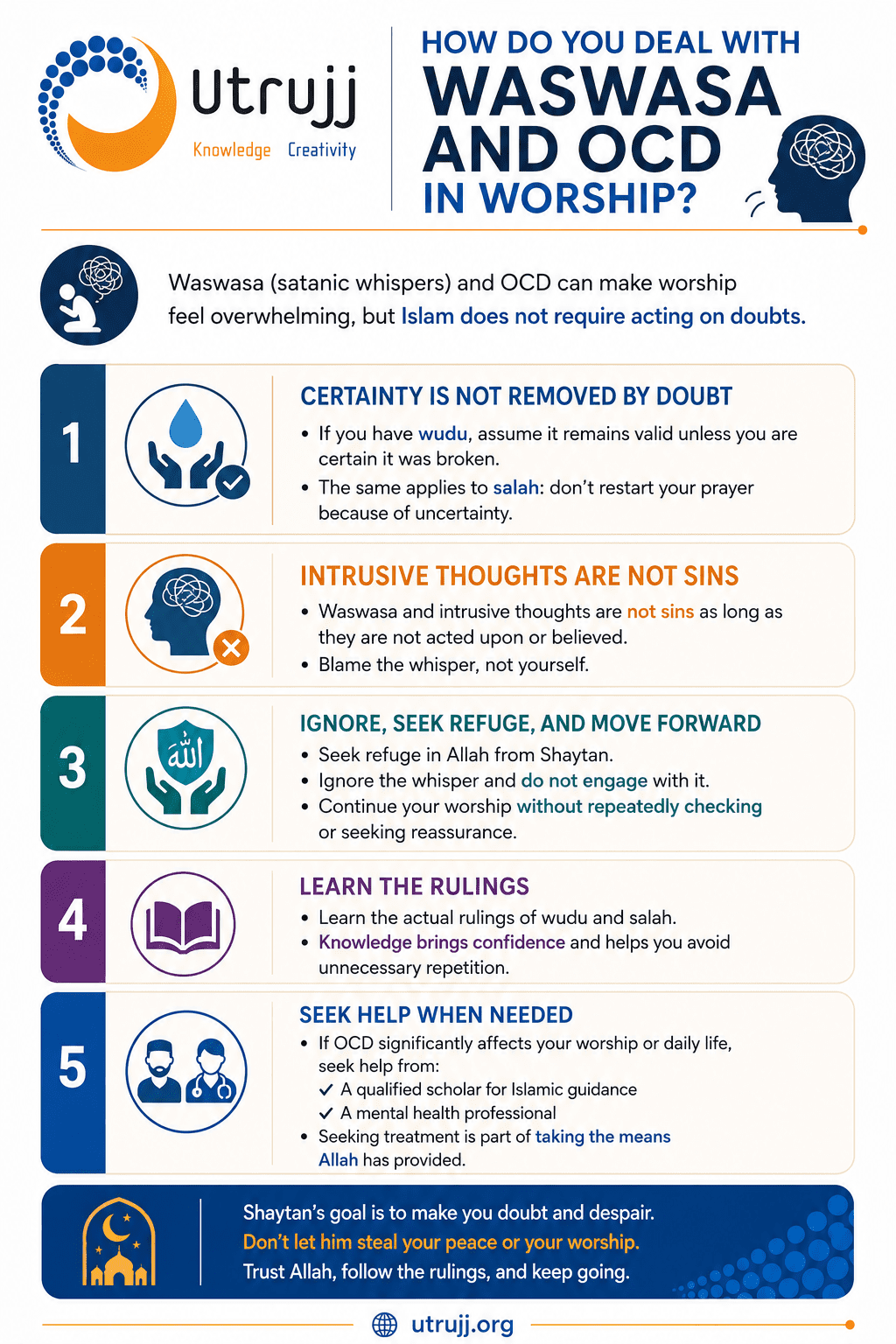
For some people, however, the doubt becomes a loop. They repeat wudu. They repeat salah. They keep checking fatwas. They ask the same questions again and again. They may feel calm for a short time, but the doubt soon returns.
Over time, worship begins to feel heavy. Salah no longer feels peaceful. Wudu no longer feels simple.
When they repeat an act of worship, they feel temporary relief, but the doubt soon returns. Worship, which was meant to connect them to Allah, begins to feel heavy and burdensome.
This is where we need both Islamic guidance and a proper understanding of OCD.
What is OCD?
OCD is not simply being fastidious. It is a condition in which a person experiences unwanted thoughts, fears or urges that keep returning and cause distress. These are often called obsessions. The person then feels driven to do certain actions to reduce the anxiety. These repeated actions are called compulsions.
OCD causes distress, as a person then feels pushed to do certain actions repeatedly to calm the anxiety.
Mayo Clinic explains that OCD can involve unwanted thoughts and fears that lead to repetitive behaviours. These can take up a great deal of time, reduce a person’s quality of life and interfere with daily routines and responsibilities.
Common OCD themes include fear of contamination, difficulty coping with uncertainty, unwanted religious thoughts, checking, washing, cleaning, counting, following strict routines and repeatedly seeking reassurance.
When OCD focuses on religion, morality, purity or sin, it is often called scrupulosity. In Islamic practice, this may appear as:
- Fear that wudu was not valid.
- Fear that salah was not accepted.
- Repeating wudu or ghusl many times.
- Spending a very long time in the bathroom.
- Repeating al-Fatihah or other parts of salah.
- Constantly asking whether something is halal or haram.
- Checking several fatwas on the same issue.
- Feeling guilty over every small matter.
- Needing a level of certainty that Allah has not required from us.
This not only distressing, it can also affect the whole family. For example, a young person may spend so long in the bathroom repeating wudu that family routines are disrupted. Parents may become worried or frustrated. Siblings may not understand what is happening. The person with OCD may feel ashamed, embarrassed or misunderstood.
OCD can also show itself through contamination fears: excessive handwashing, repeated cleaning, avoiding touching objects, or feeling unable to relax unless something has been cleaned again and again. Sometimes this overlaps with wudu and taharah, and the person begins to feel that they are never clean enough to pray.
These symptoms can become worse during times of stress, change or pressure. Ramadan, exams, family difficulties, bereavement, trauma, moving home or major life transitions can all increase anxiety. Mayo Clinic notes that OCD symptoms may worsen under greater stress, including times of transition and change. It also notes that OCD may be related to other mental health conditions, such as anxiety and depression.
For some people, OCD may also appear alongside neurodivergence, such as autism or ADHD. This does not mean every repetitive behaviour is OCD. It means the person may need a careful assessment so that their needs are properly understood. NICE guidance on autism, for example, recognises that autistic children and young people may have coexisting mental health needs and that support should be adapted appropriately.
This is why it is important not to dismiss someone by saying, “Stop overthinking,” or “Just have more iman.” The person may be trying very hard. What they need is clear Islamic guidance, compassion, and sometimes professional support.
Islam is not meant to be unbearable
Islam does not teach us to worship Allah through misery.
Allah says about wudu:
مَا يُرِيدُ ٱللَّهُ لِيَجْعَلَ عَلَيْكُم مِّنْ حَرَجٍ وَلَـٰكِن يُرِيدُ لِيُطَهِّرَكُمْ
Allah does not intend to place difficulty upon you, but He intends to purify you.
(Surah al-Ma’idah 5:6)
This verse is about purification. It shows us that wudu is meant to purify us, not trap us in endless checking.
Allah also says:
وَمَا جَعَلَ عَلَيْكُمْ فِي ٱلدِّينِ مِنْ حَرَجٍ
He has not placed upon you any hardship in the religion.
(Surah al-Hajj 22:78)
The Prophet ﷺ said:
إِنَّ الدِّينَ يُسْرٌ
Religion is easy.
(Bukhari)
This does not mean we become careless. It means we worship Allah properly, but we do not make the religion harder than Allah made it.
What is waswasa?
Waswasa refers to whisperings and doubts that disturb the heart and mind. In worship, waswasa can make a person question whether their wudu, salah, intention or recitation was valid, even when there is no real reason to doubt it.
Islam does not tell us to follow every doubt. There is a well-known fiqh principle:
Certainty is not removed by doubt.
This means that what you know to be true remains true unless you are certain it has changed. If you made wudu, you are still in wudu unless you are certain it broke. If you prayed, your prayer stands unless you are certain something invalidated it. If you washed a limb, you do not repeat it just because your mind says, “Maybe I didn’t.” Doubt alone is not enough to undo certainty.
Wudu is not invalidated by doubt
The Prophet ﷺ was asked about a person who felt unsure during prayer whether he had broken his wudu.
`Abbad bin Tamim (may Allah be pleased with him) narrated:
عَنْ عَبَّادِ بْنِ تَمِيمٍ، عَنْ عَمِّهِ، أَنَّهُ شَكَا إِلَى رَسُولِ اللَّهِ ﷺ الرَّجُلُ الَّذِي يُخَيَّلُ إِلَيْهِ أَنَّهُ يَجِدُ الشَّىْءَ فِي الصَّلَاةِ، فَقَالَ: لَا يَنْفَتِلْ، أَوْ لَا يَنْصَرِفْ، حَتَّى يَسْمَعَ صَوْتًا أَوْ يَجِدَ رِيحًا
My uncle asked Allah’s Messenger ﷺ about a person who imagined that he had passed wind during the prayer. Allah’s Messenger ﷺ replied: “He should not leave his prayer unless he hears a sound or smells something.”
(Bukhari)
This hadith is very important for anyone struggling with waswasa. The Prophet ﷺ did not say, “Repeat your wudu just in case.” He taught us not to act on doubt.
So if a person thinks, “Maybe my wudu broke,” but they are not sure, they should ignore the doubt and continue.
Wudu is not invalidated by a feeling. It is not invalidated by anxiety. It is not invalidated by “what if?”
It is only invalidated by certainty.
Intrusive thoughts are not sins
People with waswasa often feel guilty for the thoughts themselves.
They may think:
“Does this thought mean I believe it?”
“Am I sinful for thinking this?”
“Is Allah angry with me?”
But an unwanted thought is not the same as a chosen belief.
The Prophet ﷺ said:
إِنَّ اللَّهَ تَجَاوَزَ لِأُمَّتِي عَمَّا وَسْوَسَتْ أَوْ حَدَّثَتْ بِهِ أَنْفُسَهَا، مَا لَمْ تَعْمَلْ بِهِ أَوْ تَكَلَّمْ
Allah has forgiven my ummah for what their souls whisper to them, as long as they do not act upon it or speak of it.
(Bukhari)
This means that if a disturbing thought enters your mind, you are not sinful just because it came.
The fact that you dislike the thought and feel upset by it often shows that you do not accept it.
Allah says:
وَإِمَّا يَنزَغَنَّكَ مِنَ ٱلشَّيْطَـٰنِ نَزْغٌ فَٱسْتَعِذْ بِٱللَّهِ
If you are tempted by Satan, then seek refuge with Allah.
(Surah al-A’raf 7:200)
The answer is not to argue with every whisper. It is not to spend hours checking. It is not to search again and again until the anxiety disappears.
The answer is to seek refuge in Allah, refuse to engage with the whisper, and carry on.
Say:
أَعُوذُ بِاللَّهِ مِنَ الشَّيْطَانِ الرَّجِيمِ
I seek refuge in Allah from Shaytan, the rejected. Then move on.
When checking becomes part of the problem
For someone with OCD, checking can feel responsible. Repeating wudu may feel like respect for purity. Repeating al-Fatihah may feel like respect for salah. Reading another fatwa may feel like sincerity. Asking a family member again may feel like the only way to calm down. But if the action is driven by panic, and it keeps happening without bringing lasting clarity, it may no longer be learning. It may be reassurance-seeking.
There is a difference between asking a genuine question and feeding a cycle.
A genuine question is asked, answered and then acted upon.
A reassurance cycle keeps returning:
“Was my wudu valid?”
“Yes.”
“But what if?”
So the person asks again.
They feel better for a short time, but then the doubt comes back.
The way forward is not to keep answering the same doubt. The way forward is to stop feeding it.
Make wudu once.
Pray once.
Ask a qualified scholar if there is a real fiqh question.
Then stop.
This will feel uncomfortable at first. But waswasa becomes stronger when it is obeyed, and weaker when it is not fed.
The time burden of OCD
One of the clearest signs that waswasa has become harmful is time.
A person may intend to make wudu in a few minutes, but they remain in the bathroom for half an hour or longer. They wash the same limb again and again. They restart because they feel unsure. They use large amounts of water. They come out exhausted before salah has even begun.
This affects the person and the household. It can delay salah, school, work, sleep and family routines. It can cause arguments at home. It can make the person feel guilty, ashamed or isolated.
This is not the ease that Allah intended.
The Prophet ﷺ used a small amount of water for wudu.
Anas (may Allah be pleased with him) narrated:
كَانَ النَّبِيُّ ﷺ يَغْتَسِلُ بِالصَّاعِ إِلَى خَمْسَةِ أَمْدَادٍ، وَيَتَوَضَّأُ بِالْمُدِّ
The Prophet ﷺ used to perform ghusl with one sa‘ up to five mudds of water, and used to perform wudu with one mudd of water.
(Bukhari)
A mudd is a small amount of water, roughly what fills two cupped hands. This shows that the Prophet ﷺ used water carefully and simply.
He did not stand at the tap for a long time. He did not repeat every limb until he felt emotionally satisfied.
The Sunnah is balance and contains ease.
Practical guidance for wudu
A person with waswasa should learn what is actually required in wudu.
The obligatory parts of wudu are:
- Washing the face.
- Washing both arms up to and including the elbows.
- Wiping the head.
- Washing both feet up to and including the ankles.
Each part only needs to be washed properly once for the wudu to be valid.
Washing three times is Sunnah, but washing once is enough.
So if a person washed once or twice instead of three times, their wudu is still valid.
In the Hanafi school, the order of washing the limbs is Sunnah, not a condition for validity. This means that if a person washed the limbs in a different order by mistake, the wudu is still valid, as long as the required parts were washed.
So do not repeat wudu because of doubts about the number of times you washed or the order you washed in.
Make wudu once and move on.
A practical rule for someone with waswasa is to set a simple limit. Use a reasonable amount of water. Wash each limb once properly, or up to three times if you are able to do so without spiralling. Then leave the bathroom. Do not return to check.
Practical guidance for salah
The same principle applies to salah.
Do not break your salah and start again because of doubts.
Most mistakes in salah do not mean the whole prayer is invalid.
In salah, there are pillars, known as arkan. These are essential parts of the prayer, such as the opening takbir, standing if able, recitation, ruku, sujood and the final sitting.
If a person genuinely misses a pillar and does not correct it, then the salah is affected.
But many other mistakes are not like this. If a wajib action is missed, the prayer is usually corrected with sajdah al-sahw, the prostration of forgetfulness.
This distinction matters.
Shaytan wants every small mistake to feel like a disaster. But the Shariah does not work like that.
If a person forgets a wajib action, they do not panic, break the salah and start again. They complete the prayer and make sajdah al-sahw.
If they are unsure whether they prayed two or three rak‘ahs, they build on what they are certain about. If they are certain they prayed two, they continue from two, complete the prayer and make sajdah al-sahw.
A clear mistake is one thing.
A whisper is another.
Do not treat every doubt as a disaster.
OCD is not weakness of iman
A person struggling with waswasa should not be told, “You just need more iman.” That is not always fair, and it can make the person feel worse.
Some people love Allah and love salah, but OCD makes worship feel frightening. It turns every letter, movement and intention into a test. The person may begin to fear salah instead of finding rest in it.
NICE notes that people with OCD may feel ashamed or embarrassed about their symptoms and that professionals should explore the hidden distress and disability linked to OCD sensitively. NICE also recognises that obsessive-compulsive symptoms may involve religion and scrupulosity, and that religious support can be helpful where appropriate.
This is important. A person with religious OCD is not necessarily careless. Often, they care deeply. The problem is that their care has become trapped in fear.
The answer is not to abandon worship. The answer is to return worship to the simple Prophetic way.
Abu Zayd al-Balkhi and early Muslim insight into OCD
Discussion of OCD and Islamic wellbeing should not ignore the remarkable work of Abu Zayd al-Balkhi, a ninth-century Muslim scholar and polymath.
His work, Sustenance of the Soul, contains one of the earliest known discussions of psychological distress in the Islamic intellectual tradition. A Royal College of Psychiatrists poster exploring al-Balkhi’s work notes that he described OCD-like symptoms and offered a treatment plan that considered the social, psychological and physical dimensions of the condition.
Al-Balkhi recognised that recurring negative thoughts can affect a person’s body, relationships, daily life and inner peace. He also warned against isolation and idleness, because being alone and inactive can allow harmful thoughts to grow. His advice included staying engaged in beneficial activity, seeking support from trusted people, and challenging exaggerated fears.
This is strikingly relevant today. Modern therapy also helps people notice unhelpful thought patterns, reduce avoidance, face fears gradually, and stop compulsive behaviours. Al-Balkhi’s work reminds us that caring for mental health is not foreign to the Islamic tradition. It has deep roots in our scholarly heritage.
Seeking help is part of taking the means
Seeking help for OCD is not a lack of tawakkul. It is part of taking the means Allah has placed in the world.
The NHS states that OCD can be treated. The main treatments are talking therapy and, when needed, medication. Therapy for OCD is usually cognitive behavioural therapy, known as CBT, with exposure and response prevention, known as ERP. This involves learning to face fears and obsessive thoughts without “putting them right” through compulsive behaviours.
For example, the thought comes:
“Maybe my wudu broke.”
The compulsion says:
“Repeat it.”
The Islamic rule says:
“You are still in wudu unless you are certain.”
ERP helps the person practise not repeating the wudu. At first, the anxiety may rise. The person may feel irresponsible. But over time, the brain learns that the fear does not need to be answered with repetition.
A scholar can help with the Islamic ruling. A therapist can help with the OCD cycle. Sometimes both are needed.
Families also need guidance. NICE recommends that assessment and treatment should involve family members or carers where appropriate, and that the impact of rituals and compulsions on others should be considered.
This matters because families often become part of the OCD cycle without realising it. They may keep reassuring the person, waiting for them, answering the same questions, helping them clean, or allowing routines to become dominated by the OCD. These responses are understandable, but they may keep the cycle going. Families need compassion as well as practical support.
Sabr does not mean suffering without help
Sometimes people who are struggling are told, “Just have sabr,” “Carry on,” or “Put one foot in front of the other.”
These words may be well intended, but they can sometimes make a person feel that their pain is being dismissed.
Sabr is not the same as ignoring pain. It is active, not passive. It does not mean refusing help. True sabr is to remain connected to Allah while taking the right means to heal.
This is especially important for people who have experienced trauma. A person with post-traumatic stress may struggle with fear, panic, flashbacks, nightmares, avoidance, guilt or feeling constantly on edge. They do not simply need to be told to “get on with it.” They may need proper support and trauma-informed care.
In the same way, a person with severe waswasa or OCD may need more than repeated reassurance. They may need a qualified mental health professional to help them break the cycle of anxiety and compulsion.
This is not a weakness of iman. It is taking the means Allah has placed in the world.
We should be careful not to use religious language in a way that closes the door to treatment. We can remind someone of sabr, du‘a and tawakkul, but we should also encourage them to seek appropriate help when their distress is persistent, severe or affecting their daily life.
When should someone seek help?
A person should consider seeking professional help if:
- The doubts are constant or very distressing.
- Wudu, ghusl or salah take a long time because of repeating.
- They avoid salah because it feels too stressful.
- They spend a lot of time washing, cleaning or checking.
- Their skin is harmed by repeated washing.
- They repeatedly ask for reassurance but never feel settled.
- Their family, school, work or daily life is affected.
- They feel hopeless, ashamed or unable to cope.
Mayo Clinic lists complications of OCD as including excessive time spent on rituals, health issues from frequent handwashing, difficulty with school, work or social activities, troubled relationships and poor quality of life.
If someone has thoughts of self-harm or feels unsafe, they should seek urgent help immediately from emergency services, a crisis line, a GP, or a trusted adult who can help them access support.
Avoiding Fatwa-hunting
For someone struggling with waswasa, it is important to choose one reliable, qualified scholar or trusted body of scholarship and follow their guidance, instead of moving from one fatwa to another. Constantly comparing opinions can feel like sincerity, but for a person with OCD it often becomes part of the cycle. They read one answer, feel relief for a moment, then another doubt appears and they search again. This is not the same as seeking knowledge. A layperson is not required to investigate every scholarly disagreement or carry the burden of deciding between every view. Once they have asked someone qualified, sincere and trustworthy, they should act on that answer and stop reopening the issue. This protects the heart from confusion and allows worship to return to simplicity, confidence and peace.
Dua
اللَّهُمَّ لَا سَهْلَ إِلَّا مَا جَعَلْتَهُ سَهْلًا، وَأَنْتَ تَجْعَلُ الْحَزْنَ إِذَا شِئْتَ سَهْلًا
Allahumma la sahla illa ma ja‘altahu sahla, wa anta taj‘alul-hazna idha shi’ta sahla.
O Allah, nothing is easy except what You make easy, and You can make difficulty easy if You will.
You can also say simply:
اللَّهُمَّ يَسِّرْ وَلَا تُعَسِّرْ
Allahumma yassir wa la tu‘assir.
O Allah, make it easy and do not make it difficult.
And you can ask Allah:
رَبَّنَا لَا تُؤَاخِذْنَآ إِن نَّسِينَآ أَوْ أَخْطَأْنَا
Our Lord, do not take us to task if we forget or make a mistake.
(Surah al-Baqarah 2:286)
Reviewed by and contributed to by Dr Saania Bhatti.
Helpful links
Related posts