
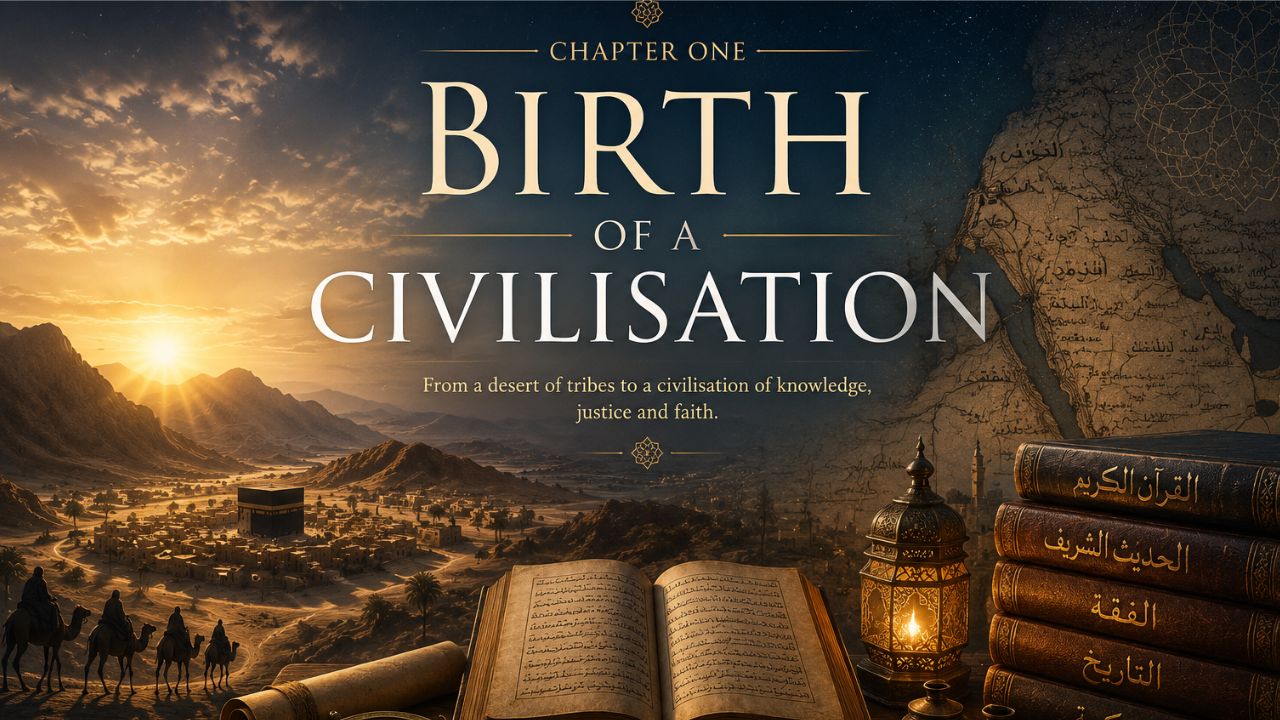
The Birth of a Civilisation (7th Century)
Arabia Before Islam
History is often shaped in places that few people expect. When people think of the great civilisations of the ancient world, they picture the temples of Egypt, the academies of Athens, the roads of Rome or the palaces of Persia. Rarely do they imagine the deserts of Arabia. To many of the powerful empires that surrounded it, the Arabian Peninsula appeared to lie on the margins of civilisation – a vast land of mountains, oases and seemingly endless sands, inhabited by fiercely independent tribes who owed allegiance to no emperor. Yet it was here, in one of the harshest environments on earth, that a movement began which would reshape the course of world history.
Arabia was never an empty wilderness. For thousands of years it had been home to merchants, shepherds, farmers and caravan traders. The south of the peninsula, in present-day Yemen, had long been connected to the incense trade, exporting frankincense and myrrh across the ancient world. In the north, Arab tribes interacted with the Byzantine and Sasanian Empires, serving at times as allies, traders or frontier communities. Along the western trade routes, caravans carried spices, leather, textiles and precious goods between the Indian Ocean and the Mediterranean.
Among these trading settlements stood Makkah. Nestled within a valley surrounded by rugged hills, Makkah occupied no fertile plain and possessed no great river. Its importance lay elsewhere. At its centre stood the Ka’bah, a sanctuary revered by many Arab tribes. Pilgrims travelled there throughout the year, bringing trade as well as religious devotion. Markets flourished during the pilgrimage seasons, and poets, merchants and tribal leaders gathered to exchange goods, settle disputes and display their eloquence.
Arab society possessed many qualities worthy of admiration. Hospitality towards guests was considered a sacred duty. Loyalty to one’s family and tribe was embedded in their culture. Courage, generosity and keeping one’s word were celebrated in poetry that remains among the finest works of classical Arabic literature. Even before Islam, the Arabs possessed a rich oral culture, capable of preserving long poems with astonishing accuracy across generations. Yet alongside these virtues existed deep divisions.
Arabia was not a single nation but a mosaic of tribes, each fiercely protective of its independence. Honour was often defended through revenge, and disputes between clans could continue for decades. The famous Basus War, remembered in Arabic literature, is said to have lasted around forty years after a seemingly minor dispute escalated into generations of bloodshed. In such a society, justice often depended less upon impartial law than upon the strength and alliances of one’s tribe.
Religion reflected this diversity. Many tribes worshipped idols housed within or around the Ka’bah, while others followed forms of Christianity, Judaism or older Arabian beliefs. A small number of individuals, remembered in the Islamic tradition as hunafa’, rejected idolatry altogether and sought the pure monotheism associated with the Prophet Ibrahim (Abraham), though they formed only a tiny minority.
Social inequalities were also evident. Slavery existed, as it did throughout much of the ancient world. Women enjoyed varying degrees of status depending upon tribe and circumstance. Some became successful merchants, poets or respected members of society, while others possessed few legal protections. Historical sources indicate that female infanticide occurred among certain tribes, often driven by fear of poverty or shame, though it was neither universal nor practiced by all Arabs. The Qur’an would later condemn the practice in some of its most powerful verses, asking:
“And when the girl who was buried alive is asked for what sin she was killed.” (Qur’an 81:8–9)
To the north and east, two superpowers dominated the political landscape. The Byzantine Empire ruled vast territories stretching across the eastern Mediterranean, while the Sasanian Empire controlled Persia and much of Mesopotamia. Their rivalry had endured for centuries, exhausting both states through repeated wars. Arabia lay between them, influenced by both yet controlled by neither.
Few observers in the early seventh century could have imagined that this fragmented peninsula would soon become the birthplace of one of history’s great civilisations. Nothing in the political balance of the age suggested that Arabia would eclipse the empires surrounding it. It possessed no mighty army, no renowned universities and no monumental cities comparable to Constantinople or Ctesiphon. Measured by the standards of the great powers of the day, it appeared an unlikely candidate to shape the future. Yet history repeatedly reminds us that the greatest transformations often begin in the most unexpected places.
The birth of Muhammad ﷺ
For the people of Makkah, life revolved around the valley. Long before sunrise, the first sounds echoed between the dark granite hills as merchants unfastened their animals and prepared for another day’s trade. The smell of leather, wool and woodsmoke drifted through narrow streets while travellers arriving after days in the desert searched for water and shade. At the heart of the settlement stood the Ka’bah, the sanctuary built generations earlier by Prophet Ibrahim (peace be upon him). Pilgrims came from every corner of Arabia to honour it, though by the sixth century hundreds of idols surrounded the sacred building, each representing the gods of different tribes.
Among the families entrusted with the care of Makkah’s sanctuary was the clan of Banu Hashim. They were respected among the Quraysh, not because they ruled the city, but because they served its pilgrims and traced their lineage to Ibrahim through his son Isma’il. It was into this household that Muhammad ﷺ was born around the year 570 CE.
His father, Abdullah, had died while returning from a trading journey before his son entered the world. His mother, Aminah, named him Muhammad, “the praised one”, though there was nothing to suggest that this orphaned child would one day become known across continents. Like many children of Makkah, he spent his earliest years not in the crowded valley but among the Bedouin of the surrounding desert. Families believed that life in the open wilderness strengthened both body and character, while the pure Arabic spoken by the desert tribes gave children an eloquence difficult to acquire in the busy trading towns.
The desert shaped those who lived within it. Rain was scarce, grazing unpredictable and every well precious. Days passed beneath an endless sky where the horizon seemed without limit, while the nights revealed a canopy of stars undimmed by fire or smoke. Travellers learned to navigate by those stars, to recognise changing winds and to respect the harshness of a land that could sustain life one season and threaten it the next. Patience was not admired as an abstract virtue; it was essential for survival.
Muhammad ﷺ returned to Makkah while still a young child, but the security of family life did not last. When he was six years old, his mother died during the journey home from visiting relatives in Yathrib. The caravan returned without her. An orphan who had never known his father now buried his mother as well. His grandfather, Abd al-Muttalib, took him into his care, surrounding him with affection despite his advancing years. Two years later, he too passed away. Once again, the boy’s life changed. Guardianship fell to his uncle, Abu Talib, whose household was large and whose means were modest, yet who would remain fiercely protective of his nephew throughout the years ahead.
Makkah offered few luxuries to a young man without wealth. Like many boys, Muhammad ﷺ worked as a shepherd. Before dawn he would lead sheep and goats beyond the valley, climbing the rocky slopes where sparse grasses appeared after the winter rains. Shepherding demanded long hours of quiet attentiveness. An animal wandering from the flock could disappear among the ravines, while wolves and thieves remained constant dangers. There were no crowds to applaud success and no audience to admire diligence. The work rewarded only patience, alertness and a willingness to care for creatures that could offer little in return. Years later, the Prophet ﷺ remarked that every prophet had tended sheep, a simple observation that hints at how ordinary labour can prepare a person for extraordinary responsibility.
As he grew older, another world opened before him. Every year the great caravans departed Makkah, carrying leather, hides and local goods north towards the markets of Syria and south towards Yemen. Hundreds of camels moved together across the desert, their bells breaking the silence as they followed ancient routes between wells and oases. The journey demanded experience. A mistake in navigation or poor judgement over water could end in disaster. Yet for those who travelled successfully, the caravan became a moving marketplace where goods, languages and ideas met.
Muhammad ﷺ earned a reputation as a careful and dependable merchant. Commercial dealings depended almost entirely upon trust. Contracts were often sealed with little more than a spoken agreement, and a trader’s reputation could determine whether others would entrust him with valuable cargo. Among the Quraysh he became known as al-Amīn—the Trustworthy. It was not a title he claimed for himself but one bestowed by those who knew him best. They relied upon his honesty, sought his judgement and left their possessions in his care, confident that they would be returned exactly as they had been received.
His reputation eventually reached Khadijah bint Khuwaylid, one of Makkah’s most respected merchants. She employed men to conduct trading expeditions on her behalf, and Muhammad ﷺ soon distinguished himself through both his integrity and his skill. In time, Khadijah proposed marriage. Their home became one of affection, stability and mutual respect, a place of quiet contentment in the midst of the bustling commercial life of Makkah.
Yet despite his success, there were signs that material prosperity alone did not satisfy him. Each year the markets grew busier, the caravans larger and the wealth of the Quraysh more secure. But the sanctuary built for the worship of the One God remained surrounded by idols, while tribal loyalties continued to shape the pursuit of justice. The city celebrated eloquence and honour, yet the weak could still find themselves without protection if no powerful clan stood beside them.
Increasingly, Muhammad ﷺ sought periods of solitude away from the valley. Leaving behind the noise of the markets and the endless movement of caravans, he climbed Jabal al-Nur, the Mountain of Light, overlooking Makkah. From its slopes the city appeared small beneath the vast Arabian sky. There, in a narrow cave open to the wind and the silence, he spent days in reflection, carrying only simple provisions. He did not yet know that he was approaching the moment for which all those years had prepared him. One night, in that lonely cave above the sleeping city, history changed forever.