
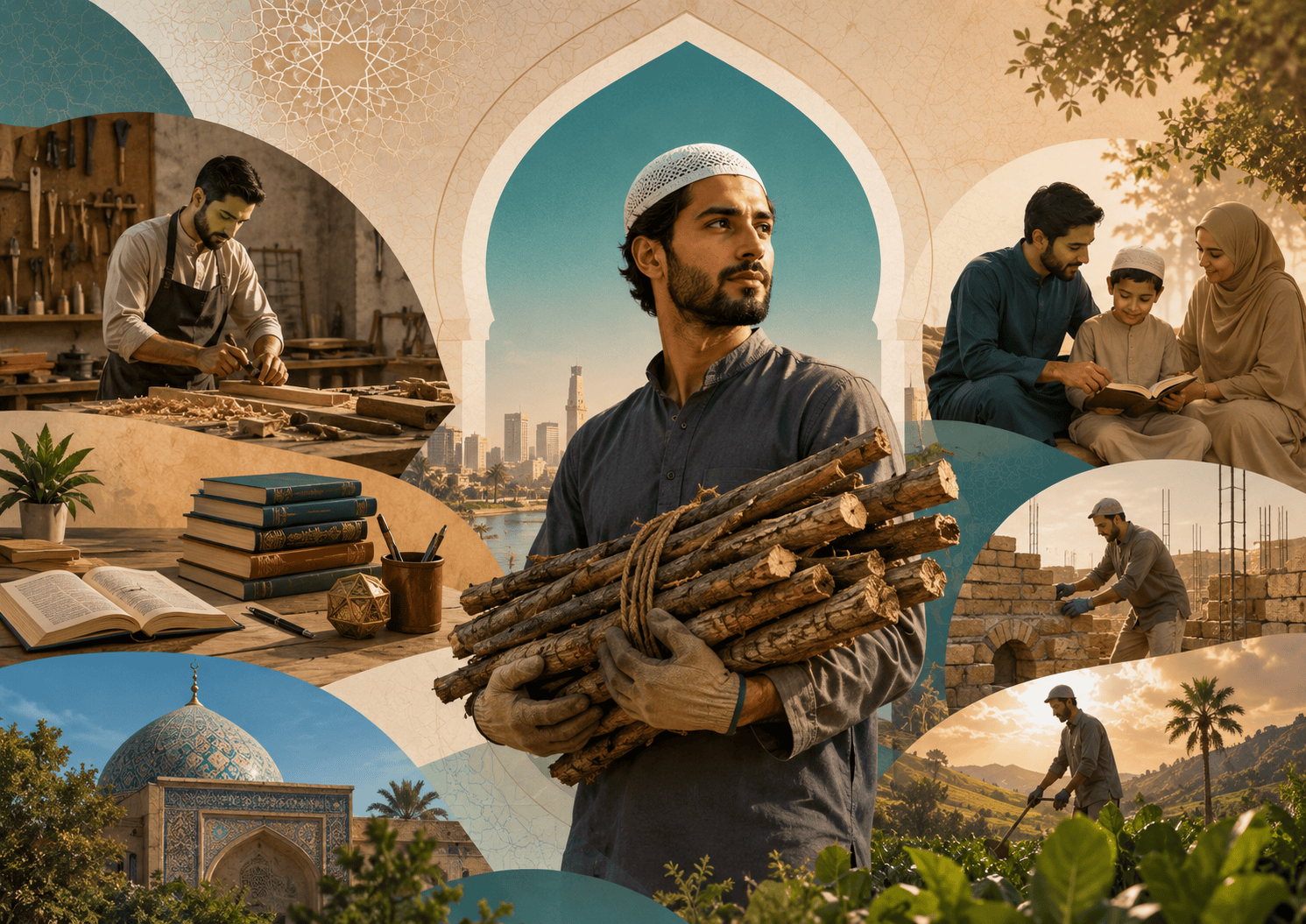
The seven instructions of the Prophet ﷺ
Abu Dharr al-Ghifari (may Allah be pleased with him) narrated that the Prophet ﷺ gave him seven pieces of advice:
“My beloved friend instructed me with seven things. He instructed me to love the poor and remain close to them; to look at those who have less than me and not at those who have more than me; to maintain my family ties even if they turn away from me; not to ask anyone for anything; to speak the truth even if it is bitter; not to fear the blame of anyone for the sake of Allah; and to frequently say la hawla wa la quwwata illa billah (there is no power nor strength except through Allah), for it is a treasure from beneath the Throne.”
(Ahmad)
This is a wasiyyah, an important piece of advice, which was given to Abu Dharr, but through him it is advice to the whole Ummah. Each one of these seven instructions could be a khutbah in itself.
There is also something beautiful in the way Abu Dharr introduces them. He does not simply say, “The Prophet ﷺ instructed me.” He says, “My beloved friend instructed me.” Khalil conveys deep love and closeness, and those few words reflect the immense love the Companions had for the Prophet ﷺ. Abu Dharr did not need to write pages describing his love for him. It comes through naturally in the way he speaks about him.
Expressing our love for someone is itself from the Sunnah. If you love someone, tell them that you love them. Abu Dharr expressed his love for the Prophet ﷺ simply by calling him his khalil. Among these seven instructions, the fourth is particularly significant: “He instructed me not to ask anyone for anything.”
Do not ask anyone for anything
This is not an easy command, yet when we look at the life of Abu Dharr (may Allah be pleased with him), we see that he fulfilled it. The same principle appears in the well-known narration of Thawban (may Allah be pleased with him). The Prophet ﷺ was once sitting with a group of Companions, said in some narrations to have been seven or eight, when he asked:
“Who will undertake one thing for me, and I will guarantee Paradise for him?”
The Companions hesitated, but Thawban accepted. The Prophet ﷺ told him, “Do not ask people for anything.” Thawban took this so seriously that if the whip or strap he used while riding fell to the ground, he would dismount and pick it up himself rather than ask someone standing nearby to pass it to him.
It seems like a very small thing, but it was training him in something much bigger: not to become unnecessarily dependent upon other people.
Build your relationship with Allah
At the heart of this command is first and foremost our relationship with Allah Almighty. Allah says:
“You alone we worship and You alone we ask for help.”
(Surat al-Fatihah, 1:5)
From the perspective of Aqidah, our reliance is upon Allah. He is the One who provides, gives and has power over all things. This does not mean that it is prohibited to ask another human being for help. Of course we can ask people to do things which are within their ability. We can cooperate with one another, employ people, form partnerships, have friends who help us and enter alliances where there is benefit.
There is no contradiction between this and Tawhid. When we ask another person for something, we still know that ultimately Allah is the One who provides and enables. Our hearts are attached to Him, not to people. So the Prophet ﷺ was not teaching us never to cooperate with anyone; he was establishing a mindset in which we do not make ourselves unnecessarily dependent upon others, particularly when we are capable of doing something ourselves.
The upper hand is better
The Prophet ﷺ said, “The upper hand is better than the lower hand.” The hand which gives is better than the hand which takes. In another narration, a man came to the Prophet ﷺ asking for something. He was given something, then returned and asked again. Eventually, the Prophet ﷺ directed him towards working for himself. He told him to go out, gather firewood, sell it in the market and earn money rather than continue asking people, whether they gave him something or refused him.
There is dignity in earning with your own hands. This is what the Prophet ﷺ was cultivating: work, produce, develop your abilities and take responsibility for yourself rather than placing yourself unnecessarily at the mercy of another person. His instruction to Abu Dharr and Thawban was about creating independence. A believer should have dignity and honour, should have agency, and should be capable of making their own decisions rather than becoming beholden to somebody else.
From the individual to the Ummah
This begins with the individual, but it does not end there. The individual should strive to be independent, then the family should be able to stand on its own feet, the community should develop the capacity to meet its needs, and the Ummah as a whole should work towards self-sufficiency. We cannot build an independent Ummah without first cultivating independence in its individuals.
This helps us understand the distinction our scholars made between fard ayn and fard kifayah. Fard ayn refers to individual obligations which each person must fulfil, such as the five daily prayers, fasting and zakat. Fard kifayah refers to collective obligations, responsibilities which the community must ensure are being fulfilled by a sufficient number of people.
A society needs enough doctors to treat its sick and enough engineers to build what it requires. It needs people who understand finance, including Islamic finance, as well as agriculture, technology and every other useful field. Useful knowledge and beneficial skills are not optional luxuries for an Ummah that wants to be strong. The Ummah has to acquire them, develop them and put them into practice so that it is capable of meeting its own needs.
Self-sufficiency is an obligation
When the Prophet ﷺ said, “Do not ask anyone for anything,” this apparently small instruction contains within it a much larger strategy. As an Ummah, we should strive to be economically independent, commercially independent and politically independent. We should have control over our resources and our wealth, and we should have the ability to protect ourselves rather than permanently needing somebody else to defend or protect us.
This does not mean we cannot have alliances or work with others. Cooperation is not the problem; dependence is. There is a considerable difference between choosing to cooperate with someone from a position of strength and having no choice because you cannot function without them.
If another nation controls what you need in order to survive, it inevitably has leverage over your decisions. The Ummah should therefore have the capacity to make its own decisions rather than continually having decisions imposed upon it. This is part of izzah, dignity and honour.
We cannot keep weeping over the ruins
Too often, we look at the state of the Ummah and spend our time lamenting what has been lost. Classical Arabic poetry famously begins with the poet standing before the abandoned campsite, weeping over the memory of the beloved:
“Stop, you two, and let us weep over the memory of a beloved and a dwelling…”
Someone later joked, “Tell the man who stands weeping over the ruins: what harm would there have been if he sat down?” In other words, if you are going to spend such a long time crying over the past, you might as well sit down. We cannot spend our lives weeping over the ruins. At some point, we have to build.
The Muslim world possesses huge resources. We have economic resources, human resources and natural resources, as well as expertise, wealth and talent spread across the Ummah. The problem is that we are fragmented. Our strength exists, but it is scattered.
InshaAllah, after this Flood, the Ummah will begin to gather itself, bring its resources together and unite upon something good. There have been moves towards alliances and greater cooperation. Some immediately dismiss such developments and say, “It is a conspiracy.” Leave that aside. Even if we differ over details, there can still be good in Muslims coming together, pooling resources and coordinating their efforts.
Economic resources, human resources and natural resources all need to be put to good use. We should reach the point where we do not need someone else to protect us. The Ummah has immense potential for strength, but it is divided. This is why unity is not merely an emotional slogan; it has practical consequences because it allows resources, expertise and power to be brought together rather than wasted through fragmentation.
A strategy for dignity
“Do not ask anyone for anything” sounds like a small instruction given to one Companion, but in reality it contains an entire way of thinking. It builds a relationship with Allah in which the heart depends upon Him, and it builds the individual who learns to work, take responsibility and preserve their dignity. It builds the family and community, which learn to fulfil their own responsibilities, and it points towards an Ummah that develops the knowledge, skills, resources and strength necessary to be self-sufficient.
The Prophet ﷺ was building an Ummah of izzah, honour, karamah and strength. This is not simply a financial lesson. It is about belief, a way of life, a mindset and a strategy for the future. The believer’s heart relies upon Allah while their hands work, and we ask Allah Almighty to unite our ranks, unite our hearts and unite our efforts, and enable us to follow the footsteps of the Prophet ﷺ and fulfil his guidance in our lives.
Based on the khutbah of Shaykh Haytham Tamim on 14th August 2026.
Latest Blogs
- The seven instructions of the Prophet ﷺ
- Healing from the Quran and Sunnah (part 6) – wellbeing (afiya) practices and environment
- Healing from the Quran and Sunnah (part 5) – physical health, sleep and strong emotions
- Healing from the Quran and Sunnah (part 4) – prophetic food
- Healing from the Quran and Sunnah (part 3) – the holistic approach, ruqya, fasting and moderation