
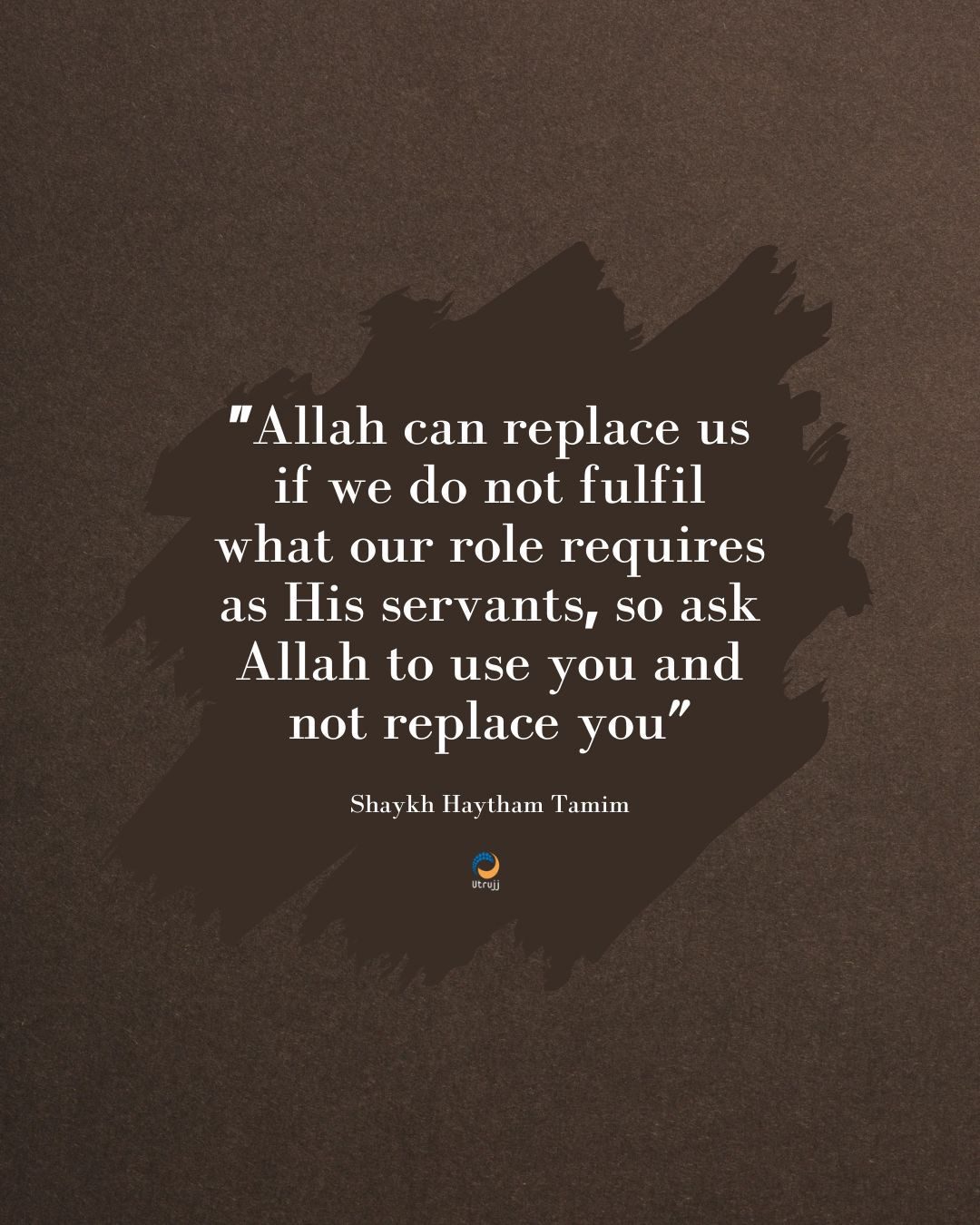
Being used in Allah’s service without being replaced
Allah does not need His creation. His religion is established, His decree unfolds, and His command prevails whether people respond or turn away.
Yet from His mercy, Allah chooses certain individuals and allows them to be part of His service. This is not a right that one earns, but an honour that one is granted.
Allah says:
وَإِن تَتَوَلَّوْا يَسْتَبْدِلْ قَوْمًا غَيْرَكُمْ ثُمَّ لَا يَكُونُوا أَمْثَالَكُمْ
“But if you turn away, He will replace you with another people; then they will not be like you.” (Muhammad 47:38)
This verse establishes a principle: Allah’s work continues, but the people involved in it may change. The question is not whether the work will be done, but whether we will be among those chosen to do it.
Being vessels of goodness
To be guided towards good actions is itself a blessing and a sign that Allah intends khayr (good) for a person.
The Prophet ﷺ said:
“If Allah intends good for someone, He uses him.”
It was asked, “How does He use him?”
He said, “He guides him to righteous deeds before death.” (Ahmad)
And in another narration, the Prophet ﷺ described how Allah honours such a person:
“If Allah loves a servant, He makes him ‘sweet like honey’.”
They asked, “What does that mean?”
He said, “He grants him righteous deeds before his death, then takes his soul upon that.” (Ahmad)
This is the true success: not just to do good, but to end upon good.
Preserving the honour
If being used by Allah is an honour, then preserving that honour requires vigilance. It requires sincerity to be renewed, intentions to be checked, and actions to remain consistent.
A person may be given knowledge, influence, or ability, but none of these are guaranteed to remain. They stay only as long as they are upheld with obedience and gratitude.
The believer lives between hope and fear: hope that Allah will use them, and fear that they may be replaced. This balance protects sincerity and keeps the heart alive.
It is not the scale of what one does that matters most, but whether Allah accepts it and allows one to continue.
For this reason, the scholars make this supplication:
اللَّهُمَّ اسْتَعْمِلْنِي فِي طَاعَتِكَ وَلَا تَسْتَبْدِلْنِي
Allahummasta‘milni fi ta‘atika wa la tastabdilni
O Allah, use me for Your service and do not replace me.
The qualities of those Allah uses
Those whom Allah selects for His service are not defined by perfection, but by their sincerity. Their actions are not driven by recognition, but by a deep awareness that Allah sees them.
Allah says:
وَمَا أُمِرُوا إِلَّا لِيَعْبُدُوا اللَّهَ مُخْلِصِينَ لَهُ الدِّينَ
“They were only commanded to worship Allah, sincere to Him in religion.” (Al-Bayyinah 98:5)
Sincerity is what gives life to actions. Without it, even the greatest efforts are hollow.
Alongside sincerity is humility. The people Allah uses do not see themselves as the source of good, but as vessels through which Allah allows good to occur. The more they are given, the more they lower themselves.
وَعِبَادُ الرَّحْمَٰنِ الَّذِينَ يَمْشُونَ عَلَى الْأَرْضِ هَوْنًا
“The servants of the Most Merciful are those who walk upon the earth humbly.” (Al-Furqan 25:63)
They are also people who respond when called. When an opportunity for good presents itself, they do not delay or hesitate. Their attitude reflects the believers described by Allah:
سَمِعْنَا وَأَطَعْنَا
“We hear and we obey.” (Al-Baqarah 2:285)
Consistency defines them. Their deeds may be small, but they are continuous. The Messenger of Allah ﷺ said:
“The most beloved deeds to Allah are those that are consistent, even if small.” (Bukhari)
Their hearts are soft, moved by the condition of others. They seek to benefit people, knowing that service to creation is a path to closeness to the Creator.
They fall into sin, as all humans do, but they are quick to return. Their repentance keeps their connection alive and prevents their hearts from hardening.
Be grateful and turn back to Allah
Allah chose the prophets and messengers to carry His message and they were the most grateful of all people. Prophet Suleman (peace be upon him) who was blessed with a kingdom unlike any other, made this dua:
رَبِّ أَوۡزِعۡنِيٓ أَنۡ أَشۡكُرَ نِعۡمَتَكَ ٱلَّتِيٓ أَنۡعَمۡتَ عَلَيَّ وَعَلَىٰ وَٰلِدَيَّ وَأَنۡ أَعۡمَلَ صَٰلِحٗا تَرۡضَىٰهُ وَأَدۡخِلۡنِي بِرَحۡمَتِكَ فِي عِبَادِكَ ٱلصَّـٰلِحِينَ
“My Lord, enable me to be grateful for Your favour which You have bestowed upon me and upon my parents, and to do righteousness that pleases You, and admit me by Your mercy among Your righteous servants.” (Surah An-Naml 27:19)
Prophet Muhammad ﷺ also asked Allah to make him constantly grateful, constantly remembering Allah, and constantly turning back to Allah.
اللَّهُمَّ اجْعَلْنِي لَكَ شَكَّارًا، لَكَ ذَكَّارًا، أَوَّابًا مُنِيبًا
O Allah, make me constantly grateful to You, constantly remembering You, repeatedly returning to You, and turning back to You. (Abu Dawud)
Those who turn back to Allah are ‘munib’, which is a well-known word and also a name, meaning turn back. It is like taba which means to repent and turning back to Allah, turn back to the truth, and to the straight path.
Blessings are not preserved by words alone, but by how they are used. Gratitude in Islam is expressed through action. It is to take what Allah has given and use it in a way that pleases Him.
Allah says:
لَئِن شَكَرْتُمْ لَأَزِيدَنَّكُمْ
“If you are grateful, I will surely increase you.” (Ibrahim 14:7)
Knowledge is shared through teaching and acting upon it. Wealth is shared through giving. Influence is used to guide others to good. Experience is shared by giving sincere advice.
When a blessing is used correctly, it grows. When it is neglected, it begins to fade.
The danger of neglect and replacement
Just as Allah grants the honour of service, He can remove it. This removal is not random; it follows neglect, ingratitude, or arrogance.
The Qur’an does not say the work will stop. It says you will be replaced.
This is a serious reality. A person may be given a role, a platform, or an opportunity, but if it is not honoured, it will not remain.