
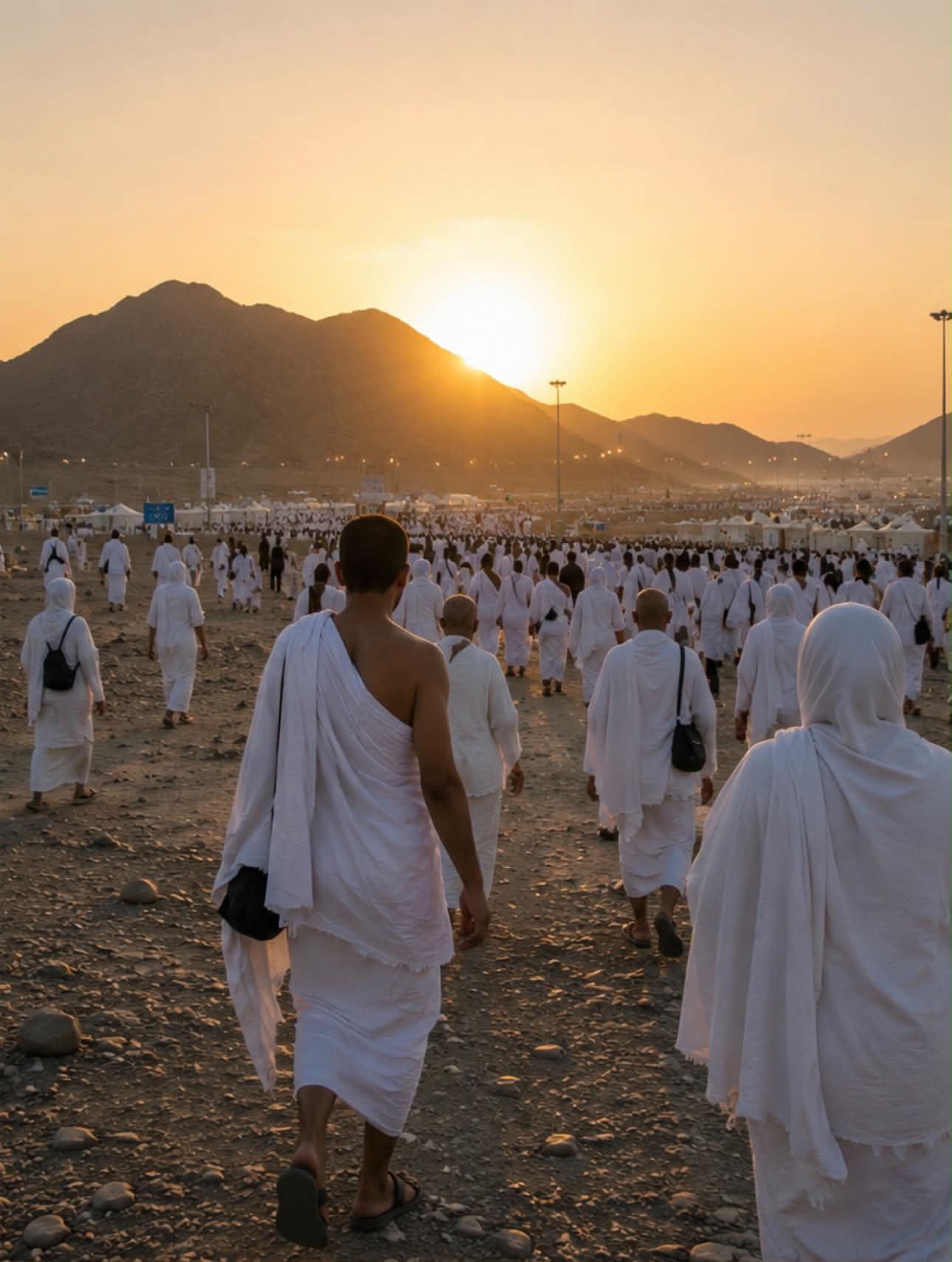
Hajj – the spiritual journey of a life-time
Hajj: a spiritual journey of a lifetime – Meaning, lessons and spiritual renewal
Hajj is one of the greatest acts of worship in Islam: a spiritual journey of a lifetime that gathers believers from every corner of the world in submission to Allah Almighty.
One of the beautiful booklets I read on Hajj is by Imam Mulla Ali al-Qari. It is a short booklet, around twenty pages depending on the copy, but it is very beautiful. Mulla Ali al-Qari was a great muhaddith, hafiz and faqih. He was encyclopaedic in many different Islamic sciences.
Although he also wrote a large work on Hajj, around four volumes, this short booklet focuses on the spiritual reflections of Hajj. I will summarise some of its meanings because they are very beautiful.
He begins by saying that the word Hajj is made up of two letters: ح and ج.
He says that the letter ح may point to حِلْمُ الْحَقّ, the forbearance of Allah Almighty. One of the names of Allah is الْحَلِيمُ, the Most Forbearing. The meaning of Al-Halim is:
الَّذِي يُؤَخِّرُ الْعُقُوبَةَ عَمَّنْ يَسْتَحِقُّهَا
The One who delays punishment from those who deserve it.
This is not a hadith; it is the reflection of Mulla Ali al-Qari on the word Hajj. He says that the ح may refer to the forbearance of Allah Almighty, and the ج may refer to جُرْمُ الْخَلْق, the sins of creation.
In the word حَجّ, there is a shaddah on the letter ج. If you remove the shaddah, it becomes as though there are two ج letters. He says this points to the many sins of people. We have so many sins, yet Allah Almighty does not punish us immediately. He gives us another chance to repent and return to Him.
So he summarises the word Hajj as:
حِلْمُ الْحَقِّ وَجُرْمُ الْخَلْقِ
“The forbearance of the True Lord and the sins of creation.”
This is how he begins the booklet. He is saying that even the name Hajj reflects the beauty of Allah’s forgiveness.
Then he quotes the hadith qudsi in which Allah Almighty says:
إِنَّ رَحْمَتِي سَبَقَتْ غَضَبِي
“Indeed, My mercy has preceded My anger.”
(Bukhari and Muslim)
So even if we have many sins, if we ask Allah sincerely to forgive us, Allah will forgive. Allah is forbearing. Allah is Halim. Allah is Rahim. Allah is Ghafur. Allah is Karim.
In another hadith qudsi, Allah Almighty says:
يَا ابْنَ آدَمَ، إِنَّكَ مَا دَعَوْتَنِي وَرَجَوْتَنِي، غَفَرْتُ لَكَ عَلَى مَا كَانَ مِنْكَ وَلَا أُبَالِي. يَا ابْنَ آدَمَ، لَوْ بَلَغَتْ ذُنُوبُكَ عَنَانَ السَّمَاءِ، ثُمَّ اسْتَغْفَرْتَنِي، غَفَرْتُ لَكَ وَلَا أُبَالِي
“O son of Adam, so long as you call upon Me and hope in Me, I will forgive you for whatever came from you, and I will not mind. O son of Adam, if your sins were to reach the clouds of the sky, then you sought My forgiveness, I would forgive you, and I would not mind.”
(Tirmidhi)
This shows us how generous Allah Almighty is with us.
Hajj is a journey of love
Mulla Ali al-Qari then asks: what is the reason for going to Hajj?
Of course, we go to fulfil an obligation. But Hajj is not just a robotic act of ticking a box. It is about yearning and longing to go to the House of Allah. It is driven not only by obligation, but by love.
Hajj is a journey of love. It is not simply a journey of completing a duty. The essence of Hajj is love for Allah Almighty and longing for His sacred House.
This is connected to the dua of Ibrahim (peace be upon him) when he left his wife Hajar (may Allah be pleased with her) and his son Ismaʿil (peace be upon him) in the valley of Makkah. Ibrahim (peace be upon him) said:
رَّبَّنَآ إِنِّيٓ أَسْكَنتُ مِن ذُرِّيَّتِي بِوَادٍ غَيْرِ ذِي زَرْعٍ عِندَ بَيْتِكَ الْمُحَرَّمِ رَبَّنَا لِيُقِيمُوا الصَّلَوٰةَ فَاجْعَلْ أَفْـِٔدَةً مِّنَ النَّاسِ تَهْوِيٓ إِلَيْهِمْ وَارْزُقْهُم مِّنَ الثَّمَرَاتِ لَعَلَّهُمْ يَشْكُرُونَ
“Our Lord, I have settled some of my descendants in a valley with no cultivation, near Your Sacred House, our Lord, so that they may establish prayer. So make the hearts of some people incline towards them, and provide them with fruits, so that they may be grateful.”
(Surat Ibrahim 14:37)
The core of this ayah is that Ibrahim (peace be upon him) made dua for people’s hearts to incline towards that place. This is why hearts long to go to Makkah. If a person has already been, they long to return. If they have not been, they long to go.
Allah accepted the dua of Ibrahim (peace be upon him). That yearning in the heart is from the dua of Ibrahim (peace be upon him), and from our love for Allah Almighty.
The blessing of the time and place
Like other obligations, Hajj is connected to conditions. You cannot pray Dhuhr before its time begins, and you cannot perform Hajj before the time of Hajj. Hajj has a connection to time.
It also has a connection to place. Salah can be prayed anywhere, as long as the place is pure and clean. But Hajj cannot be performed in your own locality. Even if it is the time of Hajj, you cannot perform Hajj anywhere else. Hajj must be performed in a particular place, at a particular time.
So Hajj brings together two connections: time and place.
The place is the House of Allah. The time is the sacred month of Dhul Hijjah, one of the sacred months. The whole atmosphere is therefore filled with blessings and special gifts from Allah Almighty. The place is full of gifts. The time is full of gifts. The rituals are full of gifts.
The journey is about seeking the pleasure of Allah Almighty. It is about fulfilling the obligation, but it is also about becoming more connected to Allah.
Allah Almighty says in Surat al-Baqarah:
وَعَهِدْنَآ إِلَىٰٓ إِبْرَٰهِيمَ وَإِسْمَٰعِيلَ أَن طَهِّرَا بَيْتِيَ لِلطَّآئِفِينَ وَالْعَٰكِفِينَ وَالرُّكَّعِ السُّجُودِ
“And We entrusted Ibrahim and Ismaʿil, saying, ‘Purify My House for those who perform tawaf, those who stay in devotion, and those who bow and prostrate.’”
(Surat al-Baqarah 2:125)
Allah Almighty entrusted Ibrahim and Ismaʿil (peace be upon him) to purify His House for those who perform tawaf, for those who stay there in worship, and for those who bow and prostrate in the Haram.
So Hajj takes place in a purified place. It is surrounded by layers of blessing: purification, love, forgiveness, connection and nearness to Allah Almighty.
Hajj as a journey of hardship and refinement
Without doubt, the journey of Hajj is not like any other journey. It is difficult. Even with all the comfort we have today — travelling by plane rather than on foot or by camel — Hajj is still hard.
But it is about bearing hardship and turning to Allah Almighty. Allah wants to test us. Every system has what they call a stress test. A fire drill is a kind of stress test. You do it to check whether everything is working: the fire doors, the exits, the procedures and so on.
Hajj is like a stress test. It tests your sabr, your patience, your commitment, your character and your discipline. It is tough, but it is a sweet journey to Allah Almighty.
Freeing yourself from the dunya
When we go to Hajj, we have to free ourselves from all attachments to the dunya. We free the heart from attachment to people, wealth, status and expectations. We free the mind from being controlled by desires, fears and constant distraction. We free the soul from habits of sin, heedlessness, ghaflah and ego.
We also free ourselves from relying on creation instead of relying on Allah Almighty.
You feel all of this in Hajj, but you have to pay attention. Otherwise, Hajj becomes merely an exercise in tiredness rather than an exercise in spiritual development. There are two ways to experience it, and you choose which one it will be. This is why sincerity is so important.
The provision for Hajj
Before going to Hajj, the scholars always speak about provision. We mentioned financial ability, but the question is: where did the money come from?
The money you use for Hajj has to be pure money. It has to be halal. There should be no interest, no haram income and no doubtful dealings in it. You are travelling to fulfil your fifth obligation. You are dealing with Allah Almighty, so the purity of your provision matters.
If a person performs all the rituals and obligations of Hajj, but the money they used was haram, this affects the acceptance of their Hajj. So the provision must be pure.
Gratitude and patience
Gratitude and patience should be the motto of the pilgrim.
When you go to Hajj, always be grateful to Allah Almighty that He called your name and allowed you to go. If you have not yet been while you had the means, you should feel a sadness in your heart and ask yourself: why has Allah not called me yet? Is there something I need to fix?
Then rectify it quickly. Put your name on the list and say: “I will go, insha’Allah. If not this year, then by the permission of Allah, next year I will go to Hajj. I want Allah to call me, and I want my name to be on that list.”
Then comes patience. I always tell those going to Hajj or Umrah that they need three things: patience, patience and patience. From the moment you leave your house until the moment you return, you will be tested. So have sabr all the way.
The outer journey and the inner journey
SubhanAllah, during one of the first times I went to Hajj, I remember having a conversation with myself. We travel all these miles to Makkah, but of course we do not worship the Kaʿbah. We worship Allah.
So is this journey a physical journey or a spiritual journey?
If it is a spiritual journey, can we not find Allah outside Makkah? Can we not find Allah outside the Kaʿbah?
Of course we can. Allah Almighty is not limited by place. Allah says:
وَلَقَدْ خَلَقْنَا الْإِنسَانَ وَنَعْلَمُ مَا تُوَسْوِسُ بِهِۦ نَفْسُهُۥ ۖ وَنَحْنُ أَقْرَبُ إِلَيْهِ مِنْ حَبْلِ ٱلْوَرِيدِ
“Indeed, We created man, and We know what his soul whispers to him, and We are closer to him than his jugular vein.”
(Surat Qaf 50:16)
Closeness to Allah has no physical distance. You do not need to travel for Allah to be near you. So why do we travel all this way?
Because Hajj is a journey of self-improvement. It is a journey of character development. It is about updating your system and returning as a better version of yourself. When done to venerate Allah’s orders and His ordained practices, it’s also a manifestation of taqwa, as evidenced by the Qur’an in Surat al-Hajj:
“Thus it is, and whoever venerates the sacred rites of God – [their acts] proceed from a pious heart.” (22:32)
The Messenger of Allah ﷺ said:
مَنْ حَجَّ لِلَّهِ فَلَمْ يَرْفُثْ وَلَمْ يَفْسُقْ، رَجَعَ كَيَوْمِ وَلَدَتْهُ أُمُّهُ
“Whoever performs Hajj for Allah and does not engage in obscenity or sin, will return as on the day his mother gave birth to him.”
(Bukhari and Muslim)
So when Hajj is accepted, it is as though the person returns like a newborn baby, with a blank new page: no sins, no burdens, nothing written against them.
There is the outer journey and the inner journey. The outer journey is that you take the plane, go through the airport, pass through security, check into the hotel and move from place to place. But what about the inner journey?
The inner journey begins with intention. You must keep remembering that you are travelling to the House of Allah Almighty. The host is Allah Almighty. You are going to Him.
The miqat and entering ihram
Mulla Ali al-Qari says that when you reach the miqat, you should remember that you are approaching Allah Almighty.
These days, many people do not physically cross the miqat unless they go to Madinah first and then travel to Makkah. If someone is flying directly towards Jeddah and Makkah, the pilot usually announces that the plane is approaching the miqat. At that point, you make your intention.
The intention depends on the type of Hajj you are performing: ifrad, qiran or tamattuʿ. These are the three types of Hajj, and that is a separate discussion.
When you reach the miqat, remember that you are preparing yourself. You are getting closer and closer to the House of Allah Almighty. This should make you control yourself more, observe yourself more and become more conscious of what you are doing.
For men, one of the rituals of Hajj is to remove stitched garments. They do not wear normal stitched clothing. This reminds them of the shroud. The pilgrim wears an upper garment and a lower garment, just as the dead body is wrapped in the shroud.
It reminds you that you are going to Allah with nothing. You came with nothing and you will leave with nothing. Not your wealth, not your status, not your position — nothing will go with you.
In ihram, you cannot distinguish between the wealthy and the poor. Almost everyone is wearing the same thing. So Hajj is also a reminder of equality.
When you take your ghusl before entering ihram, it is as though you are going through the process of preparing yourself for death. It makes you think: am I really prepared for death? Have I prepared enough? Am I ready to meet Allah?
Wearing the ihram also carries this meaning. It is sunnah to perfume the body before wearing the ihram, just as perfume is placed on the body of the deceased before burial. This is another layer of reflection. It is as though you are being reminded: you are close to crossing into the Akhirah.
So Hajj reminds you of the Hereafter.
The talbiyah: at Your service, my Lord
Then you recite the talbiyah:
لَبَّيْكَ اللَّهُمَّ لَبَّيْكَ، لَبَّيْكَ لَا شَرِيكَ لَكَ لَبَّيْكَ، إِنَّ الْحَمْدَ وَالنِّعْمَةَ لَكَ وَالْمُلْكَ، لَا شَرِيكَ لَكَ
“At Your service, O Allah, at Your service. At Your service, You have no partner, at Your service. Indeed, all praise, blessing and dominion belong to You. You have no partner.”
The talbiyah means: “At Your service, my Lord.”
But this “At Your service” is not only for Hajj and Umrah. It should be the state of the believer all the time. Whenever the Messenger of Allah ﷺ asked the companions for something, they would say:
لَبَّيْكَ يَا رَسُولَ اللهِ
“At your service, O Messenger of Allah.”
So we need this labbayk in our lives all the time. We need to be in a constant state of turning to Allah Almighty.
Ihram and abandoning comfort
Mulla Ali al-Qari said that wearing the ihram is about abandoning comfort and familiarity. We need this, because in many ways we have become pampered and spoiled. Leaving comfort and luxury trains a person to become better.
When you touch the Black Stone, or even if you cannot touch it and you simply gesture towards it with your hand, it is like renewing a pledge with Allah Almighty. It is a pledge to remain firm upon obedience and to stay faithful to the covenant between you and Allah.
When you do tawaf around the Kaʿbah, the sunnah in the first three circuits, where possible, is to walk briskly. These days it may not always be possible because of the crowds, but spiritually it reminds you of running away from your sins, leaving them behind and regretting what you have done.
Saʿi between Safa and Marwah
When you do saʿi between Safa and Marwah, Mulla Ali says it is like standing before the mizan, the scale on the Day of Judgement. There is one side here and one side there, and you are moving between hope and fear.
Will I make it, or will I not make it?
So when you walk between Safa and Marwah, remember that you are between hope and fear. You hope in the mercy of Allah, but you also fear your shortcomings.
Standing at Arafah
Standing at Arafah is like the Day of Judgement. The entire Ummah is gathered there. Some people are in more comfortable places, some have no shade, some are on the street, some are in vehicles, and people are in different states.
Similarly, on the Day of Judgement, people will be on different levels. Some will be treated with honour and given shade, including the seven categories mentioned in the hadith:
سَبْعَةٌ يُظِلُّهُمُ اللَّهُ فِي ظِلِّهِ يَوْمَ لَا ظِلَّ إِلَّا ظِلُّهُ: الْإِمَامُ الْعَادِلُ، وَشَابٌّ نَشَأَ فِي عِبَادَةِ رَبِّهِ، وَرَجُلٌ قَلْبُهُ مُعَلَّقٌ فِي الْمَسَاجِدِ، وَرَجُلَانِ تَحَابَّا فِي اللَّهِ اجْتَمَعَا عَلَيْهِ وَتَفَرَّقَا عَلَيْهِ، وَرَجُلٌ دَعَتْهُ امْرَأَةٌ ذَاتُ مَنْصِبٍ وَجَمَالٍ فَقَالَ إِنِّي أَخَافُ اللَّهَ، وَرَجُلٌ تَصَدَّقَ بِصَدَقَةٍ فَأَخْفَاهَا حَتَّى لَا تَعْلَمَ شِمَالُهُ مَا تُنْفِقُ يَمِينُهُ، وَرَجُلٌ ذَكَرَ اللَّهَ خَالِيًا فَفَاضَتْ عَيْنَاهُ
“There are seven whom Allah will shade in His shade on the Day when there will be no shade except His shade: a just ruler; a young person who grew up in the worship of his Lord; a man whose heart is attached to the mosque; two people who love one another for the sake of Allah, meeting for that and parting upon that; a man who is invited by a woman of status and beauty but says, ‘I fear Allah’; a man who gives charity so secretly that his left hand does not know what his right hand has given; and a man who remembers Allah in private and his eyes overflow with tears.”
(Bukhari and Muslim)
So standing at Arafah should remind you of standing before Allah on the Day of Judgement. You are surrounded by hardship and fear, waiting for the final decision. Where are we going? To Jannah, insha’Allah, or — may Allah protect us — somewhere else?
Reflect on this when you stand at Arafah.
Waiting for sunset on Arafah is also like waiting for the great intercession of the Messenger of Allah ﷺ. The reckoning will not begin until the Prophet ﷺ intercedes. He will come and prostrate beneath the Throne of Allah Almighty, and Allah will say:
يَا مُحَمَّدُ، ارْفَعْ رَأْسَكَ، وَسَلْ تُعْطَهْ، وَاشْفَعْ تُشَفَّعْ
“O Muhammad, raise your head. Ask, and you will be given. Intercede, and your intercession will be accepted.”
(Bukhari and Muslim)
Then the Messenger of Allah ﷺ will ask for the reckoning to begin.
Muzdalifah
Then comes Muzdalifah. Spending the night there is about worship, humility and asking Allah to accept you. It is a night to ask Allah to release you from the Fire through His mercy, forgiveness and gentleness.
That is a brief reflection. In fact, this is a summary of a summary. I summarised the book, and now I have summarised that summary for you.
The Jamarat?
The Jamarat is about pelting anything that distracts you from fulfilling your obligation towards Allah Almighty. Anything that pulls you back, you throw away. You cut your connection with your desires, your ego and whatever holds you back.
It is symbolic. You are not literally pelting Shaytan himself, but it is a symbolic act. It is narrated by Ibn Abi Shaybah in al-Musannaf that when Abraham (peace be upon him) had finished building the House (the Kaʿbah), Gabriel (peace be upon him) came to him and showed him how to perform ṭawaf (circumambulation). Then he took him to Jamrat al-ʿAqabah, where Shaytan appeared before him. Jibril took seven pebbles and gave Ibrahim (peace be upon him) seven pebbles, and said to him: “Throw and say ‘Allahu Akbar’ (God is the Greatest).” So they both threw the pebbles and proclaimed the takbir with each throw until Shaytan disappeared. Then Jibril took him to the Middle Jamrah, where Shaytan again appeared to them. Gabriel took seven pebbles and gave Abraham seven pebbles, and said: “Throw and say ‘Allahu Akbar.’” So they both threw the pebbles and proclaimed the takbir with each throw until Satan disappeared. Then he took him to the Furthest Jamrah, and they did the same there.
We also face temptations and whispers from Shaytan all the time, so we have to fight back completely.
The sacrifice
Then there is the culmination of the qurbani, the sacrifice, and cutting the hair. The qurbani is also related to Ibrahim (peace be upon him). It is about sacrifice: the willingness to sacrifice what you love for what Allah loves. Even his son, the most beloved thing to him, Ibrahim عليه السلام was willing to surrender for the sake of Allah.
This is one of the greatest lessons of Hajj. It teaches us that whatever is most dear to us must still come after Allah. If Allah asks something of us, we should be ready to give up what we love for what He loves.
Cutting the hair
The cutting or shaving of the hair is also meaningful. For men, shaving the head completely is not usually something that beautifies a person. It strips away vanity. It is a training in humility and submission.
It is as though the servant is saying: “Ya Allah, I am willing to do anything to please You.”
This is the same lesson we learn in sujud. The forehead is one of the most honoured parts of the body, yet we place it on the ground, on the dust, for the sake of Allah. That is humility. The servant lowers the most honoured part of himself before Allah Almighty.
Seeking forgiveness before Hajj
There is also a reason why people often ask others for forgiveness before going to Hajj. In the past, Hajj was a dangerous journey. Many people would leave for Hajj and never return. Even today, there is always the possibility that a person may die during the journey.
So when someone says, “Please forgive me, I am going to Hajj,” they may not always realise the deeper meaning behind it, but the meaning is powerful. They are trying to clean their record before meeting Allah.
It is better to settle your accounts now, while it is still possible, rather than carry those accounts to the Day of Judgement. If you have wronged someone, hurt someone, taken someone’s right, or upset them, try to put it right before you go. Hajj is a journey of purification, so the heart should not go carrying unnecessary burdens.
The sign of an accepted Hajj
The Messenger of Allah ﷺ said:
الْحَجُّ الْمَبْرُورُ لَيْسَ لَهُ جَزَاءٌ إِلَّا الْجَنَّةُ
“An accepted Hajj has no reward except Paradise.”
(Bukhari and Muslim)
A common question is: how do we know whether our Hajj has been accepted?
This question is not only asked after Hajj. We ask the same after Ramadan, after salah, after zakah and after any good deed. The scholars gave different answers, but one of the common signs of acceptance is that Allah inspires the person to do more good afterwards.
If after Hajj, a person becomes more obedient, more humble, more aware of Allah, more careful with people’s rights and more committed to good deeds, then this is a hopeful sign of acceptance.
But if a person returns from Hajj with arrogance, then they have missed the point. Hajj should teach humility, not pride. It should not make a person insist on being called “Hajji” or use Hajj as a title of status. If Hajj teaches us anything, it should teach us how small we are before Allah Almighty.
Hajj as a test that elevates
Hajj is a stress test for the believer’s character, patience, discipline and sincerity. But a test is not meant to humiliate the one taking it. A test is meant to improve them and move them to the next level.
In the same way, Hajj tests the pilgrim, but it also elevates them. Through its hardship, Allah gives the servant a new beginning, if the conditions of acceptance are fulfilled.
Life itself is also a test. Allah Almighty says:
لِيَبْلُوَكُمْ أَيُّكُمْ أَحْسَنُ عَمَلًا
“So that He may test you as to which of you is best in deeds.”
(Surat al-Mulk 67:2)
From the beginning of the day to the end of the day, we are tested in different ways. Some tests are obvious and difficult. Others are hidden. Wealth is a test. Free time is a test. Health is a test. Knowledge is a test. Seeing someone else in difficulty is also a test, because the question becomes: will I help them, or will I ignore them?
So not every test comes in the form of hardship. Sometimes the hidden tests are harder, because we do not even realise we are being tested.
The final revelation at Arafah
Arafah is also connected to one of the greatest moments in Islamic history. The final ayah revealed to the Messenger of Allah ﷺ was revealed on the Day of Arafah, on a Friday, during Hajj, in the sacred month of Dhul Hijjah:
الْيَوْمَ أَكْمَلْتُ لَكُمْ دِينَكُمْ وَأَتْمَمْتُ عَلَيْكُمْ نِعْمَتِي وَرَضِيتُ لَكُمُ الْإِسْلَامَ دِينًا
“Today I have perfected your religion for you, completed My favour upon you, and chosen Islam as your religion.”
(Surat al-Ma’idah 5:3)
So Arafah is not only a place of dua and forgiveness. It is also the place where Allah announced the completion of this religion.
Based on the talk delivered to the Al Manaar Convert Club on 12th May 2026
Latest Blogs
- Lessons from the Seerah 5 – the birth and family of Prophet Muhammad
- What have you prepared for the Hour?
- Moving out as a Muslim Woman: what should you consider?
- When Allah turns what you wanted away from you
- Lessons from the Seerah 4 – the strange superstitions and wacky practices of pre-Islamic Arabia