
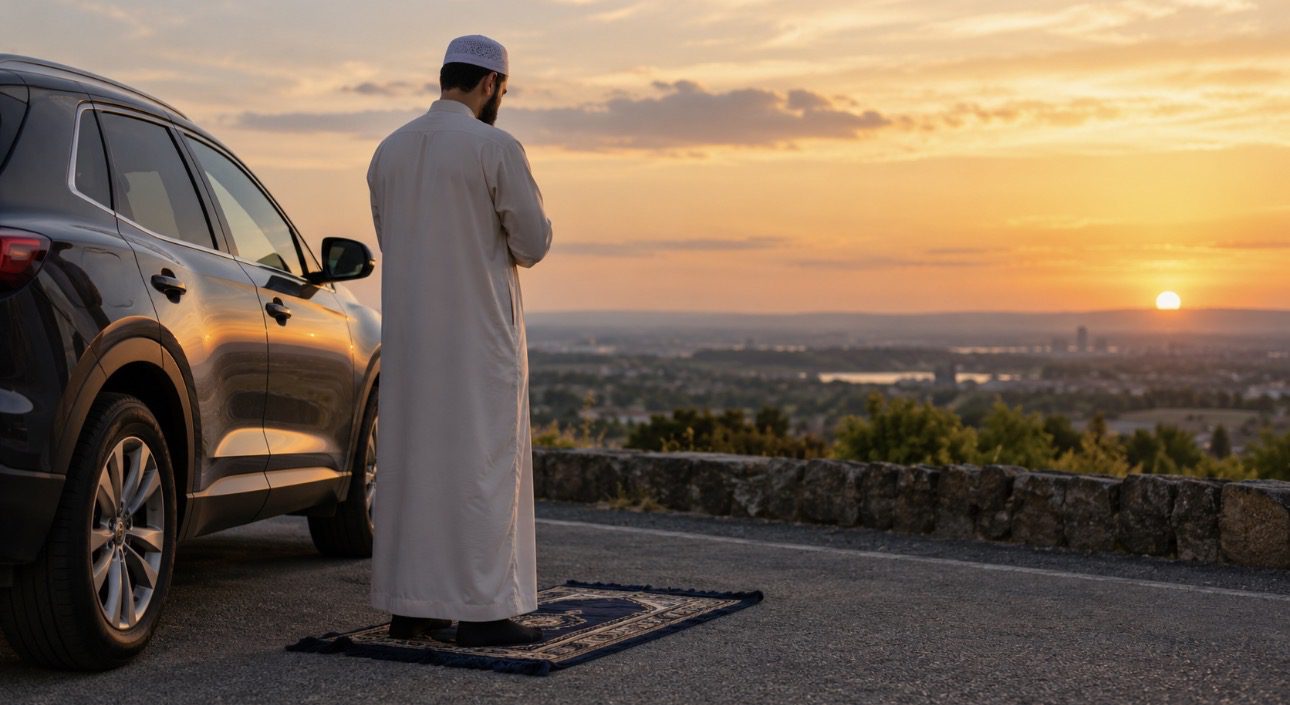
Can you pray in a car?
Can You Pray in a Car?
Is it permissible to pray in a car? What should you do if you are on a long journey and the prayer time is running out? Does it make a difference if you are on a motorway, a train or an aeroplane?
The basic rule is that an obligatory prayer should be performed in the normal way, standing and facing the qiblah, with proper ruku and sujud, if you are able to do so. Sitting in a car is therefore not normally an alternative to getting out and praying properly.
However, Islam also takes genuine difficulty and inability into account. The ruling therefore depends on whether you are able to stop or get off and pray normally before the prayer time ends.
Standing in the obligatory prayer
Standing is an integral part of the obligatory prayer for someone who is able to stand. Allah Almighty says:
حَافِظُوا عَلَى الصَّلَوَاتِ وَالصَّلَاةِ الْوُسْطَىٰ وَقُومُوا لِلَّهِ قَانِتِينَ
“Maintain the prayers, especially the middle prayer, and stand before Allah in devout obedience.”
(Al-Baqarah 2:238)
Imran ibn Husayn (may Allah be pleased with him) narrated that the Prophet ﷺ said:
صَلِّ قَائِمًا، فَإِنْ لَمْ تَسْتَطِعْ فَقَاعِدًا، فَإِنْ لَمْ تَسْتَطِعْ فَعَلَى جَنْبٍ
“Pray standing. If you cannot, then sitting; and if you cannot, then on your side.”
(Bukhari)
The important words here are, “If you cannot.” Sitting for an obligatory prayer is a concession when a person is genuinely unable to stand. It is not merely an alternative because standing or getting out of the car is inconvenient.
The Prophet ﷺ prayed voluntary prayers on his mount
There are authentic narrations that the Prophet ﷺ prayed while travelling on his mount. However, these narrations make an important distinction between voluntary and obligatory prayers.
Jabir ibn Abdullah (may Allah be pleased with him) reported:
كَانَ رَسُولُ اللَّهِ ﷺ يُصَلِّي عَلَى رَاحِلَتِهِ حَيْثُمَا تَوَجَّهَتْ، فَإِذَا أَرَادَ الْفَرِيضَةَ نَزَلَ فَاسْتَقْبَلَ الْقِبْلَةَ
“The Messenger of Allah ﷺ would pray on his mount whichever direction it turned, but when he wanted to pray the obligatory prayer, he would dismount and face the qiblah.”
(Bukhari)
Ibn Umar (may Allah be pleased with him) similarly reported:
كَانَ رَسُولُ اللَّهِ ﷺ يُسَبِّحُ عَلَى الرَّاحِلَةِ قِبَلَ أَيِّ وَجْهٍ تَوَجَّهَ، وَيُوتِرُ عَلَيْهَا، غَيْرَ أَنَّهُ لَا يُصَلِّي عَلَيْهَا الْمَكْتُوبَةَ
“The Messenger of Allah ﷺ would offer voluntary prayer on his mount whichever direction it was facing, and he would pray Witr upon it, but he would not pray the obligatory prayer upon it.”
(Bukhari and Muslim)
Therefore, the fact that the Prophet ﷺ prayed on his mount does not mean that we should routinely pray our obligatory prayers sitting in a car. The concession for voluntary prayer while travelling is broader.
What is the problem with praying in a car?
The problem is not the car itself. The issue is that when someone prays sitting in an ordinary car, they are usually unable to fulfil several requirements of the obligatory prayer properly. They cannot stand, they may not be able to face the qiblah, and they cannot perform normal ruku and sujud.
If they are capable of getting out of the car and performing these properly, they should do so.
Therefore, if you are driving from one city to another and there is somewhere safe where you can stop and pray before the prayer time ends, you should stop and pray. Being a traveller does not by itself permit you to perform the obligatory prayer sitting in your car.
What if you are on the motorway?
Being on a motorway does not automatically mean that you cannot stop to pray. If there is a service station along your route, or you can safely leave the motorway and find a suitable place to pray, you should do so.
You do not need a mosque or a designated prayer room. You only need a clean and safe place where you can perform the prayer.
It is also important to plan ahead. If you know that you are beginning a long journey shortly before a prayer time and that the prayer may expire during the journey, think beforehand about where you will stop. The concession for necessity should not replace basic planning.
There is a difference between inability and inconvenience. Not wanting to stop because it will add time to the journey is not the same as being unable to stop.
However, there can be genuine exceptional circumstances. You may be stuck in severe traffic, there may be nowhere safe to stop, or an emergency may prevent you from leaving the vehicle. If the prayer time is going to expire and you genuinely cannot stop and perform the prayer normally, then you pray according to your ability.
Allah Almighty says:
فَاتَّقُوا اللَّهَ مَا اسْتَطَعْتُمْ
“So be mindful of Allah as much as you are able.”
(Al-Taghabun 64:16)
He also says:
لَا يُكَلِّفُ اللَّهُ نَفْسًا إِلَّا وُسْعَهَا
“Allah does not burden any soul beyond its capacity.”
(Al-Baqarah 2:286)
A person who genuinely cannot perform every requirement of the prayer is not the same as someone who could perform them but chooses not to.
A driver should never attempt to perform the prayer while driving. This would not only compromise the requirements of the prayer but could put the driver, passengers and other road users in danger. They should find somewhere safe to stop.
What about praying on a train?
Travelling by train is slightly different because a passenger has no control over where or when the train stops.
First consider whether you will reach your destination before the prayer time ends. If you will, you can wait until you get off and then pray normally.
If the prayer time will end while you are still on the train, however, you should perform the prayer according to your ability. If there is space to stand, you should stand. If you are able to face the qiblah, you should do so as far as possible. If you can perform the prayer properly, you should perform it properly.
If circumstances genuinely prevent you from fulfilling some of the normal requirements, you perform what you are able to perform. There are differences among the scholars concerning some of the details, including whether a prayer performed without certain essential elements because of these circumstances should subsequently be repeated.
What about praying on an aeroplane?
If you can pray properly before boarding or after landing, while the prayer is still within its time, then this may solve the problem. If the prayer time will pass while you are in the air, combining prayers can also be relevant, but there is a difference of opinion among the schools of fiqh.
The Maliki, Shafi’i and Hanbali schools permit a traveller to combine Zuhr with Asr and Maghrib with Isha, subject to their respective conditions. This may make it possible, for example, to pray before boarding or after landing rather than during the flight.
In the Hanafi school, it is wajib to shorten, but the other schools have different opinions on this. It is permissible to shorten the salah across all schools.
The standard Hanafi position is different. According to the Hanafi school, a traveller does not normally combine two prayers into one prayer time, except at Arafah and Muzdalifah during Hajj. Instead, they may use what is known as jam’ suri, or apparent combining: praying Zuhr towards the very end of its time and Asr at the beginning of its time, and likewise with Maghrib and Isha. Some Hanafi scholars have also allowed scope in cases of genuine need or necessity to follow the position which permits combining, provided its conditions are observed.
Fajr cannot be combined with another prayer according to any of the schools.
So when booking a long flight, it is worth checking the prayer times beforehand. Sometimes the difficulty can be avoided quite easily by planning when to pray before departure, during the journey or after arrival.
However, on a long flight the entire prayer time may pass while you are in the air. In that situation, you should not deliberately allow the prayer to expire merely because you are on an aeroplane.
The principle is not that being on an aeroplane automatically allows you to pray sitting down. Rather, you fulfil whatever requirements of the prayer you are genuinely able to fulfil, and what you are genuinely unable to do is excused.
How to pray seated
If you have to pray while seated on a train or aeroplane because you are unable to perform the prayer normally, then you indicate the ruku and sujud by inclining your upper body forward. You lean forward slightly for ruku and further forward for sujud, so that the movement for sujud is lower than the movement for ruku. You do not need to place anything in front of you and raise it towards your forehead in order to make sujud. The Prophet ﷺ said:
صَلِّ قَائِمًا، فَإِنْ لَمْ تَسْتَطِعْ فَقَاعِدًا، فَإِنْ لَمْ تَسْتَطِعْ فَعَلَى جَنْبٍ
“Pray standing. If you cannot, then sitting; and if you cannot, then on your side.”
(Bukhari)
This is a concession for someone who is genuinely unable to perform the normal movements of the prayer. If you are able to perform ruku and sujud normally, then you should do so.
Voluntary prayers are different
The ruling regarding voluntary prayers while travelling is more flexible. As the hadiths above show, the Prophet ﷺ would perform voluntary prayers while riding his mount, even when it was travelling in a direction other than the qiblah.
This was a concession given for voluntary worship during travel. We should therefore not confuse the ruling of voluntary prayer with the requirements of the five obligatory prayers.
Plan your prayer when you plan your journey
When planning a journey, whether by car, train or aeroplane, it is good practice to think about your prayers at the same time. Check when the prayer times begin and end, consider whether you qualify for the concessions of travel, and think about where you can stop or when you will be able to pray.
Islam is a religion of ease, but ease does not mean abandoning the requirements of worship when we are capable of fulfilling them. At the same time, Allah does not demand from us what is genuinely beyond our ability.
There is a difference between inconvenience and genuine inability, and this distinction is at the heart of the ruling.