

Contentment: tasting the sweetness of faith
Three things that lead to Jannah
Abu Sa‘id al-Khudri (may Allah be pleased with him) narrated that the Messenger of Allah ﷺ said:
«يَا أَبَا سَعِيدٍ، مَنْ رَضِيَ بِاللَّهِ رَبًّا، وَبِالْإِسْلَامِ دِينًا، وَبِمُحَمَّدٍ نَبِيًّا، وَجَبَتْ لَهُ الْجَنَّةُ». فَعَجِبَ لَهَا أَبُو سَعِيدٍ، فَقَالَ: أَعِدْهَا عَلَيَّ يَا رَسُولَ اللَّهِ، فَفَعَلَ.
“O Abu Sa‘id, whoever is pleased with Allah as his Lord, Islam as his religion and Muhammad as his Prophet, Paradise becomes assured for him.”
Abu Sa‘id was amazed by these words and said, “Repeat them to me, O Messenger of Allah.” So he repeated them.
(Sahih Muslim)
In the narration reported by Imam Ahmad, Abu Sa‘id (may Allah be pleased with him) described how the Prophet ﷺ spoke to him:
أَخَذَ رَسُولُ اللَّهِ ﷺ بِيَدِي، فَقَالَ: «يَا أَبَا سَعِيدٍ، ثَلَاثَةٌ مَنْ قَالَهُنَّ دَخَلَ الْجَنَّةَ». قُلْتُ: مَا هُنَّ يَا رَسُولَ اللَّهِ؟ قَالَ: «مَنْ رَضِيَ بِاللَّهِ رَبًّا، وَبِالْإِسْلَامِ دِينًا، وَبِمُحَمَّدٍ رَسُولًا».
“The Messenger of Allah ﷺ took me by the hand and said, ‘O Abu Sa‘id, whoever declares three things will enter Paradise.’ I asked, ‘What are they, O Messenger of Allah?’ He replied, ‘Whoever is pleased with Allah as his Lord, Islam as his religion and Muhammad as his Messenger.’”
(Musnad Ahmad)
In another narration, al-‘Abbas ibn ‘Abd al-Muttalib, the uncle of the Messenger of Allah ﷺ (may Allah be pleased with him), said:
سَمِعْتُ رَسُولَ اللَّهِ ﷺ يَقُولُ: «ذَاقَ طَعْمَ الْإِيمَانِ مَنْ رَضِيَ بِاللَّهِ رَبًّا، وَبِالْإِسْلَامِ دِينًا، وَبِمُحَمَّدٍ رَسُولًا».
“I heard the Messenger of Allah ﷺ say, ‘He has tasted the flavour of faith who is pleased with Allah as his Lord, Islam as his religion and Muhammad as his Messenger.’”
(Sahih Muslim)
The Prophet ﷺ took him by the hand
Look at the way the Messenger of Allah ﷺ addressed Abu Sa‘id. He took him by the hand and called him by name: “O Abu Sa‘id.” He was drawing his attention to what he was about to say. Imagine what Abu Sai’d must have felt when the Prophet ﷺ took his hand, he would have felt his warmth, smelt his fragrance as he heard the jewels that came from his mouth. Of course, simply saying, “Ya Aba Sa‘id,” would have been enough. Abu Sa‘id would have been all ears, ready to respond: “At your service, (labbayka) O Messenger of Allah,” as the Companions used to do.
The Prophet ﷺ then told him about three things: whoever accepts Allah as His Lord and is content that Allah is His Lord, and is pleased with Islam as his religion and Muhammad ﷺ as his Prophet, Jannah would be his. This is why Abu Sa‘id wanted to hear these words again. Was it really these three things? He wanted to be sure that he had not missed anything. Commentators say that given how easy these words are (though harder in practice) to say and harder to practice, this showed how surprised Abu Sa’id was at the huge extent of Allah’s mercy.
Three statements that encompass the religion
Ibn al-Qayyim (may Allah have mercy on him) commented on these two hadiths, the narration of Abu Sa‘id and the narration of al-‘Abbas, and said:
«هَذَانِ الْحَدِيثَانِ عَلَيْهِمَا مَدَارُ مَقَامَاتِ الدِّينِ، وَإِلَيْهِمَا تَنْتَهِي».
“These two hadiths are the foundation around which the spiritual stations of the religion revolve, and to them they ultimately return.”
(Madarij al-Salikin)
What are the spiritual stations, or maqamat? A maqam is “a spiritual progression of a virtue from knowledge to practice, and from practice to becoming firmly embedded in the heart and reflected in one’s conduct.” We begin by understanding a quality, then practice it until it becomes established within us and shapes how we behave.
- Tawbah and Inabah: Repentance and turning wholeheartedly to Allah.
- Mahabbah, Khawf and Rajaʾ: Love, fear and hope in Allah.
- Tawakkul and Istiʿanah: Reliance upon Allah and seeking His help.
- Sabr and Shukr: Patience and gratitude.
- Rida and Taslim: Contentment with Allah’s decree and complete submission to His will.
- Ikhlas and Yaqin: Sincerity and unwavering certainty in faith.
- ʿUbudiyyah and Ihsan: Complete servitude and devotion to Allah, and striving for spiritual excellence through worshipping Him with the awareness of His constant presence.
Love (mahabba) is the foundation and highest of the spiritual stations (maqamat), while contentment (rida) is one of the fruits of love. As our love for Allah grows, so does our trust in Him and our willingness to accept His guidance and decree. Thus, these qualities deepen our ‘ubudiyyah, our servitude and devotion to Allah, and nurture ihsan: excellence in worship and conduct, with an awareness that Allah sees us.
Ibn al-Qayyim discussed these hadiths in the section on the station of rida. Their few words encompass our relationship with Allah, our acceptance of His religion and our following of His Messenger ﷺ.
Ibnul Qayyim also said:
«وَهِيَ سَهْلَةٌ بِالدَّعْوَى وَاللِّسَانِ، وَهِيَ مِنْ أَصْعَبِ الْأُمُورِ عِنْدَ الْحَقِيقَةِ وَالِامْتِحَانِ، وَلَا سِيَّمَا إِذَا جَاءَ مَا يُخَالِفُ هَوَى النَّفْسِ وَمُرَادَهَا».
“They are easy to claim and pronounce with the tongue, but they are among the most difficult matters to fulfil when faced with reality and tests of our true loyalties, especially when something happens which opposes the desires and wishes of the self.”
(Madarij al-Salikin)
This is where we need to look at ourselves. We can say the words, but do we mean them?
Being pleased with Allah as your Lord
What does it mean to be pleased with Allah as your Lord? It means relying upon Him and asking Him for help from the depths of your heart.
Every day, we recite in our salah:
إِيَّاكَ نَعْبُدُ وَإِيَّاكَ نَسْتَعِينُ
“You alone we worship, and You alone we ask for help.”
(Surat al-Fatihah, 1:5)
We ask Allah to help us with anything and everything we do, think about or plan. This is part of being pleased with Allah as our Lord. It is a state of the heart. We are also familiar with saying this as part of our daily dhikr each morning:
رَضِيتُ بِاللَّهِ رَبًّا، وَبِالْإِسْلَامِ دِينًا، وَبِمُحَمَّدٍ ﷺ نَبِيًّا وَرَسُولًا.
“I am pleased with Allah as my Lord, Islam as my religion and Muhammad ﷺ as my Prophet and Messenger.”
Saying these words in our remembrance is one thing, but we are seeking more than the words themselves. We want their meaning to be present in our hearts. We need to mean what we say.
How do ones know whether one truly means it? When the decree of Allah Almighty goes against what the heart desires, that is the real test.
When things do not go as we wish
We may feel hurt by what happens to us. We may find a situation difficult. Yet we can still be content with Allah. The bigger picture and the wisdom of Allah are often beyond our understanding. This is why we need trust and contentment. We cannot see everything, and we do not understand everything. If our response to every difficulty is, “Why me? Why now? Why this? Why that?” where is our contentment?
Instead, when we say, “I am pleased with Allah as my Lord” even in the hardest situations, it is one of the highest stations. Without contentment, we can become constantly troubled, angry and dissatisfied. We do not enjoy this or that. We argue with our spouse, our parents and even ourselves. Being content doesn’t mean suppressing our emotions, it means we put our case to Allah, tell Him what is troubling us and ask for His help. Contentment comes when we rely on Him and entrust our affairs to Him. By contrast, when we are relying on ourselves, trying to carry everything ourselves, we lose contentment.
Trusting Allah’s mercy
Contentment with Allah begins with our love for Allah and our trust in Him. We know that His mercy towards us is greater than the mercy of parents towards their children, as the Messenger of Allah ﷺ taught us. We generally have no doubt about our parents’ love for us. So why do we allow ourselves to doubt Allah’s mercy towards us?
When you trust Allah, you can recognise that there is good in what He decrees, even when you cannot understand it at the time. You may be going through a very difficult trial, but it can make you stronger and better.
Being pleased with Allah as your Lord brings you to this understanding. However, the hadith does not stop there. We must also accept Islam as our religion and Muhammad ﷺ as our Prophet and Messenger.
Being pleased with Muhammad ﷺ as your Messenger
Being pleased with Muhammad ﷺ as our Prophet and Messenger means following him from our hearts. What did the Messenger of Allah ﷺ say? We follow it. What did he instruct us to do? We accept his guidance.
Allah says:
وَمَا آتَاكُمُ الرَّسُولُ فَخُذُوهُ وَمَا نَهَاكُمْ عَنْهُ فَانْتَهُوا
“Whatever the Messenger gives you, take it; and whatever he forbids you, refrain from it.”
(Surat al-Hashr, 59:7)
If the Messenger of Allah ﷺ instructs us to do something, we accept it. If he forbids us from something, we leave it.
Being pleased with Islam as your religion
It is from Allah’s mercy that He has chosen Islam for us. Being pleased with it means accepting the guidance and rulings He has given us. There are things we may want to do which are prohibited. We may be tempted to cross the boundaries. In financial dealings, for example, there may be an investment you cannot enter into because it is haram. You may feel that you are missing out. Nevertheless, respect the limits Allah has set. Accept the rulings He has revealed, even when you have to give something up. These are His rulings. Our acceptance of them is part of our rida.
It is easy to say, “I am pleased with Islam as my religion,” when it does not cost us anything. Its meaning becomes clear when we are asked to leave something we want or fulfil something we find difficult.
This is why the Prophet ﷺ assured Abu Sa‘id that Jannah would be his if he accepted these three fundamental points.
Allah knows what is in our hearts
We may be able to deceive one another in this world, but we cannot deceive Allah Almighty. He knows whether we are truly content or merely saying that we are. Sometimes we find ourselves in a situation where we do not know what to say or do, and we try to bluff our way through it. We cannot do this with Allah. He knows exactly what is in our hearts.
This is why we need to work on the reality behind our words. When we say that we are pleased with Allah, His religion and His Messenger ﷺ, we are affirming something which should affect the way we live.
Moving from bitterness to the sweetness of faith
This brings us to the hadith narrated by al-‘Abbas:
«ذَاقَ طَعْمَ الْإِيمَانِ».
“He has tasted the flavour of faith.”
True faith has a sweetness which is unparalleled. Just as the sweetness of food and drink is tasted by the mouth, the heart can taste the pleasure of imaan.
Hence, the condition of the heart affects its ability to taste. When the heart is sound and free from the diseases of misguided desires and forbidden passions, it can savour the sweetness of imaan. When it becomes spiritually weakened by these diseases, it can lose its sensitivity to that sweetness. It may even begin to find pleasure in the very things that harm it, such as sinful acts and desires which lead it away from Allah. This is why we need to pay attention to what we allow into our hearts and what we nurture within them.
Contentment with Allah, His religion and His Messenger ﷺ helps us experience the sweetness of faith in our daily lives. Without contentment, we become agitated, dissatisfied, and angry – always complaining, always arguing with your spouse, your boss, your own self. If you want to move from bitterness towards sweetness, then nurture rida in your heart.
Where do we find contentment?
Where do we buy this contentment? Can we pick it up from a shop? Of course not. It is something we develop through our connection with Allah Almighty: through salah, dua and dhikr, and through strengthening our relationship with Him.
Contentment comes when you accept that whatever Allah has done is for your benefit, even when you do not understand it, and that even experiencing bitter tests is for our own benefit, and makes us stronger and teaches us important lessons.
As that connection grows, you begin to think differently. Why? Because you know that everything is in Allah’s hands. You do not have to carry every worry as though you are responsible for controlling every outcome.
Of course, we must do our part. Do not misunderstand this. We must do what is required of us and fulfil our responsibilities. But while we are doing so, our hearts can be at peace. We trust Allah. We are pleased with Him as our Lord, Islam as our religion and Muhammad ﷺ as our Prophet and Messenger.
Doing our part with a heart at peace
The Messenger of Allah ﷺ is teaching us how to live and how to face our difficulties with the sweetness of faith rather than allowing bitterness to overwhelm us. We will go through trials in any case. But there is a difference between going through a trial with trust and contentment, and going through it consumed by resentment. The difficulty may be there in both cases, but the state of the heart is different.
He ﷺ has taught us how to travel through this dunya and how to draw closer to Allah, even in the middle of our challenges.
There may be some commands we find difficult to carry out – it may be wearing hijab, or not investing in certain shares because they are haram, and we feel we are missing out, but we are not. Be content with Allah’s rulings.
We have to improve our obedience and follow the instructions Allah and His Messenger ﷺ gave us – because Jannah will be ours. It is not just verbal commitment, but the conviction of the heart that we need. Allah knows who is faking it; He knows the depths of your being better than you. You cannot wing it with Allah!
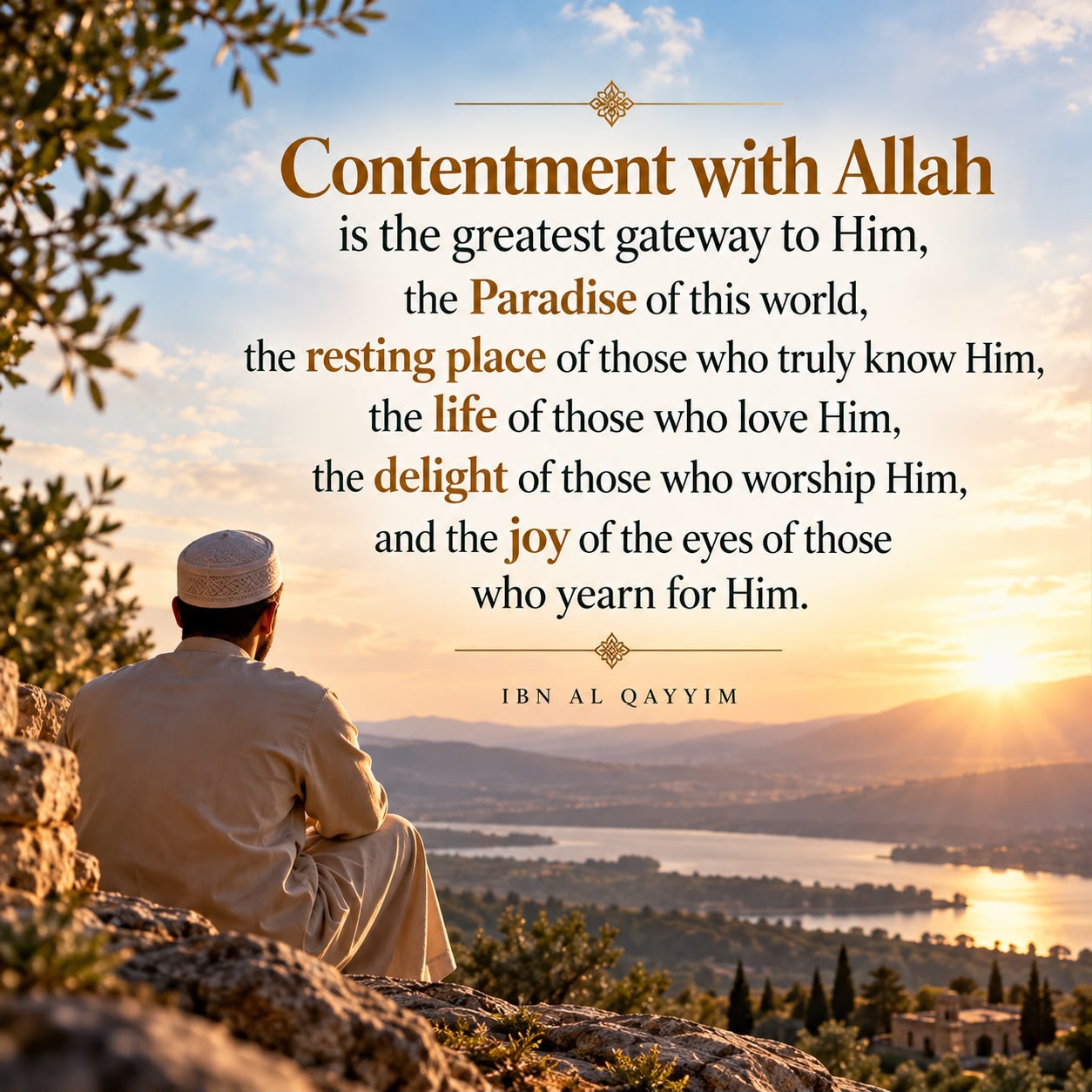
The Paradise of this world
Ibn al-Qayyim beautifully describes this station:
«وَلِذَلِكَ كَانَ الرِّضَا بَابَ اللَّهِ الْأَعْظَمَ، وَجَنَّةَ الدُّنْيَا، وَمُسْتَرَاحَ الْعَارِفِينَ، وَحَيَاةَ الْمُحِبِّينَ، وَنَعِيمَ الْعَابِدِينَ، وَقُرَّةَ عُيُونِ الْمُشْتَاقِينَ».
“For this reason, contentment is the greatest gateway to Allah, the Paradise of this world, the resting place of those who truly know Him, the life of those who love Him, the delight of those who worship Him, and the joy of the eyes of those who yearn for Him.”
(Madarij al-Salikin)
Contentment gives you tranquility. Otherwise life is bitter all the way through. That is why we see so many people who are grouchy, they have lost rida. If you want to change the bitterness to sweetness, then fill your heart with contentment, and rely upon Allah and you will find sweetness in your faith and peace in your heart, while facing the challenges of this life.
O Allah, grant us contentment and make us pleasing to You. We are pleased with You as our Lord, Islam as our religion and our master Muhammad ﷺ as our Prophet and Messenger. Protect us as You protect Your righteous servants. Forgive us, our parents, our spouses, our teachers and those who have rights over us. Grant relief to our brothers and sisters who are suffering, and bring us back to You in a beautiful return. Ameen.
Based on the khutbah of Shaykh Haytham Tamim on 16th October 2026