
Can Islam be lived in the modern world?
One of the questions people ask today is whether Islam is still practical in the modern world. Everything seems to be changing at an incredible pace. Technology is advancing, cultures are shifting, lifestyles are becoming busier, and every day brings a new trend, a new opinion or a new way of thinking. There is a constant pressure to ‘keep up’.
Sometimes people wonder whether religion belongs to another age. But Islam is not a culture frozen in one historical moment. It is divine guidance from Allah ﷻ, revealed for humanity until the end of time.
Allah says:
“Today I have perfected for you your religion, completed My favour upon you and chosen Islam as your religion.”
(Surah al-Ma’idah 5:3)
This verse shows that Islam is complete. It does not need to be replaced by modern ideas, nor is it made irrelevant by new inventions or changing lifestyles. Its principles stand the test of time, because they come from the Creator of time, who knows human nature in every age.
A perfect religion does not become outdated. Human inventions change; technology changes; fashion changes; and politics changes, yet human nature remains the same.
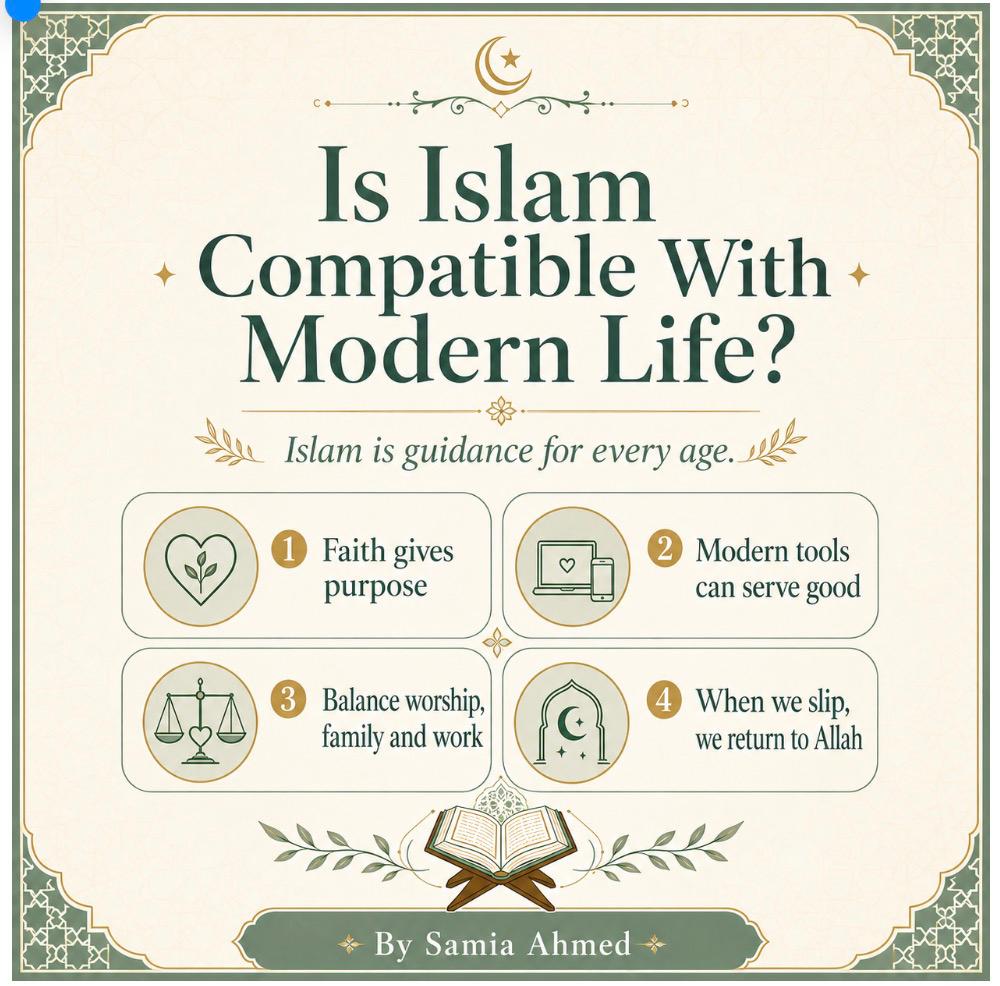
At the same time, Muslims are not required to be detached from the world they live in. We do need to be aware of modern life, understand the times, and participate fully in society. A Muslim can be educated, skilled, creative, professional, and engaged. Islam does not reject worldly life. Rather, it teaches us how to live in the world with purpose, as well as balance, and with accountability.
Technology itself is neither good nor bad. Social media is neither good nor bad. Artificial intelligence, medicine, education and modern communication are all simply tools. Like any tool, they can be used for benefit or for harm. The real question is not whether something is modern, but how we can use the blessings of this world in a way that pleases Allah and benefits others.
Allah says:
“Seek, through what Allah has given you, the Home of the Hereafter, but do not forget your share of this world.”
(Surah al-Qasas 28:77)
Allah does not ask us to abandon worldly life, nor does He encourage us to become consumed by it. We are taught to make use of the blessings He has given us while never losing sight of our ultimate destination.
The Prophet ﷺ reinforced this balance when he said:
“Your Lord has a right over you, your body has a right over you and your family has a right over you, so give everyone who has a right over you their due.”
(Sahih al-Bukhari)
Islam is not about living at one extreme or another. It teaches us to fulfil all our responsibilities with sincerity and excellence. Our work, studies, family life, business, rest and service to others can all become acts of worship when they are carried out with the right intention and within the limits Allah has prescribed.
One of the greatest differences between Islam and modern culture lies in how freedom is understood. Today, freedom is often described as doing whatever feels right and following every desire without restraint. Islam teaches something far deeper. A truly free person is not enslaved by desires, trends or the opinions of other people.
Allah says:
“Have you seen the one who has taken his own desires as his god?”
(Surah al-Jathiyah 45:23)
This verse is as powerful and relevant today as it did when it was first revealed. Every generation has its idols. Sometimes they are statues, but often they are wealth, popularity, status, influence or simply our own desires. Islam frees us from all of these by teaching us that only Allah deserves our complete obedience.
Despite all the advances of modern life, one thing has never changed: the human heart. People today enjoy greater comfort and convenience than previous generations could ever have imagined, yet anxiety, loneliness and depression remain widespread. Technology can make life easier, but it cannot give the heart tranquillity. Wealth can provide comfort, but it cannot provide contentment.
Allah tells us where true peace is found:
“Indeed, it is in the remembrance of Allah that hearts find rest.”
(Surah al-Ra’d 13:28)
The heart was created to know Allah. When it becomes disconnected from Him, no amount of success, entertainment or material comfort can fully replace what is missing.
Islam has never been opposed to knowledge or progress. In fact, the very first revelation began with a command to read:
“Read in the name of your Lord who created.”
(Surah al-‘Alaq 96:1)
The Prophet ﷺ also said:
“Seeking knowledge is an obligation upon every Muslim.”
(Sunan Ibn Majah)
This is why Muslims have contributed throughout history to medicine, mathematics, astronomy, engineering and many other fields. Beneficial knowledge has always been part of our tradition. The challenge has never been whether we should pursue knowledge, but whether we pursue it with humility, wisdom and a strong sense of responsibility before Allah.
Of course, living as a Muslim today is not always easy. We may face pressure to compromise our values, neglect our prayers, blur the boundaries of modesty or hide our Islamic identity simply to fit in. Every generation has been tested in different ways, and ours is no exception.
The Prophet ﷺ prepared us for this reality when he said:
“Islam began as something strange, and it will return to being strange, so glad tidings to the strangers.”
(Sahih Muslim)
Remaining steadfast when those around us are moving in another direction is not a weakness. It is often a sign of sincerity and commitment to Allah, despite all the pressure.
At the same time, Islam never expects perfection. Every one of us makes mistakes and falls short. What distinguishes a believer is not that they never sin, but that they never stop returning to Allah.
Allah says:
“Say, ‘O My servants who have transgressed against themselves, do not despair of the mercy of Allah. Indeed, Allah forgives all sins. He is the Most Forgiving, the Most Merciful.'”
(Surah al-Zumar 39:53)
This is one of the most hopeful verses in the Qur’an. The believer lives with hope as well as effort, knowing that the door of repentance remains open for as long as life remains.
Islam is compatible with modern life because it is guidance for life itself. It gives principles that can be applied in every generation – justice, mercy, honesty, modesty, family responsibility, care for the poor, respect for parents, protection of the vulnerable, and accountability before Allah.
The real question is not whether Islam fits into modern life. The deeper question is whether modern life, with all its speed and noise, can offer the soul what Islam offers: purpose, peace, direction, and connection with the One who created us.
Islam is what makes life meaningful.