

How well do you know yourself? Critical thinking and introspection vs deflecting blame
How well do you really know yourself?
You have lived with yourself for as long as you remember.
You have memories, hopes and fears, and worries. You have moments of joy and moments of despair. You know all these very well. You see yourself in the mirror everyday.
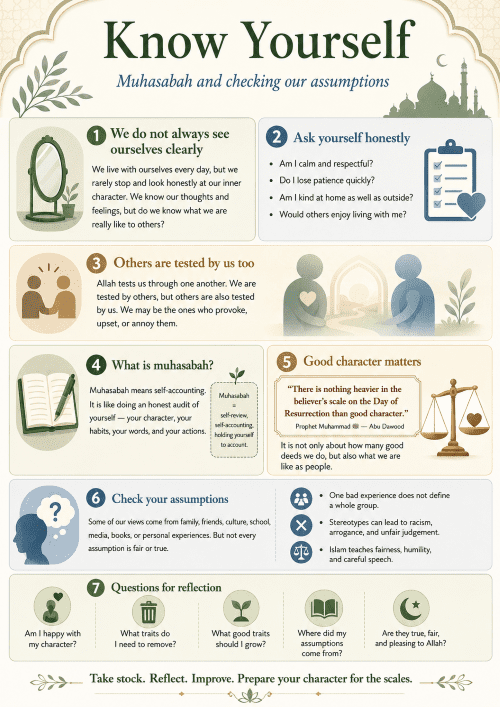
However, the time we spend looking at ourselves in the mirror is actually very little compared to how much time we spend looking at others around us. Apart from a few glances, while we brush our hair or after we have put on our clothes, the rest of the time, we do not see ourselves.
That is our external self. When it comes to our internal self, we do not even have a mirror! We are so busy being ourselves, that we do not often step out of ourselves and see us for what we truly are.
While we live inside our shells, thoughts endlessly whirling like a kitchen blender, trying to remember what we need to do, random thoughts flying into our mind, we are simply experiencing the ups and downs of a typical day: responding to the challenges, going through the motions, the mundane, the daily grind. We are, rather like Hobbits, creatures of habit – repeating the same patterns, responding to the same triggers.
Imagine for a moment, that you are not you, but someone else who has to come and live with you. Would you want to be around yourself?
Do you know what it is like for others to live with you?
Perhaps you are one of those lovely people who manage to stay calm, and are unfailingly polite and respectful to everyone, even under pressure, that you are consistent in your personality.
Or maybe you have mood swings, get impatient, lose your temper or sulk?
Maybe you are nice outside, but irritable at home?
The reality is that we are all human. We all have shortcomings. And so do others.
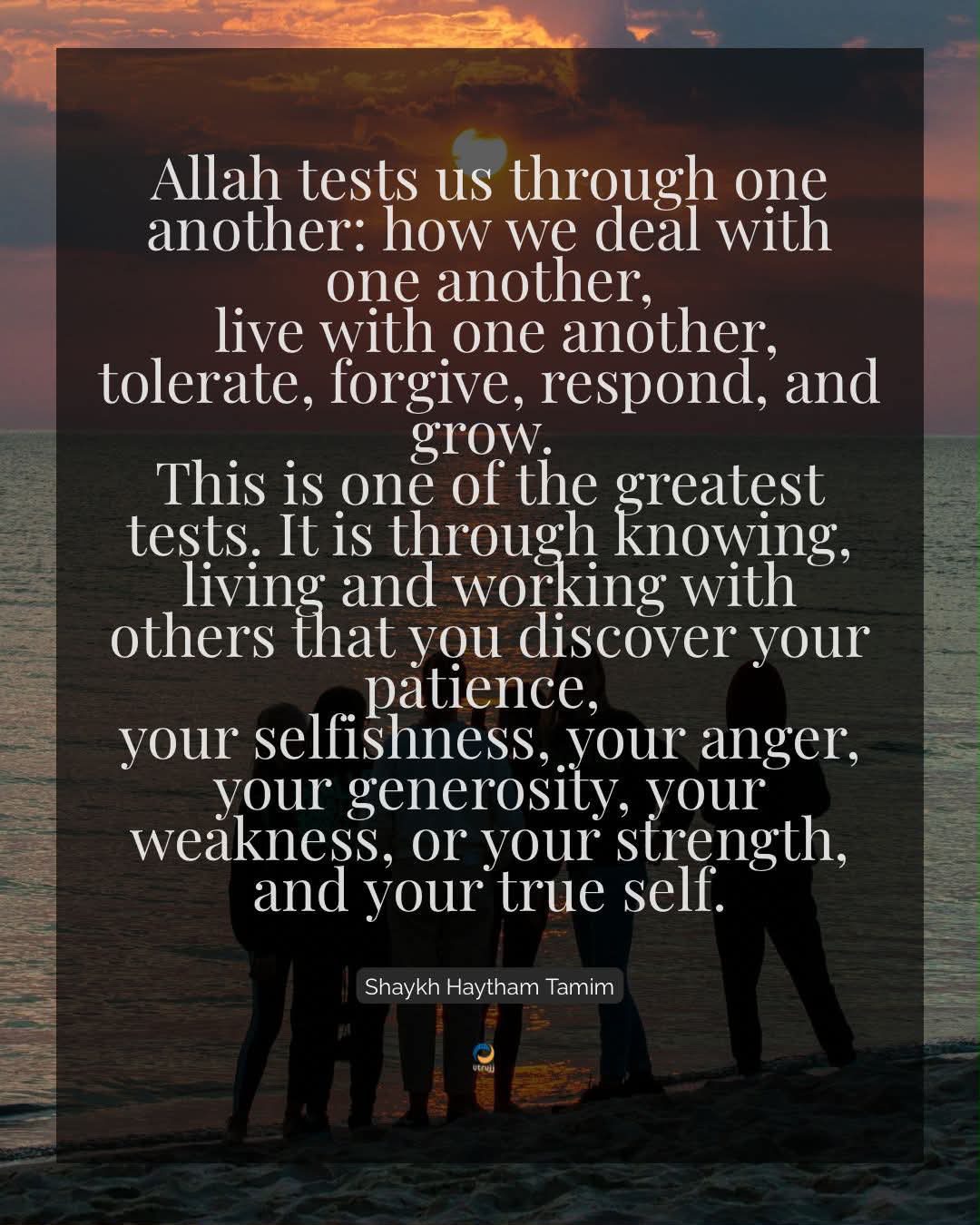
Allah tests us through one another. How we deal with each other, live with one another, tolerate one another, forgive, respond and grow together.
But if we flip that, others are being tested by us. Just as much as they are testing us, we are testing their patience. We are the ones provoking them, annoying them, and perhaps boring them.
Muhasabah
In Islam, we have the concept of muhasaba. It comes from the root: ح س ب
This root carries meanings of counting, calculating, reckoning, accounting and considering.
From the same root, we get:
حِسَاب account, reckoning, calculation
يَوْمُ الْحِسَاب the Day of Reckoning
حَسِيب one who takes account / one who is sufficient
حَاسَبَ to call someone to account
مُحَاسَبَة the act of accounting, reviewing or holding to account
So linguistically, muhasaba is like doing an audit of yourself.
On the day of judgment, we will not just have our deeds weighed, but our character. Indeed, the heaviest thing on the scales will be good character.
Abu al-Darda’ narrated that the Prophet ﷺ said:
مَا مِنْ شَىْءٍ أَثْقَلُ فِي الْمِيزَانِ مِنْ حُسْنِ الْخُلُقِ
“There is nothing heavier in the believer’s scale on the Day of Resurrection than good character.” (Abu Dawood)
When sacred times approach, like Dhul Hijjah, we try to maximise the rewards – we might fast, do extra salah, increase istighfar and tasbih, but do we reflect on ourselves?
It is not just about how many good deeds we have done, but what we are like as a person that also counts. So it is important to know ourselves. What we are really like?
Therefore, the first point is we need to stop and take stock. Are we happy with who we are? Proud to be us? And ready for our characters to be weighed on the scales?
Or are there things we need to work on? Traits that we would like to delete? Traits that we want to increase?
Assumptions
The next question is how often do we stop to examine our assumptions?
In Europe, with the rise of the far right, many people now assume dangerously that immigrants are the cause of all their problems, that if the immigrants were removed, everything would magically be fixed.
In the cosmopolitan society of Dubai, with 200 nationalities living on a tiny speck of the globe, I was shocked by some casual racism I witnessed on a WhatsApp chat for the residents of an apartment block. One member thought it was ok to make a derogatory remark about Africans. It was not just shocking that someone thought this, but that they felt zero shame uttering it.
From where had this member derived her assumption? And for that matter, from where have we derived our views?
Some are inherited from our environment, some from our parents, some from friends, some from school, some from the media and some from the books we read or from what we concluded from our experiences and interactions.
The lady who made the lazy and offensive comment, when challenged, retorted that her African maid had broken her child’s tooth. Thus, after one bad encounter, she passed judgement on 1.5 billion people.
It is plain for us to see that broad stereotypes are not helpful. But sadly, we might fall into the same trap ourselves. It is not just easy to make ill-judged statements like this, but also easy to look down on others.
Looking down on people
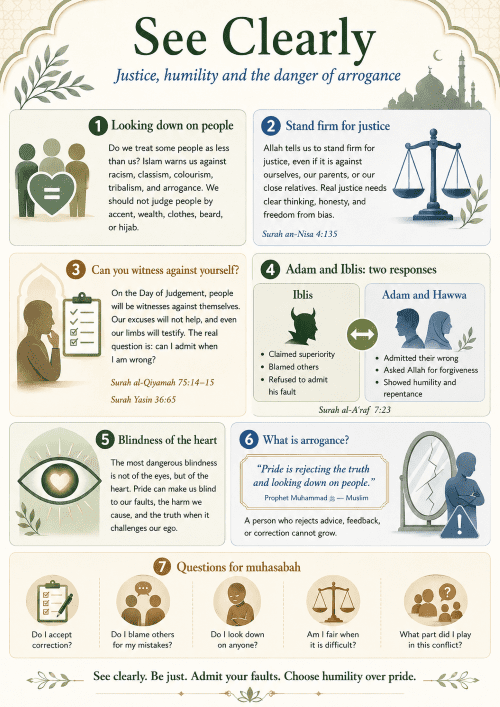
The third question is do we to think of some people as less than us? Do we belittle them, despise them, undervalue them, or treat them as beneath us?
We have so many isms – racism, classism, colourism, tribalism. We have arrogance about knowledge, wealth, beauty, family background, education, religious practice, or social status.
We regularly make assumptions about people based on their accent, their car, their handbag, their beard or hijab. This is something we need to be watchful of.
Deliver justice
One of the ayahs that delivers a particularly important and challenging concept is in Surat Nisa, Allah says:
O believers! Stand firm for justice as witnesses for Allah even if it is against yourselves, your parents, or close relatives. Be they rich or poor, Allah is best to ensure their interests. So do not let your desires cause you to deviate ˹from justice˺. If you distort the testimony or refuse to give it, then ˹know that˺ Allah is certainly All-Aware of what you do. (Surah Nisa 4:135)
In order to be just, we first need to be able to see clearly, to be able to evaluate things as they actually are. You cannot be just if you are prejudging people or situations or even yourself. You cannot be just if you are already biased.
What if people are not as we assume they are? What if our assumptions are incorrect and simply inherited second-hand? What if people on the chat accepted the comment that all Africans are bad?
It is dangerous to delegate our thinking to someone else. We have to see for ourselves, without fogged lenses. We have to think critically and check why we believe what we believe to be true.
Coming back to the ayah from Surat Nisa, it is hard enough to be a witness against your family – imagine having to give evidence against your own father? Or even taking someone else’s side against your mother; or siding with a family that your family dislikes against your own family, if your family member has wronged them.
And then imagine taking someone else’s side against your own self!
What if the other person is right, and you are in the wrong?
Could you bear witness against your own self?
On the day of judgement, it is not us who decides whether we passed or failed. It is not us who will decide what mark we got.
On the day of judgement, sinners will give evidence against their own selves. In Surat al-Qiyamah, Allah says:
“Rather, man is a witness against himself, even if he presents his excuses.”
(75:14–15)
In Surat Yasin, Allah tells us that limbs will testify when mouths try to lie.
“Today We shall seal their mouths, and their hands will speak to Us, and their feet will testify about what they used to earn.” (36:65)
Allah says in Surat al-Hashr:
“O believers, fear Allah, and let every soul look to what it has sent forth for tomorrow.”
(59:18)
In this life, we have excuses ready when we are criticised. We may think “That is just how I am”, “I did not mean it”, “They are too sensitive”, “I was tired”, or “They just don’t get me”.
However, the Qur’an makes a huge distinction between those who accept mistakes and those who shift the blame and present excuses.
The first one to present an excuse was Iblis, when he said, “It’s not my fault.” And went on to blame Allah for his disobedience.
After refusing to obey Allah, he says:
قَالَ فَبِمَا أَغْوَيْتَنِي لَأَقْعُدَنَّ لَهُمْ صِرَاطَكَ الْمُسْتَقِيمَ
“He said, ‘Because You have caused me to go astray, I will surely sit in wait for them on Your straight path.’” (Surat al-A‘raf 7:16)
And similarly:
قَالَ رَبِّ بِمَا أَغْوَيْتَنِي لَأُزَيِّنَنَّ لَهُمْ فِي الْأَرْضِ وَلَأُغْوِيَنَّهُمْ أَجْمَعِينَ
“He said, ‘My Lord, because You have caused me to go astray, I will surely beautify evil for them on earth, and I will surely mislead them all.’” (Surat al-Hijr 15:39)
So instead of admitting his mistake, he digs his own grave. Instead of saying, “I’m sorry I disobeyed,” or recognising that he was arrogant, he gets angry and super-swiftly deflects the blame.
The three responses of Iblis
Iblis responds in a very telling way. First, he claims superiority, saying:
أَنَا خَيْرٌ مِّنْهُ
“I am better than him.” (Surat al-A‘raf 7:12)
Second, he refuses to take responsibility. He justifies his bad behaviour.
Thirdly, he does not look inwards. That is too painful. Recognising our shortcomings is not a comfortable place to be.
Adam, by contrast, not only feels bad about what he has done, when he makes a mistake, but he accepts responsibility and shows more wisdom than Iblis, because he realises straight away that there are consequences for what has happened. He says:
“If you do not forgive us, we are the losers.” (7:23)
He realises that things will end badly unless he apologises.
The contrast between them is powerful.
Allah quotes Adam and Hawwa in Surat Araf:
قَالَا رَبَّنَا ظَلَمْنَا أَنفُسَنَا وَإِن
لَّمْ تَغْفِرْ لَنَا وَتَرْحَمْنَا لَنَكُونَنَّ مِنَ الْخَاسِرِينَ
“They said, ‘Our Lord, we have wronged ourselves. If You do not forgive us and have mercy on us, we will surely be among the losers.’” (Surat al-A‘raf 7:23)
That is the difference between repentance and arrogance.
So the question for us is: can we recognise when we make a mistake? Or do we choose blindness because it feels less painful?
Blindness
Blindness is a key feature of arrogance.
If we look at blindness in the Quran it appears many times. Allah highlights the fact that many people have eyes, but cannot truly see.
In Surat al-A‘raf, Allah says:
لَهُمْ قُلُوبٌ لَّا يَفْقَهُونَ بِهَا وَلَهُمْ أَعْيُنٌ لَّا يُبْصِرُونَ بِهَا وَلَهُمْ آذَانٌ لَّا يَسْمَعُونَ بِهَا ۚ أُولَـٰئِكَ كَالْأَنْعَامِ بَلْ هُمْ أَضَلُّ
“They have hearts with which they do not understand, eyes with which they do not see, and ears with which they do not hear. They are like cattle; rather, they are even more astray.” (7:179)
Disbelief is described as blindness and deafness.
In Surat Hud, Allah says:
مَثَلُ الْفَرِيقَيْنِ كَالْأَعْمَىٰ وَالْأَصَمِّ وَالْبَصِيرِ وَالسَّمِيعِ ۚ هَلْ يَسْتَوِيَانِ مَثَلًا ۚ أَفَلَا تَذَكَّرُونَ
“The example of the two groups is like the blind and deaf compared to the seeing and hearing. Are they equal in comparison? Will you not then take heed?” (11:24)
Desire can lead to blindness in judgement.
In Surat al-Jathiyah, Allah says:
أَفَرَأَيْتَ مَنِ اتَّخَذَ إِلَـٰهَهُ هَوَاهُ وَأَضَلَّهُ اللَّهُ عَلَىٰ عِلْمٍ وَخَتَمَ عَلَىٰ سَمْعِهِ وَقَلْبِهِ وَجَعَلَ عَلَىٰ بَصَرِهِ غِشَاوَةً
“Have you seen the one who takes his desire as his god, and Allah lets him go astray despite knowledge, and seals his hearing and his heart, and places a covering over his sight?” (45:23)
Disbelief places a covering over sight.
In Surat al-Baqarah, Allah says:
خَتَمَ اللَّهُ عَلَىٰ قُلُوبِهِمْ وَعَلَىٰ سَمْعِهِمْ ۖ وَعَلَىٰ أَبْصَارِهِمْ غِشَاوَةٌ
“Allah has sealed their hearts and their hearing, and over their sight is a covering.”
A person who rejects the truth has sealed their heart and blocked their hearing.
The Qur’an repeatedly teaches that the most dangerous blindness is not the blindness of the eyes, but the blindness of the heart. A person may see the world clearly, manage their affairs intelligently, and even appear successful, yet be blind to their own arrogance, blind to the harm they cause, blind to the signs of Allah, blind to their excuses, and blind to the truth when it challenges their ego.
This is why self-scrutiny is so important. We are not only asking Allah to improve our behaviour; we are asking Him to restore our vision.
Those who believe they are better than others, choose to close their eyes to qualities that make others better than them. Instead of learning from others how to improve themselves, instead of thinking “I wish I could be as kind or generous or calm as them”, they think they are already the gold standard. There is no room for improvement.
This is one of the deepest lessons in self-development: the moment you are confronted with your fault, do you turn inward with humility, or outward with blame?
As the Prophet ﷺ said:
الْكِبْرُ بَطَرُ الْحَقِّ وَغَمْطُ النَّاسِ
“Pride is rejecting the truth and looking down on people.” (Muslim)
Arrogance is two things – rejecting the truth and looking down on others.
The arrogant reject, dismiss, deny, or push away the truth when it comes. A proud person may reject the feedback, thinking:
“I cannot admit that.”
“How dare they correct me?”
“They are younger than me.”
“They are less knowledgeable than me.”
“They are not from my background.”
“I already know.”
“I cannot lose face.”
So instead of accepting the truth, they defend their ego. We might also do this when someone corrects us, advises us, challenges us, or shows us that we are wrong.
A person who cannot accept truth about themselves cannot grow. They may ask Allah for guidance, but when guidance comes through advice, criticism, feedback, or a difficult realisation, they reject it because it wounds their pride.
Arrogance is not only an inner feeling – it also manifests in how we treat people.
So often people complain that others behaved badly with them, they portray others as the ones who were mean, or rude, or hostile, and who were the cause of the problem. But do they check what part they played in it? Do they check how their tone was, what they said, what buttons they pushed in that moment?
It is a truth we do not acknowledge – we are very quick to notice how others hurt us, but slow to notice how we hurt others.
ٱلَّذِينَ يَجْتَنِبُونَ كَبَـٰٓئِرَ ٱلْإِثْمِ وَٱلْفَوَاحِشَ إِلَّا ٱللَّمَمَ ۚ إِنَّ رَبَّكَ وَٰسِعُ ٱلْمَغْفِرَةِ ۚ هُوَ أَعْلَمُ بِكُمْ إِذْ أَنشَأَكُم مِّنَ ٱلْأَرْضِ وَإِذْ أَنتُمْ أَجِنَّةٌ فِي بُطُونِ أُمَّهَـٰتِكُمْ ۖ فَلَا تُزَكُّوٓا أَنفُسَكُمْ ۖ هُوَ أَعْلَمُ بِمَنِ ٱتَّقَىٰ
“Those who avoid major sins and shameful deeds, except minor slips — indeed your Lord is vast in forgiveness. He knows you best from when He created you from the earth and when you were foetuses in the wombs of your mothers. So do not claim purity for yourselves. He knows best who is truly mindful of Him.” (Surat al-Najm 53:32)
Allah is saying: He knows us better than we know ourselves. He knew us before we were born, when we were hidden in our mother’s womb. He knows our inner motives, our weaknesses, our private sins, our hidden sincerity, our hidden pride, and the real state of our heart.
Sometimes people see a flaw in us in that we cannot see. Just as so often, we see the flaws in them that they do not see.
Why do people lack insight into themselves?
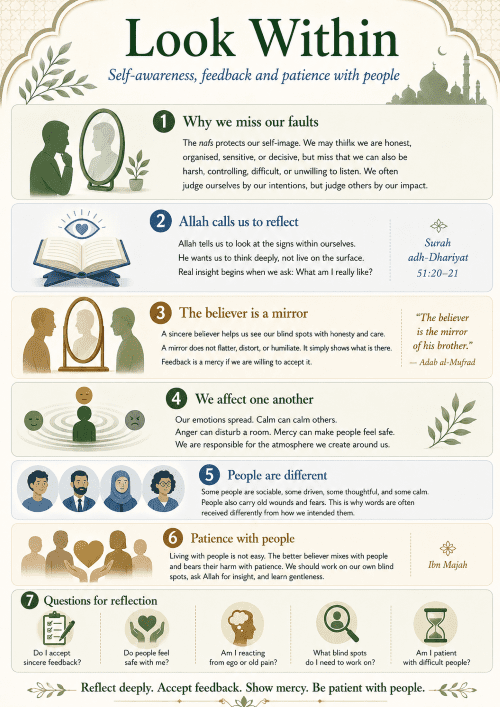
One of the reasons people fail to accept their shortcomings is because the nafs protects its self-image.
A person may know they are “honest”, but not realise they are harsh. They may think they are “organised”, but not realise they are controlling. They may think they are “sensitive”, but not realise they make everyone walk on eggshells. They may think they are “decisive”, but not realise they never listen.
There are a few reasons people miss this:
They judge themselves by their intentions, but judge others by their impact.
Sometimes people are religious outwardly, but not reflective inwardly. They may pray, fast, attend talks and quote knowledge, but still not ask:
How often do I complain? How often do I criticise others? How often do I credit someone for what they did or thank them? Do people feel comfortable in my presence or am I harsh?
Allah tells us repeatedly in the Quran to reflect. He also tells us there are signs within us, so He is directing us to reflect upon our own selves.
He mentions that He created us with other people around us so that we could know ourselves.
He also created us with metacognition – which means we have the ability to think about how we think.
In Surat adh-Dhariyat, Allah says:
وَفِي ٱلۡأَرۡضِ ءَايَٰتٞ لِّلۡمُوقِنِينَ
وَفِيٓ أَنفُسِكُمۡۚ أَفَلَا تُبۡصِرُونَ
“And on the earth are signs for those who have certainty, and within yourselves. Do you not see?” (51:20–21)
Allah talks about ulu’l-al baab, the people whose thinking is not shallow. أَلْبَاب is the plural of
لُبّ , which can be roughly translated as “inner core” or “inner depth” , i.e. ulu’l-al baab are those who aren’t just empty shells.
They are people of deep understanding, people of sound intellect, people of inner insight.
All people begin from the same point of origin, a drop of fluid. But some develop the ability to think critically while others follow Iblis’s blueprint and turn against Allah.
In Surat Yasin, Allah says:
أَوَلَمْ يَرَ الْإِنسَانُ أَنَّا خَلَقْنَاهُ مِن نُّطْفَةٍ فَإِذَا هُوَ خَصِيمٌ مُّبِينٌ
“Does man not see that We created him from a drop, then suddenly he becomes a clear opponent?”( 36:77)
Dealing with people
As we question ourselves, and our assumptions, we also need to be savvy about how we perceive others. Allah created us as nations and tribes precisely so we could know each other.
In Surat al-Hujurat, He says:
يَآ أَيُّهَا النَّاسُ إِنَّا خَلَقْنَاكُم مِّن ذَكَرٍ وَأُنثَىٰ وَجَعَلْنَاكُمْ شُعُوبًا وَقَبَآئِلَ لِتَعَارَفُوا ۚ إِنَّ أَكْرَمَكُمْ عِندَ اللَّهِ أَتْقَاكُمْ ۚ إِنَّ اللَّهَ عَلِيمٌ خَبِيرٌ
“O mankind, We created you from a male and a female, and made you into peoples and tribes so that you may know one another. Surely the most noble of you in the sight of Allah is the most mindful of Him. Surely Allah is All-Knowing, All-Aware.” (49:13)
The believer is a mirror
As we cannot always see ourselves impartially, we need trusted friends and advisors to tell us. The Prophet ﷺ said:
الْمُؤْمِنُ مِرْآةُ أَخِيهِ، إِذَا رَأَى فِيهَا عَيْبًا أَصْلَحَهُ
“The believer is the mirror of his brother. When he sees a fault in it, he should correct it.” (Adab al Mufrad)
A mirror does not distort, flatter, exaggerate or humiliate. It simply reflects what is there. In the same way, a sincere believer helps another believer see what they may not be able to see in themselves. Sometimes we do not notice our tone, our defensiveness, our arrogance, our harshness, our need for control, or the way we make others feel. A true friend, spouse, teacher or sibling can become a mercy by reflecting that back to us with honesty and care. But the mirror only helps if we are willing to look into it. If every piece of feedback feels like an attack, then we lose one of the ways Allah may be showing us our faults.
Emotional contagion
Modern psychology gives us another layer to this. Human beings are deeply affected by one another. Research on emotional contagion shows that emotions can spread between people through facial expression, posture, tone, atmosphere and social closeness; one recent review describes emotional contagion as the way our emotions are unconsciously influenced by the emotions of those around us. (Frontiers) Mirror neurones are also often discussed as a possible neural basis for this: UCLA Health explains that these are nerve cells that fire both when a person performs an action and when they see another person perform that action, helping us read and resonate with the emotional cues of others. (UCLA Health)
So when Islam tells us that the believer is a mirror to the believer, this is not only about giving advice. It is also about the way we affect each other. Our calm can calm others. Our anxiety can unsettle others. Our anger can infect a room. Our sincerity can awaken sincerity. Our arrogance can provoke defensiveness. Our mercy can make people feel safe enough to grow. This is why self-scrutiny matters: I am not only responsible for what I privately feel, but also for the atmosphere I create around me.
Transference
In psychology, transference refers to the way a person may unconsciously transfer feelings, expectations or fears from earlier relationships onto someone in the present. For example, someone who felt constantly criticised in childhood may experience ordinary feedback as rejection, humiliation or attack. This is why self-knowledge is so important. Sometimes the person in front of us is not only responding to what we said; they are responding through old wounds, old fears and old patterns. And sometimes we are doing the same. Muhasabah therefore means asking: am I seeing this person clearly, or am I reacting through something unresolved inside me?
The believer is a mirror, but a mirror requires humility. If we only want people who praise us, we will never see ourselves clearly. And if we only reflect people’s faults harshly, we are no longer a mirror; we become a weapon. The prophetic way is honesty combined with mercy.
The four humours
The Ancient Greeks classified people according to the four humours. The idea was that the body contained four main fluids, which determined a person’s physical and emotional temperament. The four were blood, yellow bile, black bile and phlegm.
Blood – Sanguine temperament
A sanguine person is usually sociable, lively, optimistic, enthusiastic and pleasure-loving. They tend to enjoy people, conversation, activity and variety. Their strength is warmth and energy, but when imbalanced they may become impulsive, distracted or overly concerned with enjoyment.
Yellow bile – Choleric temperament
A choleric person is usually driven, forceful, ambitious, direct and quick to act. They may be natural leaders who want results and progress. Their strength is decisiveness and courage, but when imbalanced they may become impatient, controlling, angry or domineering.
Black bile – Melancholic temperament
A melancholic person is usually serious, thoughtful, analytical, sensitive and reflective. They may notice details and think deeply about life. Their strength is depth, care and careful judgement, but when imbalanced they may become anxious, overly critical, pessimistic or withdrawn.
Phlegm – Phlegmatic temperament
A phlegmatic person is usually calm, steady, peaceful, patient and easy-going. They may be good at keeping harmony and avoiding unnecessary conflict. Their strength is stability and gentleness, but when imbalanced they may become passive, avoidant, unmotivated or resistant to change.
It is not modern science, but it is historically interesting because it shows that people long ago noticed that human beings have different temperaments: some are fiery, some calm, some emotional, some analytical.
Even before modern psychology, people recognised that we do not all react to the world in the same way. Some people are naturally forceful, some reflective, some sociable, and some steady.
Although these differences in personalities make us rub each other up the wrong way, they also make the world liveable because if the world was full of only one type we would not get anywhere. We would have even more problems if everyone was driven or if everyone was laid back.
Every day we mix with people with differing abilities, attitudes and temperaments. Not only this, but whatever we say is not received as we intend it, it is received by others after they filter it through their biases, preconceived ideas and frames of reference. This creates ample scope for miscommunication and misunderstanding.
So it’s not easy to get on with everyone. It requires patience, and forbearance. That is why the Prophet ﷺ said the one who mixes with others and tolerates their harm is better than the one who isolates himself.
الْمُؤْمِنُ الَّذِي يُخَالِطُ النَّاسَ وَيَصْبِرُ عَلَى أَذَاهُمْ أَعْظَمُ أَجْرًا مِنَ الْمُؤْمِنِ الَّذِي لَا يُخَالِطُ النَّاسَ وَلَا يَصْبِرُ عَلَى أَذَاهُمْ
Ibn Umar (may Allah be pleased with him) reported that the Messenger of Allah ﷺ said:
“The believer who mixes with people and bears the harm they cause with patience will have a greater reward than the believer who does not mix with people and does not put up with their harm.” (ibn Majah)
If we notice the difference between those we like and those we don’t, usually we like people who are easy going – they are quick to forgive, and do not complain endlessly. They get on with things.
We like people who are mild mannered. When they speak they are soft spoken. They are kind. They consider other people’s feelings. They are generous. They are slow to get angry and quick to cool down. These were the characteristics of the Prophet ﷺ
However, in life we can encounter many people who are not like that. We have to tolerate prickly personalities, but before that we have to work on own ourselves, we need to ask Allah for the insight into ourselves, and figure out our own blindspots! We need insight into our own selves.
Related posts
Character audit – check yourself against the prophetic template
What qualities made the Prophet ﷺ so special?
Lessons from the Seerah – our roadmap for success