
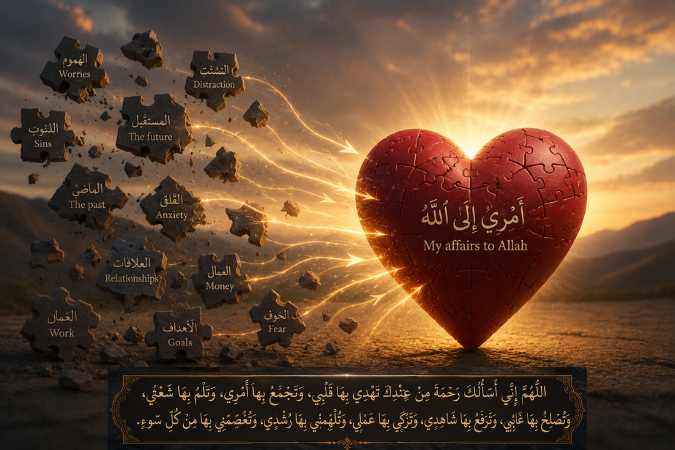
Gathering our scattered affairs back together
A mercy from Allah that gathers the heart
The Prophet ﷺ is our greatest example in how to worship Allah, how to draw close to Him, and how to ask from Him.
Ibn Abbas (may Allah be pleased with him and his father) once stayed overnight in the house of his aunt Maymunah (may Allah be pleased with her), the wife of the Prophet ﷺ. His father, al-Abbas, wanted him to observe how the Prophet ﷺ prayed at night, because the prayer of the Prophet ﷺ in the mosque was known, but his private night prayer was something they wished to learn from.
Maymunah (may Allah be pleased with her) was the last woman the Prophet ﷺ married, in the seventh year after Hijrah. Her original name was Barrah, but the Prophet ﷺ changed it to Maymunah. The scholars mention that the Prophet ﷺ disliked names that carried meanings of self-praise or self-purification. Allah Almighty says:
فَلَا تُزَكُّوا أَنفُسَكُمْ ۖ هُوَ أَعْلَمُ بِمَنِ اتَّقَىٰ
“So do not claim yourselves to be pure; He knows best who has taqwa.” (Surat an-Najm 53:32)
The Prophet ﷺ changed a number of names of people and places for better meanings and more beautiful associations. Even Madinah was previously known as Yathrib, and the Prophet ﷺ disliked that name. Imam as-Suyuti (may Allah have mercy on him) compiled a beautiful work discussing the names that were changed by the Prophet ﷺ.
The service that evoked the dua of Prophet ﷺ
عن ابن عباس رضي الله عنهما قال: بت عند خالتي ميمونة، فقام النبي صلى الله عليه وسلم يصلي من الليل، فقمت عن يساره، فأخذني من خلف ظهره فجعلني عن يمينه.
Ibn Abbas (may Allah be pleased with him and his father) said:
“I spent the night at the house of my aunt Maymunah. The Prophet ﷺ stood to pray during the night, and I stood on his left. He took hold of me from behind and placed me on his right.” (Bukhari and Muslim)
In some narrations, Ibn Abbas (may Allah be pleased with him) explains that he remained awake watching carefully how the Prophet ﷺ worshipped Allah during the night. He did not want the Prophet ﷺ to realise that he had been observing him closely, so when the Prophet ﷺ stood up, Ibn Abbas stretched and acted as though he had only just awoken.
This shows the eagerness of Ibn Abbas (may Allah be pleased with him and his father) to learn. He was young, but he was alert. He wanted to see how the Prophet ﷺ worshipped Allah when no one else could see him. He was not content with general knowledge. He wanted to learn the details that bring a person closer to Allah.
The Prophet ﷺ stood, relieved himself, and performed wudu. Ibn Abbas (may Allah be pleased with him) had quietly prepared water for him. When the Prophet ﷺ asked who had placed it there, he was told that it was Ibn Abbas (may Allah be pleased with him). So the Prophet ﷺ made dua for him:
اللهم فقهه في الدين.
“O Allah, grant him understanding of the religion.” (Bukhari)
The reward of sincerity
In another wording,, the Prophet ﷺ said:
اللَّهُمَّ فَقِّهْهُ فِي الدِّينِ وَعَلِّمْهُ التَّأْوِيلَ.
“O Allah, grant him understanding of the religion and teach him the interpretation.” (Ahmad)
A small act of sincere service opened a great door for him. He did not serve the Prophet ﷺ for status or recognition. He did it with sincerity, and Allah blessed him through the dua of the Prophet ﷺ until he became known as the scholar of the Ummah and the interpreter of the Qur’an.
Service done sincerely for Allah is never wasted. Serving one’s parents, serving the righteous, serving people of knowledge, and serving for the sake of Allah are all deeds beloved to Allah.
The men trapped in the cave
This is also seen in the famous hadith of the three men trapped in the cave. One of them mentioned his devotion and service to his elderly parents as his righteous deed. Because of that sincerity, Allah answered their dua and relieved them from their hardship.
The Prophet ﷺ said:
انطلق ثلاثة نفر ممن كان قبلكم حتى آواهم المبيت إلى غار، فدخلوه، فانحدرت صخرة من الجبل فسدت عليهم الغار، فقالوا: إنه لا ينجيكم من هذه الصخرة إلا أن تدعوا الله بصالح أعمالكم.
“Three men from those who came before you set out on a journey until they reached a cave and entered it to spend the night. Then a rock fell down from the mountain and blocked the entrance of the cave. They said: ‘Nothing will save you from this rock except that you call upon Allah through your righteous deeds.’” (Bukhari and Muslim)
One of them said:
اللهم إنه كان لي أبوان شيخان كبيران، وكنت لا أغبق قبلهما أهلاً ولا مالاً، فنأى بي طلب الشجر يوماً، فلم أرح عليهما حتى ناما، فحلبت لهما غبوقهما، فوجدتهما نائمين، فكرهت أن أوقظهما، وأن أغبق قبلهما أهلاً أو مالاً، فلبثت والقدح على يدي أنتظر استيقاظهما حتى برق الفجر، والصبية يتضاغون عند قدمي، فاستيقظا فشربا غبوقهما، اللهم إن كنت فعلت ذلك ابتغاء وجهك ففرج عنا ما نحن فيه من هذه الصخرة، فانفرجت شيئاً لا يستطيعون الخروج منه.
“O Allah, I had elderly parents, and I would never give milk to my family or wealth before them. One day I went far away seeking pasture and did not return until they had fallen asleep. I milked for them their evening drink and found them asleep. I disliked waking them or giving anyone else before them, whether family or wealth. So I remained standing with the vessel in my hand waiting for them to awaken, while my children cried from hunger at my feet, until dawn broke. Then they awoke and drank their milk. O Allah, if I did that seeking Your Face, then relieve us from what we are in because of this rock.’ So the rock moved slightly, but not enough for them to leave.” (Bukhari and Muslim)
This is the kind of sincere service that is never lost with Allah. A hidden act done purely for Allah can become a means of relief, mercy and opening.
But Ibn Abbas (may Allah be pleased with him) did not then sit back and say, “The Prophet ﷺ has made dua for me, so knowledge will come to me.” No. He travelled, asked, listened, memorised and sought knowledge from the companions of the Prophet ﷺ. The dua was a gift, but he still made the effort.
This is an important lesson. Blessings do not remove effort. A good dua is not a replacement for striving. It is a door, and the servant must walk through it.
Ibn Abbas (may Allah be pleased with him) carefully observed the prayer of the Prophet ﷺ that night. He memorised what the Prophet ﷺ recited and how he prayed. The Prophet ﷺ prayed thirteen rak‘ahs including the two sunnah rak‘ahs before Fajr. Ibn Abbas (may Allah be pleased with him) later described how the Prophet ﷺ would pray the sunnah prayers at home, then lie briefly on his right side before going to the mosque.
The beautiful dua
One of the beautiful comprehensive duas the Prophet ﷺ made was this:
“O Allah, I ask You for mercy from You, by which You guide my heart, gather my affairs, bring together my scattered matters, rectify what is hidden from me, raise what is apparent of me, purify my deeds, inspire me with right guidance, and protect me from every evil.”
(Narrated by Tirmidhi, Ibn Khuzaymah, al-Tabarani, al-Bazzar and Abu Nu‘aym in al-Hilyah, and that it has different wordings)
This dua is from the comprehensive supplications. It is particularly beautiful. It begins by asking for special mercy and makes nine requests:
- A special mercy from Allah
رحمة من عندك - Guidance of the heart
تهدي بها قلبي - Gathering one’s affairs
تجمع بها أمري - Bringing together what is scattered
تلم بها شعثي - Rectifying what is hidden/absent
تصلح بها غائبي - Rectifying/elevating what is apparent
ترفع بها شاهدي - Purifying one’s deeds
تزكي بها عملي - Inspiring right judgement/guidance
تلهمني بها رشدي - Protection from all evil
تعصمني بها من كل سوء
A special mercy
Allah’s mercy extends over all creation – the universe, the creatures, the jinn, but this dua asks Allah for a special mercy. Not just general mercy, but a mercy from Him that enters the heart and changes the state of the believer. Especially with what we are seeing on the political scene and the global state of affairs.
Guidance
We need this mercy, especially in times of confusion and rapid change. A person can sleep upon one state and wake up to another. The world changes quickly. Politics changes, society changes, people’s opinions change, and even the pressures upon our faith change. So we ask Allah for a mercy that keeps the heart firm.
The Prophet ﷺ would often say in his sujud:
يَا مُقَلِّبَ الْقُلُوبِ ثَبِّتْ قَلْبِي عَلَى دِينِكَ
“O Turner of the hearts, make my heart firm upon Your religion.” (Tirmidhi)
This is why the first request in the dua is for the heart: “Guide my heart.” The heart is a blessing from Allah. If the heart is guided, the rest of the person can be guided. If the heart is firm, the limbs can follow.
Gather my affairs
The dua asks Allah to “gather my affairs”. Ibn al-Qayyim (may Allah have mercy on him) said that one of the greatest blessings Allah can give a person is that He gathers his heart upon Him. This means that your concerns are not scattered in every direction. Your aim becomes clear. Your intention becomes one. Your purpose is to please Allah. If we can please Allah and make Him our first concern, then He will take care of our concerns.
Allah Almighty says:
الذين يستمعون القول فيتبعون أحسنه أولئك الذين هداهم الله وأولئك هم أولو الألباب.
“Those who listen to what is said and follow the best of it; they are the ones Allah has guided, and they are the people of understanding.” (Surat az-Zumar 39:18)
Bringing together what is scattered
Many people today are scattered. Their thoughts are scattered, their priorities are scattered, their attention is scattered, and their hearts are pulled in different directions. So the Prophet ﷺ teaches us to ask Allah to gather our affairs and bring order to our inner life.
The dua is a request for Allah to remove inner disorder. It is not enough for things to be gathered; they also need to be put in order. A person may have many responsibilities, relationships and worries, but without Allah’s help they remain scattered.
If we look at our religious obligations they teach us discipline and organisation, from planning our time to forming rows for salah, they are meant to make us prepared, active and productive. Yet, sadly, we find ourselves fragmented and pulling in different directions,
Rectify what is hidden
Then we ask Allah to rectify what is hidden from us. There are matters in our lives that we know need correcting, and we should work to correct them. But there are also matters we do not see. Hidden weaknesses. Unseen consequences. Mistakes in our character that others notice but we do not. We ask Allah to rectify what is hidden from us before it harms us.
Allah Almighty says:
إن الله يأمر بالعدل والإحسان وإيتاء ذي القربى وينهى عن الفحشاء والمنكر والبغي يعظكم لعلكم تذكرون.
“Indeed, Allah commands justice, excellence, and giving to relatives, and forbids immorality, wrongdoing and oppression. He admonishes you so that you may take heed.” (Surat an-Nahl 16:90)
Rectify what is apparent
Then we ask Allah to raise and rectify what is apparent from us. This is what people see: our speech, our manners, our actions and our dealings. Islam is not only about the hidden state of the heart; it also reforms what appears from us. A believer should seek goodness inwardly and outwardly.
Purify my deeds
Then comes the request: “Purify my deeds.” A deed may look good outwardly, but it needs sincerity to be accepted. We ask Allah to purify our actions from showing off, from seeking reputation, and from wanting people’s praise.
Guidance in our decisions
The Prophet ﷺ also taught us to seek guidance in our decisions. The dua says: “Inspire me with right guidance.” This means: O Allah, help me to choose what is right in my speech and action. Help me not to be led by ego, fear, anger or confusion.
Restore my harmony
This is a request for Allah to bring back affection, closeness and calm after distance, tension or estrangement. It includes harmony within the heart, within the family, with loved ones, and with people. The servant asks Allah for relationships to be repaired and for love and tranquillity to return where there has been separation or unease.
The Prophet ﷺ loved concise and comprehensive duas. Aisha (may Allah be pleased with her) said:
كان رسول الله صلى الله عليه وسلم يستحب الجوامع من الدعاء، ويدع ما سوى ذلك.
“The Messenger of Allah ﷺ loved comprehensive supplications and would leave other than that.” (Abu Dawud)
This is why these duas are so powerful. They do not only ask for one small thing. They gather the needs of the heart, the mind, the body, the family, the dunya and the akhirah.
Another beautiful dua of the Prophet ﷺ is:
“O Ever-Living, O Sustainer, by Your mercy I seek help. Rectify all of my affairs for me, and do not leave me to myself even for the blink of an eye.” (Nasa’i)
This is the reality of servanthood. We are always in need of Allah. We cannot rely on ourselves, our intelligence, our planning, our strength or our experience. We ask Allah to take care of us with His mercy.
In difficult times, in global uncertainty, in personal confusion, in family worries, and in the storms that affect the Ummah, we need to return to Allah with these duas.
We ask Allah to guide our hearts, gather our affairs, rectify our hidden and apparent states, purify our deeds, inspire us with right guidance, and protect us from every evil.
May Allah make us among those who listen to what is good and follow the best of it. May He return us to Him in a beautiful way. May He make our hearts firm upon His religion. May He grant relief to our brothers and sisters in Palestine, Lebanon and wherever Muslims are suffering. May He rectify the affairs of the Ummah of our master Muhammad ﷺ.
Based on the khutbah of Shaykh Haytham Tamim on 8th May 2026