
Lessons from the Seerah 3 – Makkan society
Previously, we looked briefly at why we need to study the Seerah and the importance of studying it. We then followed that with an overview of the situation in Arabia and the regions surrounding it at that time.
We need to know what was going on around the Arabian Peninsula. It was not just about Makkah. Arabia was connected to the surrounding world through trade routes by land and sea, and there were different political, social and economic influences which helped to shape the situation.
Therefore, we need to understand the Seerah within this wider context rather than simply zooming in on the life of the Prophet ﷺ without understanding what affected the circumstances in Makkah and Madinah and how that situation had developed.
Last time, we looked at the Arabian Peninsula and the Byzantine influence in the region known as al-Sham, which in today’s terms includes Palestine, Syria, Lebanon and Jordan. This area was politically influenced by, and had alliances with, the Byzantine Empire. On the other side, there was Persian influence. Within Arabia itself, there were also the relationships and rivalries between the different tribes, which we will discuss today, insha’Allah.
Makkah before Islam
Before the Prophet ﷺ was sent, what was the composition of Makkan society?
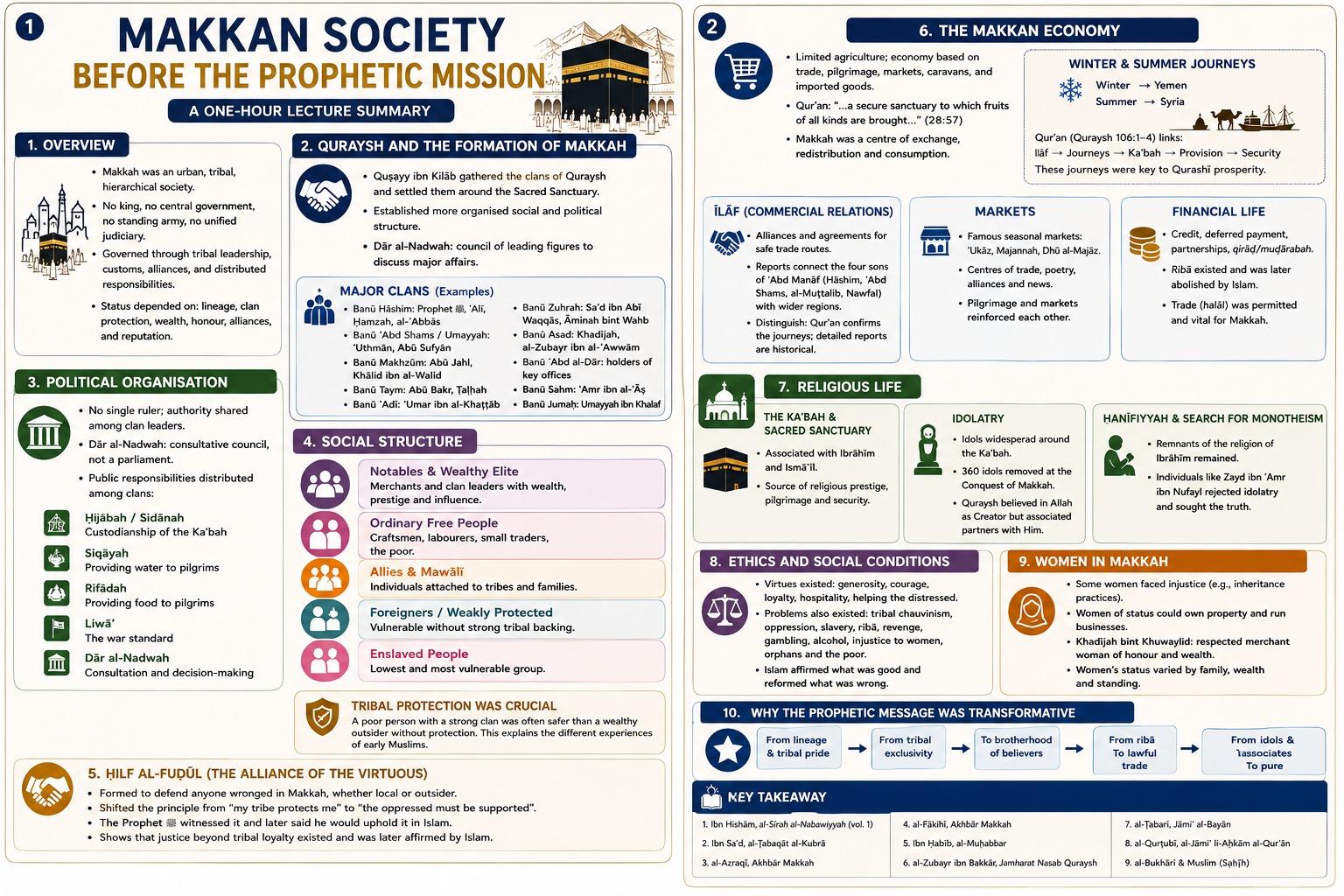
Makkah was a tribal society. More specifically, it was an urban tribal society. Of course, it contained the Ka’bah, and this gave the people of Makkah a very special position within Arabia. Nevertheless, there was no government in Makkah in the way we understand government today. There was no state, no standing army and no unified judicial system. Instead, society was governed through tribal leadership, customs and alliances.
In Arabic, customs are called adat. Every society has its customs. Even in the corporate world today, if there is a dispute and there is no written document dealing with the issue, people might ask, “What is the common practice?” or “What is the accepted professional practice?” This is the idea of adat: recognised customs which people follow.
Makkan society was also governed through alliances. We touched on this previously. A smaller or weaker tribe might place itself under the protection of a larger and more powerful tribe. These alliances were known as a hilf, with the plural ahlaf. Alliances were very common throughout Arabia, just as alliances between countries continue to exist today.
So there was tribal leadership, there were recognised customs, and there were alliances. Alongside this, different clans had different responsibilities. There was no king in Makkah and no single leader who controlled everything. Instead, particular responsibilities were held by different clans and their leaders.
Quraysh and social status
The main tribe in Makkah was Quraysh. A person’s status within society depended on several things: lineage, clan protection, wealth, honour and reputation. To be highly respected, a person might possess one or several of these.
Someone might belong to Quraysh, which immediately gave them status. They might also be extremely wealthy, although wealth on its own was not always enough. A person might instead be known as honourable and trustworthy and therefore command great respect.
Tribal protection was particularly important. I mentioned previously the story of Abu Dharr al-Ghifari (may Allah be pleased with him). Abu Dharr belonged to the tribe of Ghifar, which was a strong tribe and one which Quraysh knew could cause them serious problems.
When Abu Dharr accepted Islam in Makkah and publicly declared his faith, Quraysh beat him severely. Al-Abbas ibn Abd al-Muttalib intervened and reminded them that Abu Dharr was from Ghifar and that their trading caravans passed through the territory of his tribe. Quraysh therefore realised the consequences they might face and stopped attacking him. (Sahih al-Bukhari). So someone’s tribe and reputation could provide significant protection.
A person might even be poor but nevertheless highly respected because he was known to be a man of his word. Throughout Arab history, there are personalities who became famous not because of their wealth but because of their character and reputation.
Qusayy ibn Kilab and the formation of Quraysh
Quraysh was the dominant tribe of Makkah, but how did Quraysh come together?
There are different explanations for the origin of the name Quraysh. One explanation mentioned by linguists and scholars of Seerah connects the name with the idea of gathering together after having been scattered. There are other explanations as well, but this is one of the interpretations that has been mentioned.
The important point for us is to remember the name Qusayy ibn Kilab. He was a very important figure in the political and social organisation of Quraysh. He established and organised much of the social and political structure of Makkah. The early authors of Seerah, including Ibn Ishaq and Ibn Hisham, describe the extraordinary authority he possessed among Quraysh. They effectively submitted to his judgement and leadership to the extent that his position resembled that of a king, even though Makkah itself was not a monarchy. (Ibn Hisham, al-Sirah al-Nabawiyyah, account of Qusayy ibn Kilab and the organisation of Quraysh)
In this sense, Qusayy became something like the father of the organised Quraysh.
Dar al-Nadwa
Although there was no government or formal state in Makkah, Quraysh had something known as Dar al-Nadwa.
Dar al-Nadwa was the council house where the senior leaders of Quraysh would meet and consult one another about major affairs. Important political and social decisions concerning Makkah were discussed there.
Many of you will already have come across the name Dar al-Nadwa in the Seerah. Later, we will also see the Prophet ﷺ using Dar al-Arqam as a meeting place for the early Muslims. So we have Dar al-Nadwa on one side and Dar al-Arqam on the other, although they served very different purposes.
Dar al-Nadwa was essentially the political council of Quraysh. The leading figures of the major clans would come together there to discuss important matters. Of course, not everybody participated equally in decision-making. It was primarily the senior and influential leaders, and we will look at that structure in more detail later, insha’Allah.
So there was no single ruler or supreme authority over Quraysh. There was no king. Instead, authority was shared between the leading clans, creating a form of collective tribal leadership.
This was the decision-making mechanism they had accepted. One leader from this clan, another leader from that clan, and so on. They would come together, perhaps around ten of the senior leaders, give or take depending on the situation. These were the people involved in making the major decisions.
Decisions were therefore made through consultation, and this is why they had Dar al-Nadwa. The writers of the Seerah mention that Qusayy ibn Kilab established Dar al-Nadwa. Major decisions affecting Quraysh were discussed and made there. (Ibn Hisham, al-Sirah al-Nabawiyyah, account of Qusayy ibn Kilab)
The clans of Quraysh
Among the major clans of Quraysh, just to give you an idea, we have several different branches. They were all Quraysh, but Quraysh itself was divided into clans. In Arabic, we have the qabilah, the wider tribe, and within it the butun, the different clans or branches.
One of these was Banu Hashim. The Prophet ﷺ was from Banu Hashim, as were Ali ibn Abi Talib, Hamzah ibn Abd al-Muttalib and al-Abbas ibn Abd al-Muttalib (may Allah be pleased with them). If I were to show you a complete map of every clan and all the people within it, it would be huge. I am simply giving you an idea of the structure.
Another clan was Banu Abd Shams, from which came Banu Umayyah, the Umayyads. Among them were Uthman ibn Affan (may Allah be pleased with him) and Abu Sufyan ibn Harb (may Allah be pleased with him). Later, of course, the Umayyads became very significant in Islamic history.
Then we have Banu Makhzum. Abu Jahl was from Banu Makhzum, as was Khalid ibn al-Walid (may Allah be pleased with him), along with many others.
We also have Banu Taym, another branch of Quraysh. Abu Bakr al-Siddiq and Talhah ibn Ubaydillah (may Allah be pleased with them both) were from Banu Taym.
Then there was Banu Adi, from whom came Umar ibn al-Khattab (may Allah be pleased with him).
We have Banu Zuhrah. Sa’d ibn Abi Waqqas (may Allah be pleased with him) was from Banu Zuhrah, and so was Aminah bint Wahb, the mother of the Prophet ﷺ.
Then we have Banu Asad. Khadijah bint Khuwaylid (may Allah be pleased with her) was from Banu Asad, as was al-Zubayr ibn al-Awwam (may Allah be pleased with him).
There was also Banu Abd al-Dar. The custodianship of the Ka’bah and its key was associated with this clan. The descendants known as Banu Shaybah have continued to hold the key of the Ka’bah until today.
We also have Banu Sahm, from whom came Amr ibn al-As (may Allah be pleased with him), as well as other clans of Quraysh.
This is simply an overview. There were many people and branches within each of these clans, but it gives us an idea of how Quraysh itself was structured.
The public offices of Makkah
There was also a distribution of what we might call public offices today. Different clans had responsibility for different functions within Makkah.
For example, there was the custodianship of the Ka’bah, which was entrusted to a particular clan. There was siqayah, the responsibility of providing water for the pilgrims. There was rifadah, providing food for pilgrims.
There was also al-liwa’, responsibility for the war standard, meaning the banner carried when Quraysh went to war.
And, as we mentioned earlier, there was Dar al-Nadwa, the place for consultation and major decision-making.
Some of you might be slightly surprised by this because when we hear the word Jahiliyyah, we sometimes imagine an entirely uneducated and disorganised people with no structure at all. That is not the case.
They had a system. They had mechanisms that people followed. They had customs, tribal rules and recognised responsibilities. It was certainly not a perfect system, but to a certain extent it performed the functions required by their society.
The social structure of Makkah
We have spoken about the tribal and political structure. Now we can look at the social structure. Society was not divided simply into rich and poor. Of course, there were rich and poor people, as there are in every society, but that was not the only distinction.
At the top were the wealthy and honourable elite: major merchants, clan leaders and people with prestige and influence.
Then there were ordinary free people. The expression “free people” might sound strange to us today, but in that society it had a very specific meaning. These were small traders, craftsmen, labourers and ordinary members of society who were not enslaved. Poor people could also fall within this category.
Then there were allies and mawali. You will come across the term mawali many times in the Seerah. These were individuals who had become attached to a particular tribe or family through an agreement or relationship of protection. They might also be described as allies, ahlaf.
There were also foreigners and people who had no strong tribal protection. These people were particularly vulnerable because they lacked tribal backing.
The key point is that vulnerability was not simply about being poor. A poor person who had a powerful tribe behind him could still be protected. A wealthy person without strong protection might find himself in a much more difficult position.
And tribal protection could apply regardless of religious belief. A person might completely disagree with another member of his clan in matters of belief, but tribal loyalty could still oblige him to protect that person.
This is exactly what happened with the Prophet ﷺ. Abu Talib protected the Prophet ﷺ even though Abu Talib did not accept his message. He continued to defend him because Muhammad ﷺ was his nephew and a member of his clan, Banu Hashim. Quraysh therefore had to take that tribal protection seriously. This protection became particularly significant when Quraysh began intensifying its persecution of the Prophet ﷺ. (Ibn Hisham, al-Sirah al-Nabawiyyah, account of Abu Talib’s protection of the Prophet ﷺ)
At the lowest level of the social structure were slaves. They had neither independence nor tribal protection and were subject to their owners. They could be bought and sold, and unfortunately they could be beaten, tortured and treated with extraordinary cruelty.
This was not unique to Makkah. Slavery existed throughout Arabia and across much of the wider world at the time.
Why tribal protection mattered
Tribal protection was therefore extremely important in Makkah and throughout Arabia. In many cases, it was even more important than wealth. The Prophet ﷺ had the protection of Banu Hashim, particularly through his uncle Abu Talib. Muslims who did not have this kind of protection were much more exposed to persecution.
Bilal ibn Rabah (may Allah be pleased with him), for example, was not from one of the powerful Makkan tribes. He was enslaved and therefore had no tribe to protect him. When he accepted Islam, his master Umayyah ibn Khalaf subjected him to severe torture, taking him out into the intense heat and placing a heavy stone upon him in an attempt to force him to abandon his faith. Bilal continued to say:
أَحَدٌ أَحَدٌ
“One, One.”
Abu Bakr (may Allah be pleased with him) later purchased Bilal and freed him. (Ibn Hisham, al-Sirah al-Nabawiyyah; see also Sahih al-Bukhari).
There were many others who suffered because of their belief and because they had no strong protection. Abu Bakr (may Allah be pleased with him), on the other hand, occupied a very different position in Makkan society. He was a notable person, wealthy, respected, from a recognised clan and with a very good reputation. He therefore had several of the elements which gave a person protection in that society.
This does not mean that Abu Bakr was never physically attacked. Early Seerah reports mention that he was severely beaten after publicly preaching Islam near the Ka’bah. However, the broader point is that someone of Abu Bakr’s social standing was not as exposed as an enslaved person or a foreigner who had no tribal protection. His lineage, reputation and connections gave him a degree of security that people such as Bilal (may Allah be pleased with him) simply did not have. (Ibn Hisham, al-Sirah al-Nabawiyyah, account of Abu Bakr’s public preaching in Makkah)
So when we go through the events of the Seerah, we need to understand that persecution was influenced not only by a person’s faith but also by their position within the tribal structure.
Hilf al-Fudul: the Alliance of the Virtuous
We mentioned earlier the alliances and agreements that existed between tribes, individuals and families. These were known as hilf, alliances. One of the best-known alliances in the Seerah is Hilf al-Fudul, often translated as the Alliance of the Virtuous. It was established to defend people who were oppressed in Makkah, whether they were residents or outsiders.
There is a longer story behind it, but to summarise it, a merchant came to Makkah from Yemen with goods to sell. He sold his merchandise to one of the prominent men of Quraysh, who then refused to pay him what he was owed.
The merchant had no strong tribal protection in Makkah, so he appealed publicly for help. A number of the clans of Quraysh then came together and agreed that they would stand against injustice and ensure that an oppressed person received his rights, regardless of whether he was from Makkah or from outside it. This became Hilf al-Fudul.
The Prophet ﷺ witnessed this pact before prophethood. Later, he spoke positively about it and said:
لَقَدْ شَهِدْتُ فِي دَارِ عَبْدِ اللَّهِ بْنِ جُدْعَانَ حِلْفًا مَا أُحِبُّ أَنَّ لِيَ بِهِ حُمْرَ النَّعَمِ، وَلَوْ أُدْعَى بِهِ فِي الْإِسْلَامِ لَأَجَبْتُ
“I witnessed in the house of Abdullah ibn Jud’an an alliance which I would not exchange for red camels. If I were called to such an alliance in Islam, I would respond.”
(Ibn Hisham, al-Sirah al-Nabawiyyah, account of Hilf al-Fudul; al-Bayhaqi, al-Sunan al-Kubra)
The principle behind the alliance was simple: protect the oppressed and support them in recovering their rights. It shows us that justice could sometimes extend beyond tribal loyalty. The man who had been wronged was an outsider with no powerful clan behind him, yet people of goodness came together and pledged to defend anyone who suffered injustice.
This is also important when we think about the word Jahiliyyah. We sometimes imagine that everything in pre-Islamic Arabia was bad. That is not correct. They possessed many good qualities which Islam later affirmed and refined.
They valued keeping one’s word and fulfilling promises. They admired courage, dignity and generosity. Truthfulness was highly respected, while lying was considered deeply shameful because it could destroy a person’s reputation.
This was before Islam. Islam did not come to erase every characteristic of Arab society. It confirmed what was good and corrected what was wrong.
The Makkan economy
Last time, we also touched on the economy of Makkah. Makkah had very little agriculture. Its economy therefore depended heavily upon trade, pilgrimage, markets, caravans and imported goods.
You could say that the economy of Makkah had two main lifelines. The first was Hajj and Umrah, and the second was the trade caravans travelling outside Makkah to places such as Yemen and al-Sham and then returning with goods to sell. The Quran refers directly to these journeys in Surat Quraysh:
لِإِيلَافِ قُرَيْشٍ إِيلَافِهِمْ رِحْلَةَ الشِّتَاءِ وَالصَّيْفِ فَلْيَعْبُدُوا رَبَّ هَٰذَا الْبَيْتِ الَّذِي أَطْعَمَهُمْ مِنْ جُوعٍ وَآمَنَهُمْ مِنْ خَوْفٍ
“For the security of Quraysh, their security in the journeys of winter and summer, let them worship the Lord of this House, Who has fed them against hunger and made them safe from fear.”
(Surat Quraysh, 106:1-4)
The winter journey was generally towards Yemen, while the summer journey was towards al-Sham, which included the regions of present-day Palestine, Jordan, Syria and Lebanon.
Makkah therefore became an important centre of exchange, redistribution and consumption. People travelled there from different parts of Arabia, particularly for Hajj and Umrah. The merchants of Quraysh imported goods from other regions and sold them to the people coming into Makkah.
There were also seasonal markets. We mentioned some of these previously, including Ukaz, Majanna and Dhu al-Majaz. These markets were important not only economically but also socially and culturally. There were also more permanent local markets.
So trade was organised. There were partnerships between merchants and different tribes, and some individuals became extremely successful and well known.
Among the prominent businesspeople of that society were Abu Bakr, Uthman ibn Affan, Abd al-Rahman ibn Awf and Khadijah bint Khuwaylid (may Allah be pleased with them). They were known not only for their wealth but also for their reputation, honesty and fairness.
Later, we will see that the Prophet ﷺ himself traded on behalf of Khadijah (may Allah be pleased with her) before their marriage. His honesty and excellent character were among the qualities for which he was already known, and the journey proved particularly profitable for her. (Ibn Hisham, al-Sirah al-Nabawiyyah, account of the Prophet’s ﷺ trade on behalf of Khadijah)
Problems within the economic and social system
Having said that, not everything within the Makkan economy was acceptable. One of the major problems was riba, usury or interest. It became a means through which people could exploit others and cause serious economic oppression.
Islam would later prohibit riba, but this prohibition did not come immediately. The final prohibition came much later, during the Madinan period.
Allah says:
يَا أَيُّهَا الَّذِينَ آمَنُوا اتَّقُوا اللَّهَ وَذَرُوا مَا بَقِيَ مِنَ الرِّبَا إِنْ كُنْتُمْ مُؤْمِنِينَ
“O you who believe, fear Allah and give up what remains of riba, if you are truly believers.”
(Surat al-Baqarah, 2:278)
Alcohol was another significant social problem. Again, Islam did not prohibit alcohol at the beginning of the Makkan period. Its prohibition came gradually and was completed later in Madinah.
There were also injustices towards women, orphans, the poor and those without protection. These are all matters which Islam would address as the revelation continued.
Religious life in Makkah
Now we come to the religious life of Makkah. At its centre was the Ka’bah, the Sacred House built by Ibrahim and Isma’il (peace be upon them). It was a source of enormous prestige, respect and security for the people of Makkah and a focal point for the Arabs.
Allah says regarding Ibrahim and Isma’il:
وَإِذْ يَرْفَعُ إِبْرَاهِيمُ الْقَوَاعِدَ مِنَ الْبَيْتِ وَإِسْمَاعِيلُ
“And remember when Ibrahim and Isma’il raised the foundations of the House.”
(Surat al-Baqarah, 2:127)
Unfortunately, by the time of the Prophet ﷺ, idolatry had become established around the Ka’bah. The Seerah sources mention that there were around 360 idols surrounding it, which the Prophet ﷺ removed when Makkah was conquered. (Sahih al-Bukhari)
Yet Quraysh did not deny the existence of Allah. This is something the Quran repeatedly makes clear. They acknowledged Allah as the Creator of the heavens and the earth.
Allah says:
وَلَئِنْ سَأَلْتَهُمْ مَنْ خَلَقَ السَّمَاوَاتِ وَالْأَرْضَ لَيَقُولُنَّ اللَّهُ
“If you ask them, ‘Who created the heavens and the earth?’ they will certainly say, ‘Allah.’”
(Surat Luqman, 31:25)
Their problem was not that they denied Allah altogether. Their problem was shirk. They worshipped other beings alongside Allah and regarded their idols as intermediaries through whom they could approach Him.
The Quran describes their reasoning:
مَا نَعْبُدُهُمْ إِلَّا لِيُقَرِّبُونَا إِلَى اللَّهِ زُلْفَىٰ
“We only worship them so that they may bring us nearer to Allah.”
(Surat al-Zumar, 39:3)
The Hanifs
At the same time, there were a very small number of people who rejected idol worship. They are usually referred to as the Hanifs, individuals who were searching for the pure monotheistic religion of Ibrahim (peace be upon him). Their number was very small.
One of the best-known was Zayd ibn Amr ibn Nufayl. He rejected the worship of idols and openly distanced himself from the religion of Quraysh. He searched for the true religion and refused to eat meat which had been sacrificed to idols. The Prophet ﷺ later spoke positively of him. (Sahih al-Bukhari)
We also came across Waraqah ibn Nawfal previously. He had rejected idolatry and was familiar with the scriptures of the People of the Book. By the time revelation came to the Prophet ﷺ, Waraqah had embraced Christianity and recognised that what had come to Muhammad ﷺ was the same divine messenger who had come to the prophets before him. (Sahih al-Bukhari). So even within overwhelmingly polytheistic Makkah, traces of monotheistic belief remained.
A small number of people therefore continued to seek al-hanifiyyah, pure monotheism, the religion of Ibrahim (peace be upon him). You will come across this term throughout the Seerah. Al-hanifiyyah refers to turning away from idolatry towards the pure worship of Allah alone.
The ethical and social condition of Makkah
When we look at the ethical and social condition of Makkah, we find both good qualities and serious problems.
The Arabs were known for courage, loyalty, generosity and hospitality. They protected their guests, honoured their promises and alliances, and helped neighbours and people in distress. These were among the strong qualities for which Arab society was known.
At the same time, there were major problems. Tribal arrogance was widespread. The weak could be oppressed, and slavery was part of the social system. Revenge was also a serious issue. A conflict based on revenge could continue between tribes for decades.
There was gambling, alcohol, fornication and other social problems. There was also injustice towards women, orphans, the poor and those without strong protection.
The status of women
When we speak about women in pre-Islamic Makkah, we need to avoid oversimplifying the situation. Some women suffered serious injustice. Inheritance is one example. Women were often denied inheritance, and in some circumstances a widow herself could effectively be treated as part of the deceased man’s estate. Allah later prohibited this practice:
يَا أَيُّهَا الَّذِينَ آمَنُوا لَا يَحِلُّ لَكُمْ أَنْ تَرِثُوا النِّسَاءَ كَرْهًا
“O you who believe, it is not lawful for you to inherit women against their will.”
(Surat al-Nisa, 4:19)
We also hear about the pre-Islamic practice of burying newborn girls alive. This did happen, and Allah condemned it very strongly in the Quran:
وَإِذَا الْمَوْءُودَةُ سُئِلَتْ بِأَيِّ ذَنْبٍ قُتِلَتْ
“And when the girl buried alive is asked for what sin she was killed.”
(Surat al-Takwir, 81:8-9)
However, we should not imagine that every Arab tribe routinely buried its daughters. It existed among some groups, but it was not a universal practice across the whole of Arabia.
The status of a woman also varied considerably according to her family, wealth and social standing. The experience of a poor woman or an enslaved woman could be completely different from that of a woman from a powerful and respected family.
Khadijah (may Allah be pleased with her), for example, was a successful and highly respected merchant. She had wealth, dignity and protection within her society.
Islam came and corrected the injustices that existed. It recognised women as independent human beings with rights to property, inheritance, protection and dignity.
Allah says:
لِلرِّجَالِ نَصِيبٌ مِمَّا تَرَكَ الْوَالِدَانِ وَالْأَقْرَبُونَ وَلِلنِّسَاءِ نَصِيبٌ مِمَّا تَرَكَ الْوَالِدَانِ وَالْأَقْرَبُونَ
“For men there is a share of what parents and close relatives leave, and for women there is a share of what parents and close relatives leave.”
(Surat al-Nisa, 4:7)
From tribal pride to an Ummah
When we look at the Prophetic message, we see that the Prophet ﷺ gradually transformed the structure of society. It moved from tribal pride towards the brotherhood of believers. This was not an easy transformation. It moved from riba and exploitative practices towards justice, fairness and protection of the weak. It moved from idols and intermediaries towards the pure worship of Allah alone. This was an enormous task which Allah facilitated for the Prophet ﷺ.
Pre-Islamic Makkah was therefore a structured society built around tribe, trade, pilgrimage and established customs. Among its strengths were cooperation, courage and hospitality, but alongside these were injustice and inequality.
Islam transformed the basis upon which society was valued. It was no longer supposed to be about which tribe you belonged to, how wealthy you were or how powerful your family was. Allah says:
يَا أَيُّهَا النَّاسُ إِنَّا خَلَقْنَاكُمْ مِنْ ذَكَرٍ وَأُنْثَىٰ وَجَعَلْنَاكُمْ شُعُوبًا وَقَبَائِلَ لِتَعَارَفُوا ۚ إِنَّ أَكْرَمَكُمْ عِنْدَ اللَّهِ أَتْقَاكُمْ
“O humanity, We created you from a male and a female, and made you into peoples and tribes so that you may know one another. Surely the most honoured of you in the sight of Allah is the most God-conscious of you.”
(Surat al-Hujurat, 49:13)
So the movement was from tribal privilege towards piety and moral worth, from exploitation and injustice towards justice and human dignity, and from idolatry towards the pure tawhid of Allah.
This gives us a general overview of Makkah, the structure of Quraysh, what was happening within the city and how Makkan society operated before Islam.
Based on the talk delivered to the Al Manaar Convert Club on 1st September 2026.
Related posts