

Abortion in Islam
Is abortion permissible in Islam?
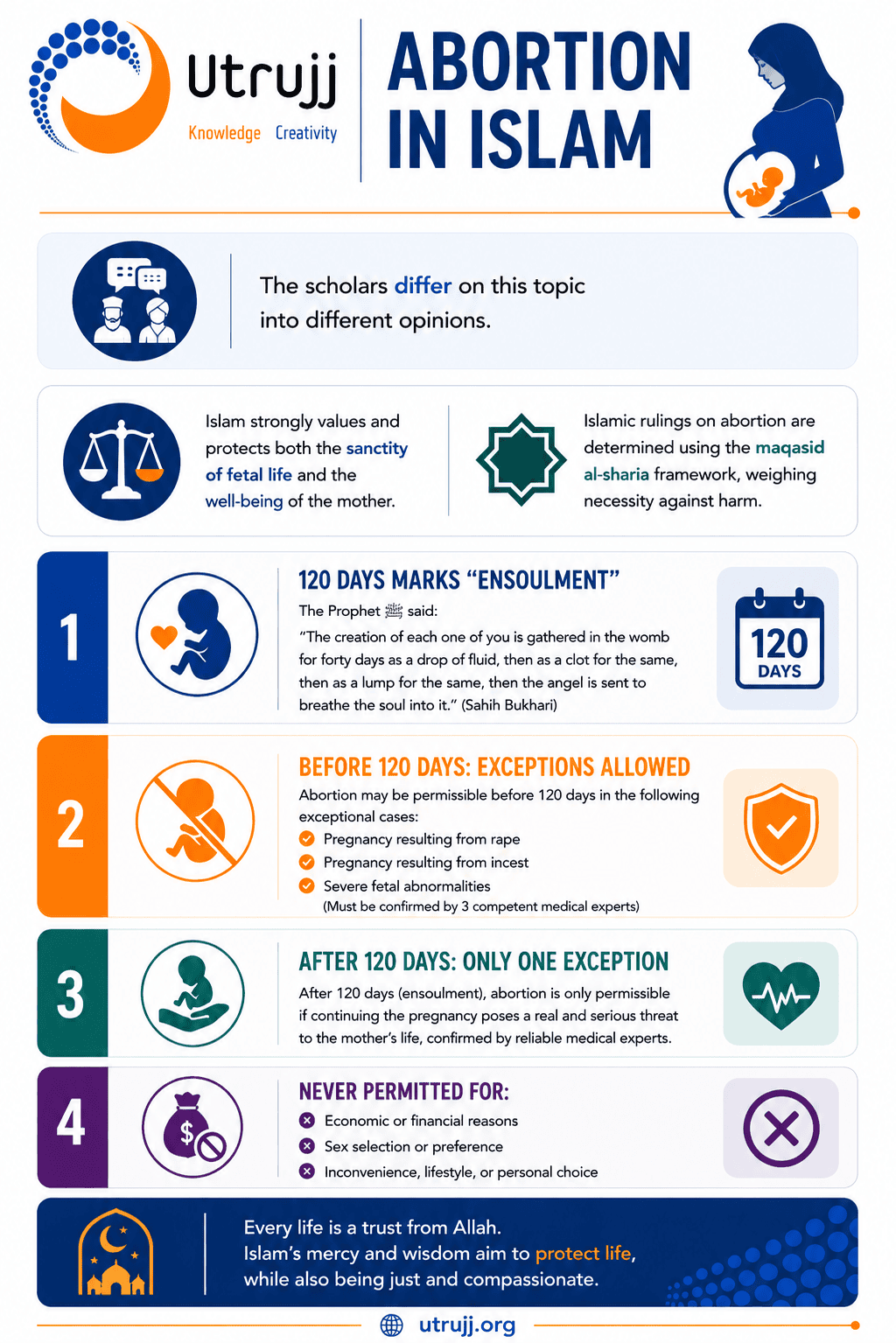
Abortion in Islam
Abortion is a sensitive subject. Islam places great value on human life, including the life developing in the womb. At the same time, the Shariah takes harm, necessity and the well-being of the mother seriously. For this reason, the ruling on abortion is not the same in every situation. It depends on the stage of the pregnancy and the circumstances surrounding it.
Allah Almighty says:
وَلَا تَقْتُلُوا النَّفْسَ الَّتِي حَرَّمَ اللَّهُ إِلَّا بِالْحَقِّ
“Do not take a life which Allah has made sacred, except with legal right.”
(Surat al-Isra, 17:33)
This protection of life is the starting point. However, the Shariah also recognises situations of genuine necessity, particularly where continuing a pregnancy would place the mother in serious danger.
The stages of development in the womb
The Qur’an describes the development of the human being in the womb through a number of stages. Allah Almighty says:
وَلَقَدْ خَلَقْنَا الْإِنسَانَ مِن سُلَالَةٍ مِّن طِينٍ ثُمَّ جَعَلْنَاهُ نُطْفَةً فِي قَرَارٍ مَّكِينٍ ثُمَّ خَلَقْنَا النُّطْفَةَ عَلَقَةً فَخَلَقْنَا الْعَلَقَةَ مُضْغَةً فَخَلَقْنَا الْمُضْغَةَ عِظَامًا فَكَسَوْنَا الْعِظَامَ لَحْمًا ثُمَّ أَنشَأْنَاهُ خَلْقًا آخَرَ فَتَبَارَكَ اللَّهُ أَحْسَنُ الْخَالِقِينَ
“Indeed, We created man from an extract of clay. Then We placed him as a drop in a secure place. Then We developed the drop into an ‘alaqah, then developed the ‘alaqah into a mudghah, then developed the mudghah into bones, then clothed the bones with flesh, then We brought him into being as a new creation. So blessed is Allah, the Best of Creators.”
(Surat al-Mu’minun, 23:12–14)
The Prophet ﷺ also described these stages in the well-known hadith of Ibn Mas‘ud. On the classical understanding of this hadith, the development is divided into three periods of forty days before ensoulment:
- Nutfa: days 0–40 (نُطْفَة)
- Alaqa: days 40–80 (عَلَقَة)
- Mudgha: days 80–120 (مُضْغَة)
- Ensoulment: around day 120 (nafkh al-ruh)
Nutfah – the first 40 days:
The earliest stage of human development, beginning from conception. Nutfah literally refers to a small drop of fluid.
‘Alaqah – approximately 40 to 80 days:
The next stage of development. The word ‘alaqah carries meanings including something which clings or is attached.
Mudghah – approximately 80 to 120 days:
The developing human reaches the stage described as mudghah, literally something resembling a chewed morsel.
After 120 days – ensoulment:
According to the majority classical view, at around 120 days the angel is sent and the soul (ruh) is breathed into the developing child. This is why 120 days became such an important point in the classical discussion of abortion.
These stages should not be treated as a modern medical timetable. Medical embryology describes development using a different system and doctors normally date a pregnancy from the first day of the woman’s last menstrual period, rather than from conception. The stages come from the language of the Qur’an and Sunnah and form the basis on which the classical jurists discussed the rulings.
It is also important to remember that ensoulment is not the beginning of the pregnancy’s sanctity. The developing life is respected before 120 days as well. So, one cannot assume that the developing child has no value before 120 days, or that abortion before this point is automatically permissible. The pregnancy is protected from its earliest stages. What changes as the pregnancy develops is the seriousness of interfering with it.
When does ensoulment take place?
The Prophet ﷺ said:
إِنَّ أَحَدَكُمْ يُجْمَعُ خَلْقُهُ فِي بَطْنِ أُمِّهِ أَرْبَعِينَ يَوْمًا، ثُمَّ يَكُونُ عَلَقَةً مِثْلَ ذَلِكَ، ثُمَّ يَكُونُ مُضْغَةً مِثْلَ ذَلِكَ، ثُمَّ يُرْسَلُ إِلَيْهِ الْمَلَكُ فَيَنْفُخُ فِيهِ الرُّوحَ
“The creation of each one of you is brought together in his mother’s womb for forty days, then he is an ‘alaqah for a similar period, then a mudghah for a similar period. Then the angel is sent to him and breathes the soul into him…”
(Bukhari and Muslim)
On the basis of this hadith, the majority of classical jurists treated 120 days as the point of ensoulment. However, there is no single opinion across the four Sunni schools which says that a woman may simply choose to have an abortion at any time before 120 days.
The Maliki school is generally the strictest and gives protection to the pregnancy from its very early stages.
Within the Hanafi school, there are opinions which allow abortion before ensoulment when there is a recognised and serious reason, though other Hanafi jurists disliked or prohibited it. It was not treated as an unrestricted choice.
The Shafi’i school also contains different opinions. Some jurists allowed greater scope during the earlier stages of pregnancy, while others took a much stricter position.
The Hanbali school generally gives more scope during the first forty days where there is a valid reason, and becomes considerably stricter once the pregnancy has progressed beyond that stage.
Before ensoulment, there is considerably more disagreement among the jurists. This difference of opinion can, however, provide room in genuinely difficult circumstances. That is part of the breadth of fiqh. Not every woman asking this question is in the same situation, and therefore not every case should receive the same answer.
After ensoulment, the prohibition of abortion becomes extremely strong. Abortion is not permitted except in an exceptional situation, most importantly where continuing the pregnancy presents a grave and established danger to the mother’s life.
Overview of the rulings by different schools
- Hanafi: allows abortion before 120 days, including for reasons like rape or foetal defect.
- Shafi‘i: generally permits abortion before 120 days; some jurists consider 80 days the ensoulment mark.
- Hanbali: similar to Hanafis pre-ensoulment; post-ensoulment, abortion is only allowed if the mother’s life is at risk.
- Maliki: opposes abortion at all stages, except if the mother faces death.
Fiqh Council Fatwa
The Islamic Fiqh Council of the Muslim World League, at its Twelfth Session held in Makkah al-Mukarramah from Saturday, 15 Rajab 1410 AH (10 February 1990) to Saturday, 22 Rajab 1410 AH (17 February 1990), considered this matter. Following deliberations by the esteemed members of the Council and by the specialist physicians who attended for this purpose, the Council resolved by majority as follows:
- After 120 days of pregnancy
If the pregnancy has reached 120 days, it is not permissible to terminate it, even if medical diagnosis indicates that the foetus has congenital abnormalities.
An exception may be made where a committee of trustworthy specialist physicians confirms that continuing the pregnancy poses a definite danger to the mother’s life. In such a case, termination is permissible, whether or not the foetus has abnormalities, in order to avert the greater of two harms.
- Before 120 days of pregnancy
Before 120 days have elapsed, if a committee of trustworthy specialist physicians establishes and confirms—on the basis of appropriate medical examinations, diagnostic equipment, and laboratory tests—that the foetus has a serious and incurable abnormality, and that, if the pregnancy continues and the child is born at term, the child’s life would be severely impaired and would entail suffering for the child and the family, then termination of the pregnancy is permissible at the request of the parents.
In issuing this resolution, the Council advises physicians and parents to fear Allah and to exercise the utmost care and certainty in this matter.
And Allah is the Granter of success.
— Resolution of the Islamic Fiqh Council, Muslim World League, on the termination of pregnancy in cases of foetal abnormality.
When the mother’s life is in danger
Unanimously, abortion is permitted at any stage if the mother’s life is in danger. Scholars invoke the principle of choosing the lesser harm.
The clearest exception is when continuing the pregnancy poses a serious danger to the mother’s life. Islam does not require us to stand by while one life is lost when medical intervention can prevent it. Where trustworthy specialists conclude that continuing the pregnancy presents a grave danger to the mother, abortion may be permitted, including after ensoulment when the circumstances reach the level of necessity.
This is based on the juristic principle of preventing the greater harm when two harms cannot both be avoided. However, this should be based on a genuine medical assessment rather than fear or speculation. The more advanced the pregnancy, the stronger the reason required.
Pregnancy following rape or incest
A woman who becomes pregnant as a result of rape has committed no sin. She is the victim of a terrible injustice, and she should be treated with compassion and dignity rather than judgement. The scholars have differed over abortion in such circumstances.
Before ensoulment, some jurists and contemporary scholars have permitted abortion where the pregnancy resulted from rape, particularly when the pregnancy is still at an early stage and continuing it would cause severe harm or trauma. Other scholars take a more restrictive position and do not regard rape alone as sufficient reason to terminate the pregnancy.
After ensoulment, the ruling becomes much stricter and abortion would generally not be permitted unless continuing the pregnancy posed a grave danger to the mother’s life.
This is precisely the kind of case in which a woman should not be handed a generic answer from the internet. Her circumstances, the stage of pregnancy, her physical and psychological condition and the relevant scholarly position all need to be considered.
Serious foetal abnormalities
Modern medicine can sometimes identify very serious conditions before birth. Receiving such news can be devastating for parents, and the ruling should not be presented without recognising the emotional weight of what they are facing.
Contemporary fiqh councils have allowed abortion before ensoulment in certain cases where a reliable team of specialist doctors has established that the foetus has a severe and incurable condition and the consequences of continuing the pregnancy would be exceptionally serious.
- Abortion before 120 days is permitted if three medical experts confirm serious defects.
- Based on decisions from the Islamic Fiqh Council (1990) and the Saudi Council (2011).
This is not a general permission to abort any child who has a disability or medical condition. There is an important difference between a manageable disability and a severe condition which specialists consider profoundly serious or incompatible with normal life.
Once 120 days have passed, a foetal abnormality by itself is generally not considered sufficient reason for abortion. At that stage, termination would only be considered where continuing the pregnancy presents a grave danger to the mother’s life.
These decisions require both medical expertise and sound Islamic guidance. A diagnosis should be properly confirmed before an irreversible decision is made.
Severe psychological harm
Severe psychological trauma can be valid grounds pre-ensoulment under some juristic opinions, especially when linked to maternal health.
Mental health is part of a person’s health and should not be dismissed. There can be cases in which pregnancy produces severe psychiatric or psychological harm. Some jurists allow this to be taken into consideration before ensoulment, particularly where the harm is serious, clinically established and connected to the woman’s health.
At the same time, ordinary anxiety, fear about the future or feeling unprepared for motherhood would not automatically make abortion permissible. There is a difference between distress, which may be understandable and significant, and a level of harm which creates a genuine necessity.
Again, the circumstances have to be assessed properly rather than reduced to a single sentence or general rule.
Pregnancy in a young girl
In cases where the pregnant individual is a minor, some scholars consider the severe social, psychological, and physical harm likely to occur. If such harm is verified, abortion pre-ensoulment may be permitted.
If a child or very young girl becomes pregnant, particularly through abuse, this involves several issues at once: safeguarding, physical health, psychological trauma and the pregnancy itself. Her young age may mean that pregnancy carries greater medical risks, and the circumstances in which she became pregnant may involve profound trauma. These factors have to be assessed together, along with the stage of the pregnancy.
There is therefore no responsible way to give a blanket ruling based on age alone. She needs immediate protection and appropriate medical care, alongside case-specific Islamic guidance.
Financial difficulty
Financial pressure can be very real. Raising another child may feel overwhelming, particularly when a family is already struggling. Nevertheless, financial hardship alone is not normally accepted as a reason for terminating an established pregnancy.
Allah says:
وَلَا تَقْتُلُوا أَوْلَادَكُمْ خَشْيَةَ إِمْلَاقٍ نَّحْنُ نَرْزُقُهُمْ وَإِيَّاكُمْ إِنَّ قَتْلَهُمْ كَانَ خِطْئًا كَبِيرًا
“Do not kill your children for fear of poverty. We provide for them and for you. Indeed, killing them is a grave sin.”
(Surat al-Isra, 17:31)
Abortion for economic reasons is not permitted under any school.
This does not mean that Islam ignores the genuine hardship families experience. They should be supported. Couples may also consider permissible forms of contraception to space future pregnancies. But once pregnancy has begun, financial concerns on their own do not justify abortion.
What if contraception failed?
Most scholars do not consider failed contraception a valid reason for abortion, particularly once pregnancy is established, though some leniency is shown in the very early stages (first 40 days).
Sometimes a couple has taken reasonable steps to avoid pregnancy and contraception fails. The pregnancy may come as a shock, but failure of contraception does not in itself make abortion permissible.
There are juristic opinions which allow greater flexibility within the very earliest stage of pregnancy where there is a genuine need, particularly within the first forty days. However, this is not the same as saying that an unwanted or unplanned pregnancy may simply be terminated.
An unplanned pregnancy and a medically or Islamically necessary abortion are not the same thing.
Abortion because of the baby’s sex
Absolutely prohibited. Islam does not permit abortion for reasons of gender preference.
A preference for a boy or a girl is not a valid reason for terminating a pregnancy. Islam came to remove the attitudes of Jahiliyyah in which daughters were regarded as a burden or source of shame. A child’s worth before Allah does not depend on whether the child is male or female.
Abortion purely because the parents wanted a child of the opposite sex is therefore impermissible.
High-risk multiple pregnancies
If a high-risk multiple pregnancy threatens the life of the mother or viability of the other fetuses, and specialists advise selective reduction before ensoulment, scholars differ but some allow it under necessity.
Occasionally a woman may be carrying several babies and doctors conclude that continuing with all of them creates a serious danger to the mother or greatly reduces the chances of the other babies surviving.
In such circumstances, specialists may recommend selective reduction. This is a complex contemporary issue. Some scholars have permitted it where there is a genuine medical necessity, particularly before ensoulment, while others take a stricter view. It should therefore only be considered following careful specialist medical advice and consultation with a scholar who understands the medical details of the case.
The dates need to be checked carefully
One practical point is often overlooked. Doctors usually calculate the length of a pregnancy using gestational age, beginning from the first day of the woman’s last menstrual period. Discussions in classical fiqh about the age of the embryo and the 120-day threshold are not always expressed using exactly the same method of calculation.
If a ruling depends on whether the pregnancy is before or after a particular threshold, do not try to work this out from an app or by counting dates yourself. The actual stage of the pregnancy should be clarified with the doctor and then explained accurately to the scholar giving the ruling.
A difference of a week or two can be extremely important in a time-sensitive case.
Every case is different
This is perhaps the most important point. A woman saying, “I am considering an abortion,” has not yet told us enough to give her a ruling. How far advanced is the pregnancy? Why is she considering abortion? Is there a danger to her life or health? Has a serious condition been diagnosed in the baby? Was the pregnancy the result of rape? How certain is the medical diagnosis? What have the specialists said? These details matter.
Fiqh is not applied by taking one sentence from a book and placing it over every situation. A sound fatwa understands both the Shariah and the reality of the case.
Where there is a serious medical issue, the scholar needs reliable information from the doctors. The doctor explains the medical facts and risks; the scholar applies the Islamic principles to those facts. Neither should pretend to have the expertise of the other.
Abortion should therefore never be treated casually, but nor should someone facing an exceptionally painful situation be met with harshness and a one-line answer.
Islam protects life, but it also recognises necessity and removes unbearable harm. Before ensoulment, the jurists differed and there can be scope for concessions when there is a serious reason. After ensoulment, the protection of the unborn child becomes much stronger, and abortion is only allowed in exceptional circumstances, particularly where the mother’s life is in grave danger.
Anyone facing this decision should seek both trustworthy medical advice and individual guidance from a qualified scholar rather than relying on a general ruling online.
And Allah knows best.
Legal applications in Muslim-majority countries
- Notable fatwas supporting abortion pre-ensoulment in such cases have come from Egypt, Jordan, and Bosnia.
- Abortion for war rape victims has been allowed pre-ensoulment by scholars in Jordan, Algeria, and during the Bosnian conflict.
- Egypt: Follows fatwas of Dar al-Ifta; allows abortion pre-ensoulment in cases of rape and serious deformities.
- Jordan: Permits abortion before 120 days for confirmed foetal defects; after that, only if the mother’s life is in danger.
- Saudi Arabia: Follows strict timelines; abortion allowed pre-ensoulment for health or deformity; restricted post-ensoulment.
- Indonesia and Turkey: Permit abortion for rape and maternal risk under time limits.
Related posts
Rulings on how to bury a foetus