
Lessons from the Seerah 5 – the birth and family of Prophet Muhammad
Lessons from the Seerah: The Birth and Family of Prophet Muhammad ﷺ
In the previous sessions, we made some introductions about the society in which he lived: the people, the leadership, the different tribes and alliances, their habits, beliefs and practices. All of this was to paint a picture of the world into which The Prophet ﷺ was born.
We are sitting here in the 21st century, in London, looking back more than 1,400 years. Even if you visit Makkah and Madinah today, the environment is completely different. Apart from the Ka’bah, which remains at the heart of Makkah, almost everything around it has changed. This is why these introductions are important. They take us back into that world and help us visualise the seerah. When we talk about the Prophet’s ﷺ tribe, his city, the trade routes, the caravans or the safety of travellers, we need to understand what those things actually meant at the time. It was very different from the world we know today.
Understanding that background also helps us appreciate the challenges the Prophet ﷺ faced. His mission was not a smooth ride. Delivering the message was not an easy task.
Very early in the revelation, Allah prepared him for the weight of what was coming:
إِنَّا سَنُلْقِي عَلَيْكَ قَوْلًا ثَقِيلًا
“Indeed, We will cast upon you a heavy word.” (Surat al-Muzzammil, 73:5)
The message itself was weighty, and so were the responsibilities and challenges which came with carrying it. The Prophet ﷺ would face rejection, persecution, mockery and attacks, and he had to be prepared for that. And through him there is also a lesson for everyone who carries the message of Allah and tries to follow in the footsteps of the Prophet ﷺ.
None of the prophets and messengers had an easy path with their people. They were challenged, rejected, mocked and opposed. Allah tells us:
كَذَٰلِكَ مَا أَتَى الَّذِينَ مِنْ قَبْلِهِمْ مِنْ رَسُولٍ إِلَّا قَالُوا سَاحِرٌ أَوْ مَجْنُونٌ
“Likewise, no messenger came to those before them without them saying, ‘A magician or a madman.’” (Surat al-Dhariyat, 51:52)
So this pattern was not unique to the Prophet ﷺ. The prophets came with truth, but truth often challenged the habits, interests and assumptions of the societies around them. And the last of those messengers, and the best of them, was Muhammad ﷺ. This is why knowing his tribe, his city and the social structure around him helps us understand what happened later.
If you tell me that you live in a city I have never visited, the name alone does not tell me very much. I need to know what that city is like, who lives there, how people interact and what kind of society it has. It is the same with the seerah.
The Prophet ﷺ lived in Arabia, and more specifically in Makkah. Makkan society was made up of different tribes and families, and there were also different levels of wealth and social standing. You had very wealthy merchants and businessmen, you had what we might today call a middle class, and you also had people living in extreme poverty.
The Prophet ﷺdid not come from the wealthiest section of society. But in terms of lineage, he came from the very highest level. And lineage was extremely important to the Arabs. In Arabic we call it nasab. Your ancestry, your tribe and your family carried enormous social weight, and the Prophet ﷺ had one of the most honoured lineages among Quraysh.
In this article, we will look at his family: his parents, grandparents, uncles and aunts, and later his wives, children and grandchildren. And, we will look at the birth of The Prophet ﷺ in Makkah and the circumstances surrounding it.
The family of the Prophet ﷺ
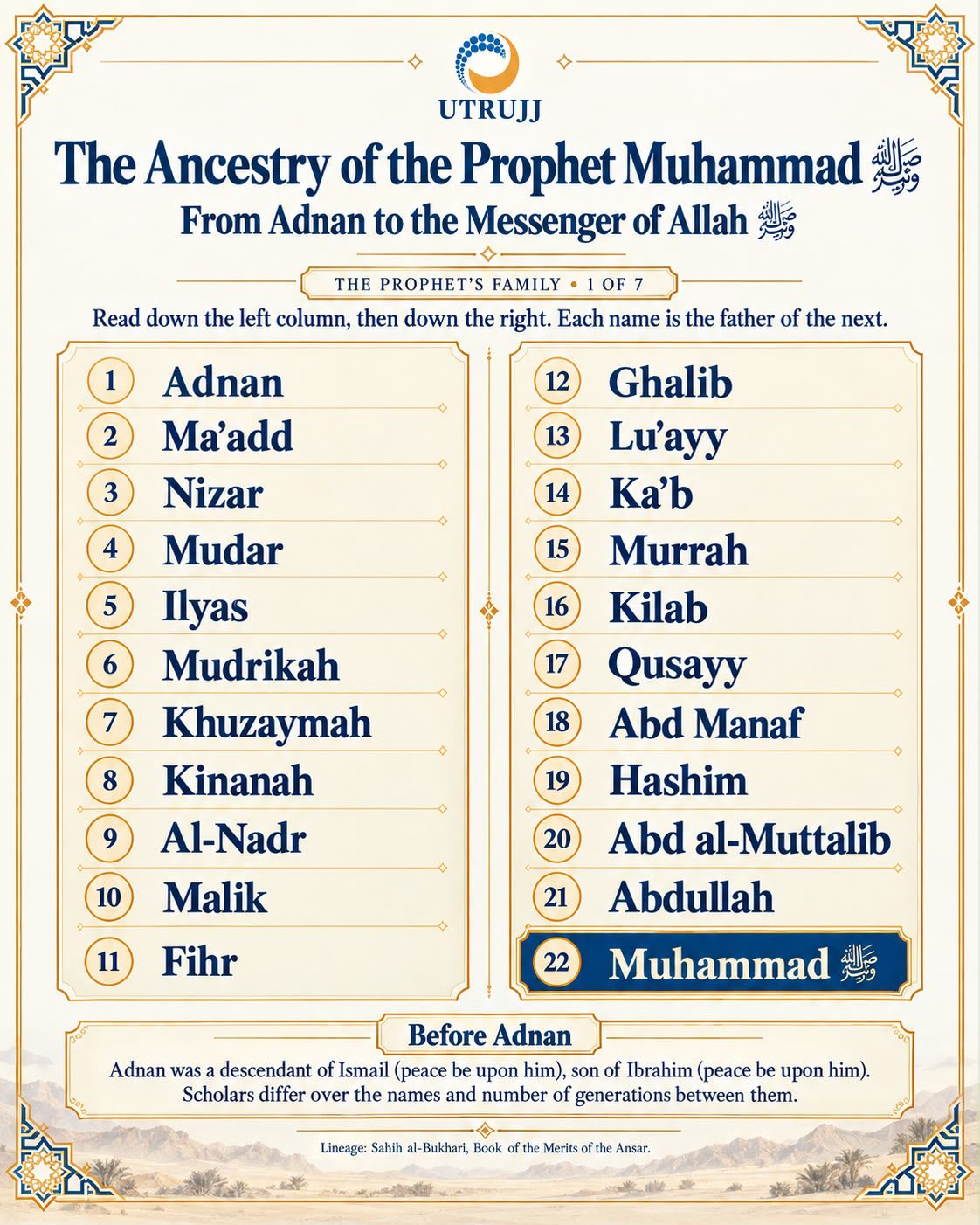
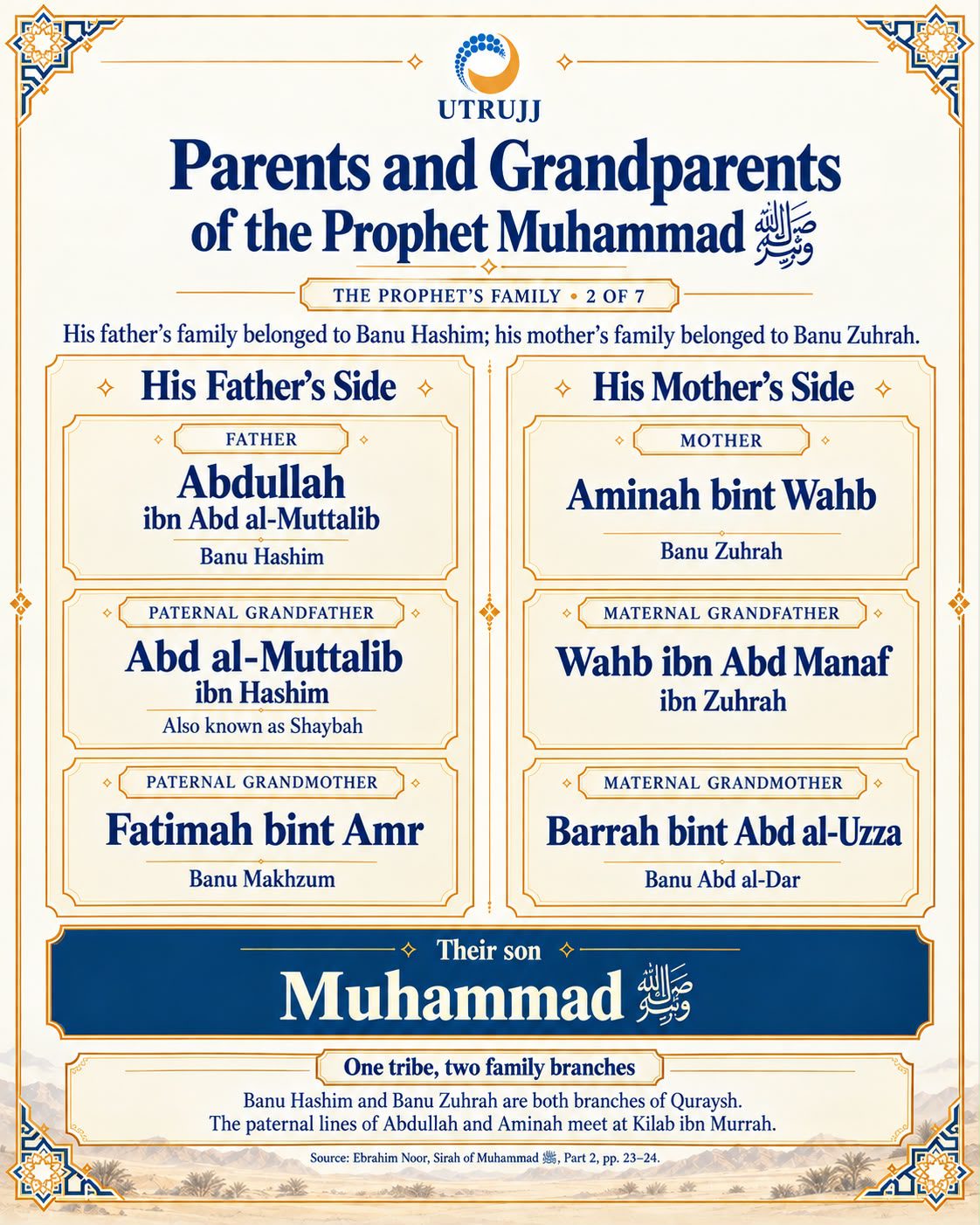
We have already mentioned that The Prophet ﷺ was from Quraysh. He was Muhammad ibn Abdullah ibn Abd al-Muttalib ﷺ.
His father was Abdullah ibn Abd al-Muttalib, and his grandfather was Abd al-Muttalib, one of the most respected figures in Makkah.
His mother was Aminah bint Wahb. Her father was Wahb ibn Abd Manaf, and her mother was Barrah bint Abd al-Uzza.
For some, these names might feel like a lot of information, and one might wonder, “What difference does it make?” But it is useful to know the connections.
As we continue through the seerah, these family relationships will matter. You will see how tribal protection worked, why certain people supported The Prophet ﷺ, why others opposed him, and how different branches of Quraysh were connected.
The uncles of the Prophet ﷺ
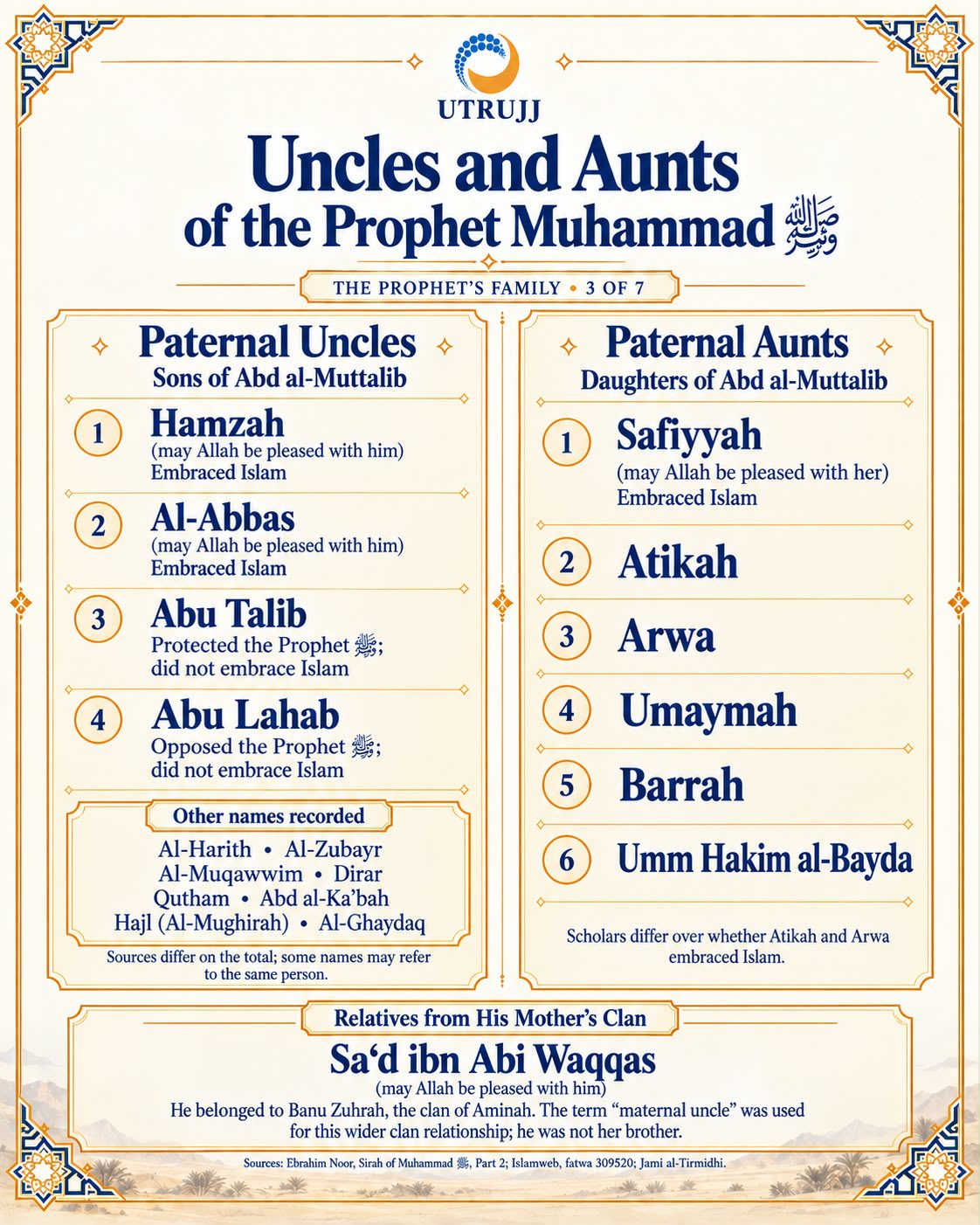
Among the most famous paternal uncles of The Prophet ﷺ was Hamzah ibn Abd al-Muttalib, who later embraced Islam and became one of the great Companions.
Another was al-Abbas ibn Abd al-Muttalib, who also later embraced Islam.
Then there was Abu Talib, who protected and supported The Prophet ﷺ for many years, although he did not accept Islam.
And of course there was Abu Lahab, whose opposition to The Prophet ﷺ became so notorious that Allah revealed an entire surah concerning him:
تَبَّتْ يَدَا أَبِي لَهَبٍ وَتَبَّ مَا أَغْنَىٰ عَنْهُ مَالُهُ وَمَا كَسَبَ
“May the hands of Abu Lahab perish, and perish he. Neither his wealth nor his gains will benefit him.” (Surat al-Masad, 111:1–2)
There were other paternal uncles as well, including al-Harith and al-Zubayr, and the historians differ slightly over the full number and some of their names. But Hamzah, al-Abbas, Abu Talib and Abu Lahab are the names which appear most frequently in the seerah.
The paternal aunts of the Prophet ﷺ
The Prophet ﷺ also had six paternal aunts, the daughters of Abd al-Muttalib: Safiyyah, Atikah, Arwa, Umaymah, Barrah and Umm Hakim al-Bayda.
Safiyyah (may Allah be pleased with her) certainly embraced Islam and became one of the well-known women among the Companions. She was also the mother of al-Zubayr ibn al-Awwam (may Allah be pleased with him).
As for Atikah and Arwa, the historians differed over whether they embraced Islam. Some reports say that they did, while others are less certain.
So even within the immediate family of the Prophet ﷺ, you can already see different responses to Islam. Some became among his strongest supporters, some protected him without accepting the message, and some became among his strongest opponents.
And this is one of the remarkable things about the seerah: the message of Islam cut across family, tribe and social status. Being related to the Prophet ﷺ did not automatically mean that someone would believe in him, and being outside his family did not prevent someone from becoming one of the closest people to him.
In Arabic, the paternal uncles are called a’mam, the plural of a’m, and the paternal aunts are a’mmat, the plural of a’mmah. The maternal aunts are called khalat.
These family relationships matter in Islam, and Allah refers to them when discussing those whom a person is prohibited from marrying:
حُرِّمَتْ عَلَيْكُمْ أُمَّهَاتُكُمْ وَبَنَاتُكُمْ وَأَخَوَاتُكُمْ وَعَمَّاتُكُمْ وَخَالَاتُكُمْ
“Forbidden to you in marriage are your mothers, your daughters, your sisters, your paternal aunts and your maternal aunts…” (Surat al-Nisa, 4:23)
So these are not only words in a family tree. These relationships have legal and social significance as well.
The children of the Prophet ﷺ
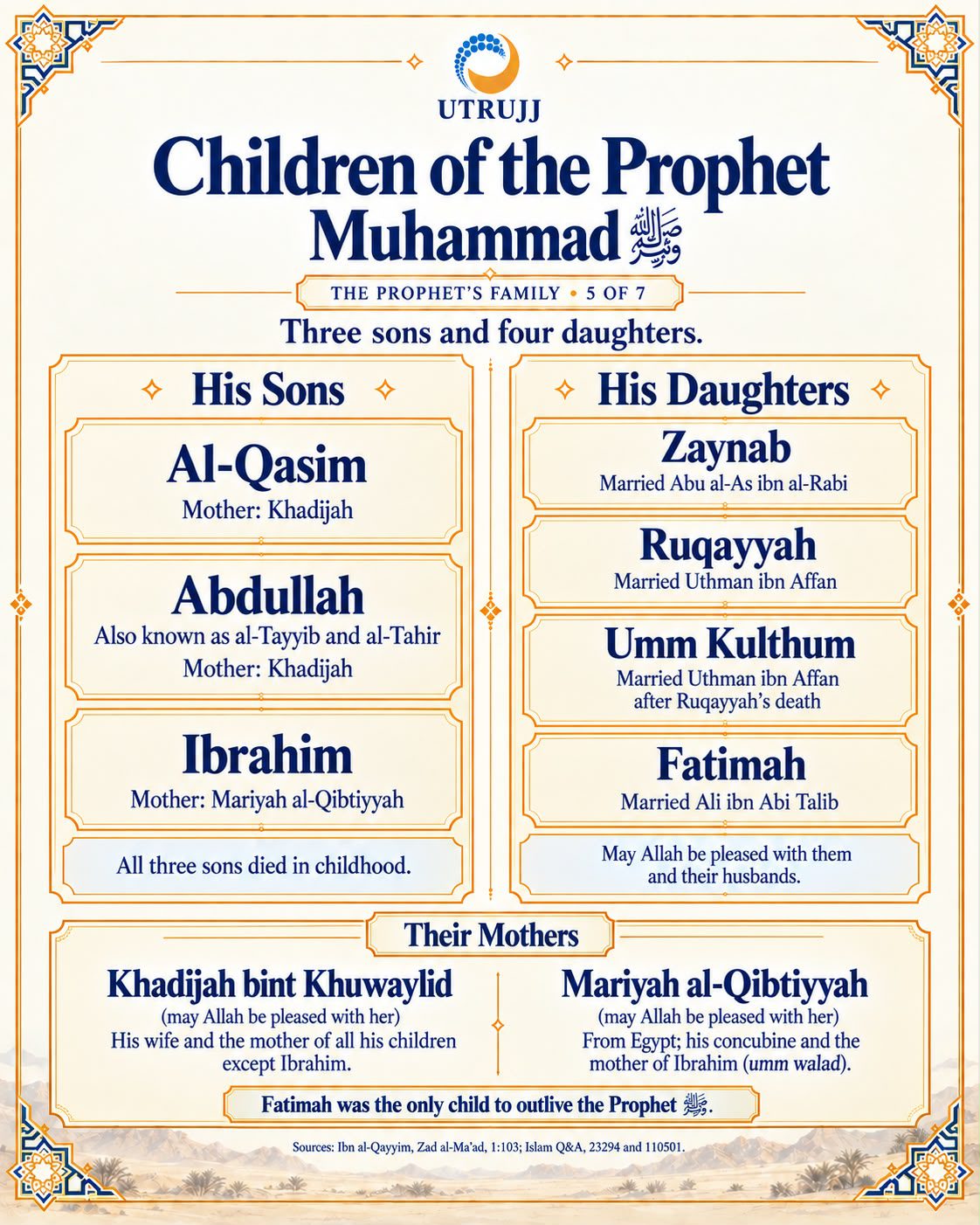
The Prophet ﷺ had four daughters: Zaynab, Ruqayyah, Umm Kulthum and Fatimah (may Allah be pleased with them). All four were born to Khadijah (may Allah be pleased with her).
Ruqayyah (may Allah be pleased with her) married Uthman ibn Affan (may Allah be pleased with him). After she passed away, her sister Umm Kulthum (may Allah be pleased with her) later married Uthman as well. This is why Uthman became known as Dhu al-Nurayn, the Possessor of the Two Lights, because he married two daughters of the Prophet ﷺ.
The Prophet ﷺ also had three sons: al-Qasim, Abdullah and Ibrahim. Al-Qasim and Abdullah were born to Khadijah (may Allah be pleased with him), while Ibrahim was born later to Mariyah al-Qibtiyyah. All three sons died in childhood during the lifetime of the Prophet ﷺ.
All four of his daughters reached adulthood, but three of them passed away during his lifetime. Fatimah (may Allah be pleased with her) was the only daughter who outlived him, and she passed away around six months after him.
The Prophet ﷺ told her privately during his final illness that she would be the first of his family to follow him, and that is exactly what happened. (Bukhari; Muslim)
The Prophet ﷺ had grandchildren through several of his daughters, although his surviving line became especially associated with the descendants of Fatimah (may Allah be pleased with him).
Zaynab (may Allah be pleased with her) had children including Ali and Umamah. Ruqayyah (may Allah be pleased with her)had a son named Abdullah, who died young. Umm Kulthum (may Allah be pleased with her) did not leave surviving children.
Fatimah (may Allah be pleased with her) and Ali ibn Abi Talib (may Allah be pleased with him) had al-Hasan, al-Husayn, Zaynab and Umm Kulthum. The classical sources also mention Muhsin, who died very young.
From al-Hasan and al-Husayn (may Allah be pleased with him) came many of the descendants of The Prophet ﷺ who spread throughout the Muslim world.
So when we speak about the family of the Prophet ﷺ today and people say they are descended from him, that descent is traced through Fatimah (may Allah be pleased with him).
The wives of the Prophet ﷺ
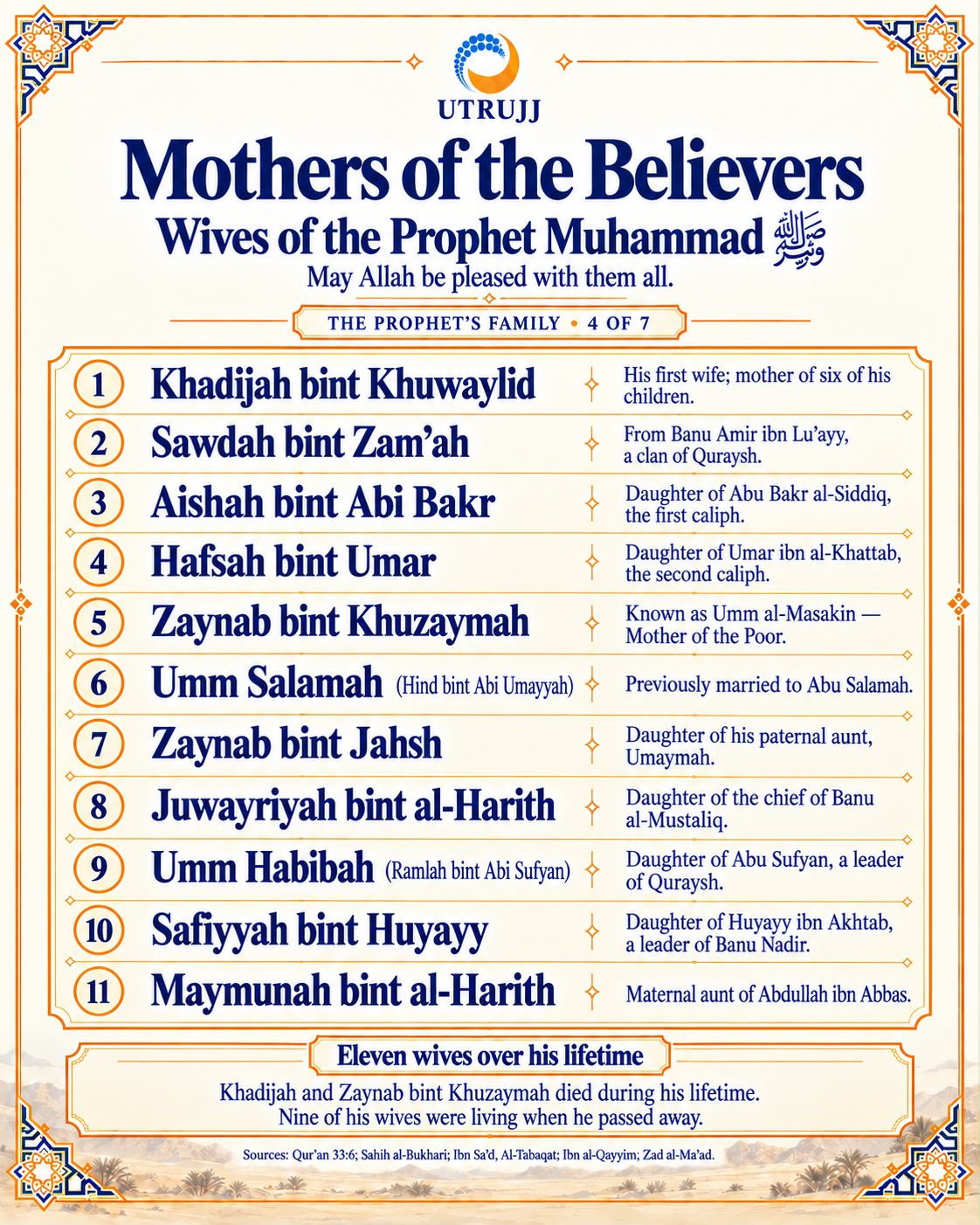
We should also know the Mothers of the Believers, the wives of The Prophet ﷺ.
Allah says:
النَّبِيُّ أَوْلَىٰ بِالْمُؤْمِنِينَ مِنْ أَنْفُسِهِمْ وَأَزْوَاجُهُ أُمَّهَاتُهُمْ
“The Prophet has a greater claim over the believers than they have over themselves, and his wives are their mothers.” (Surat al-Ahzab, 33:6)
His first wife was Khadijah bint Khuwaylid (may Allah be pleased with him), and he remained married only to her for approximately twenty-five years until she passed away.
After Khadijah came Sawdah bint Zam’ah (may Allah be pleased with her) and Aisha bint Abi Bakr (may Allah be pleased with him). Aisha, of course, was the daughter of Abu Bakr al-Siddiq (may Allah be pleased with him).
Then there was Hafsah bint Umar (may Allah be pleased with him), the daughter of Umar ibn al-Khattab (may Allah be pleased with him) ; Zaynab bint Khuzaymah (may Allah be pleased with him); Umm Salamah (may Allah be pleased with him), whose name was Hind bint Abi Umayyah; Zaynab bint Jahsh (may Allah be pleased with him); Juwayriyah bint al-Harith (may Allah be pleased with him); Umm Habibah (may Allah be pleased with him), whose name was Ramlah bint Abi Sufyan; Safiyyah bint Huyayy (may Allah be pleased with him); and Maymunah bint al-Harith (may Allah be pleased with him). These eleven are commonly listed as the wives of the Prophet ﷺ.
We will come back to many of them later because each has her own story and each marriage has its own circumstances and wisdoms. For now, I only want you to have the family picture in your mind.
Abd al-Muttalib, the grandfather of the Prophet ﷺ
Now let us go back one generation and look more closely at the grandfather of The Prophet ﷺ, Abd al-Muttalib.
His birth name was Shaybah, and he is also referred to in some sources as Shaybat al-Hamd. His father was Hashim ibn Abd Manaf, while his mother, Salma bint Amr, was from Yathrib. So Shaybah spent part of his early life in Yathrib among his mother’s family. Later, his paternal uncle al-Muttalib ibn Abd Manaf travelled to Yathrib and brought him back to Makkah.
When the people of Makkah saw the young Shaybah arriving with al-Muttalib, they assumed that he was a servant or slave belonging to him. So they began calling him Abd al-Muttalib, meaning “the servant of al-Muttalib”.
Al-Muttalib explained that he was not his servant at all; he was the son of his brother Hashim. But the name had already stuck, and from then onwards Shaybah became much better known as Abd al-Muttalib.
Abd al-Muttalib later became one of the most respected leaders of Quraysh. He held important responsibilities connected with the Ka’bah and the pilgrims, and this gave him considerable status in Makkah.
In that society, having a large family was also a source of strength. If you had many sons, you had people who could help you, support you, represent you and defend the family if necessary. You still see something similar in traditional farming communities. If somebody has a large farm and only one child, that one child has to do everything! But if you have seven, eight or ten sons, there are many hands available to help.
In tribal Arabia, of course, the significance went even further. A large number of sons could add to a man’s protection, influence and standing.
This becomes important when we come to the famous vow of Abd al-Muttalib concerning his sons, which we will discuss shortly.
The rediscovery of Zamzam
Another major event connected to Abd al-Muttalib was the rediscovery of the well of Zamzam.
You all know the origin of Zamzam. Ibrahim (peace be upon him) left Hajar and their infant son Ismail (peace be upon him) in the barren valley of Makkah. Their water ran out, and Hajar desperately searched between Safa and Marwah. Allah then provided Zamzam as a mercy and source of sustenance for Ismail (peace be upon him) and his mother.
The Prophet ﷺ described how Hajar heard a sound and saw the angel at the place of Zamzam, digging until the water appeared. She began gathering the water around it, trying to contain it. The Prophet ﷺ said:
«يَرْحَمُ اللَّهُ أُمَّ إِسْمَاعِيلَ، لَوْ تَرَكَتْ زَمْزَمَ أَوْ قَالَ لَوْ لَمْ تَغْرِفْ مِنَ الْمَاءِ لَكَانَتْ زَمْزَمُ عَيْنًا مَعِينًا»
“May Allah have mercy on the mother of Ismail. Had she left Zamzam alone — or had she not scooped from the water — Zamzam would have been a flowing spring.” (Bukhari)
Over the generations, however, the location of the well was lost and Zamzam was no longer being used. Then, many generations later, Abd al-Muttalib began seeing dreams directing him towards its location. This would become one of the defining events of his life and would greatly increase his standing among Quraysh.
Abd al-Muttalib began seeing dreams directing him to dig for Zamzam. The seerah sources give slightly different versions of these dreams. Some mention a sequence of several visions, each one bringing him closer to the location, until finally he was told clearly to dig Zamzam. The details vary, but the central point is the same: Abd al-Muttalib became convinced that he had been shown where the lost well was.
The Arabs knew that Zamzam had once existed near the Ka’bah. It was part of their history, but its exact location had been lost over time. People had searched for it before without success.
This mattered enormously because providing water for the pilgrims was one of the great responsibilities in Makkah. Abd al-Muttalib was responsible for Siqayah, providing water to those who came for Hajj. Before Zamzam was rediscovered, water had to be brought in from wells outside the immediate area of the Ka’bah. That meant collecting it, carrying it back to Makkah and storing enough to serve the pilgrims.
Imagine doing that when hundreds, and during the major pilgrimage season perhaps many more, are arriving. No taps. No pipes. No tankers. Everything had to be carried. So Siqayah was an honour, but it was also a huge responsibility.
According to the seerah reports, Abd al-Muttalib eventually understood from his dreams where he should dig. He told Quraysh, but they were not convinced.
At that time, al-Harith was his only son, so Abd al-Muttalib took him and began digging near the Ka’bah. The reported location was close to the place where the idols Isaf and Na’ilah stood, so some of Quraysh objected strongly. They did not want him disturbing a place they regarded as sacred.
Abd al-Muttalib continued digging while al-Harith stood beside him and protected him from interference. Eventually, he began to uncover signs which convinced him that he had found what he was looking for. When he reached the ancient well, he cried, “Allahu Akbar!”
Now suddenly everyone became interested. The same people who had doubted him began to recognise that he had indeed rediscovered Zamzam. And then came the argument.
Quraysh said that Zamzam belonged to all of them and that they should have a share in it. Abd al-Muttalib refused. His position was that he had been directed to it, he had undertaken the digging, and they had opposed him rather than helped him. The dispute became serious enough that they agreed to seek arbitration.
The dispute over Zamzam
The seerah literature reports that they decided to travel to a well-known female soothsayer or diviner to settle the matter. This is part of the historical seerah account rather than an authenticated prophetic hadith, so we should understand it in that category.
On the journey, they travelled through the desert and eventually ran out of water. The situation became desperate. According to the report, some of them became convinced that they were going to die and began preparing their own graves so that, if one died before the others, his companions could bury him.
Abd al-Muttalib objected to giving up. He said, in effect, that they should continue searching and trust that a way out might still appear. Then, as he moved his camel, water appeared. When the others saw what had happened, they regarded it as a sign.
They said that there was no longer any need to continue to the soothsayer. The One who had provided water for Abd al-Muttalib in the desert was the One who had given him Zamzam. So they accepted his claim and returned to Makkah.
The rediscovery of Zamzam transformed the responsibility of providing water to pilgrims. Instead of having to transport large quantities of water from outside Makkah, the water was now right beside the Sacred House. It also greatly increased the standing of Abd al-Muttalib among Quraysh.
The vow of Abd al-Muttalib
The Zamzam story is also connected in the seerah to another famous incident in the life of Abd al-Muttalib. At the time he dug Zamzam, he had only one son with him, al-Harith. In a tribal society, that could leave a man vulnerable, particularly someone with the responsibilities and status of Abd al-Muttalib.
A large family, especially a number of adult sons, meant strength, protection and support. So Abd al-Muttalib made a vow. According to Ibn Ishaq’s account, he vowed that if Allah gave him ten sons who grew old enough to support and protect him, he would sacrifice one of them.
From an Islamic perspective, of course, such a vow would not be permissible. Islam does not allow a person to fulfil a vow involving disobedience or the taking of innocent life.
But this was before Islam, and Abd al-Muttalib was acting within the religious and tribal world of pre-Islamic Makkah.
Over the years, he was blessed with the sons he had hoped for. Then came the moment when he remembered his vow. According to the seerah account, he gathered his sons and told them what he had promised. Lots were then cast to determine which son would be chosen.
The Arabs used divining arrows for decisions of this kind. The names were written and the lots were drawn without knowing which one would appear. The name that came out was Abdullah. The future father of the Prophet ﷺ. And this is where the story becomes even more important, because Abdullah was not sacrificed. Quraysh objected, and another solution was eventually sought, leading to the famous ransom involving camels, which we will come to next.
When the lot fell on Abdullah, Quraysh objected. They said they could not allow Abd al-Muttalib to sacrifice his son like this. So what could they do instead? According to the seerah reports, they were advised to cast lots between Abdullah and a number of camels. They began with ten camels. If the lot fell on Abdullah, they would add another ten and repeat the process. Again the lot fell on Abdullah. So they increased the number to twenty camels. Again, Abdullah. They continued in this way, adding ten camels each time, until the number reached one hundred. Then the lot finally fell on the camels.
Abd al-Muttalib wanted to be certain, so the drawing was repeated until he was satisfied that the camels had been accepted in place of Abdullah. The one hundred camels were then sacrificed and Abdullah was spared.
This story became closely associated with the later value of diyah, blood money, among the Arabs. The standard compensation for a life became one hundred camels, although we should be careful about saying that this incident alone created the whole system of blood money. Forms of compensation for killing already existed in tribal society, but the figure of one hundred camels became strongly associated with this account. Because Abdullah had been selected for sacrifice and then ransomed, he became known in the seerah tradition as al-Dhabih, the one who was to be sacrificed.
There is also a famous statement attributed to The Prophet ﷺ:
«أَنَا ابْنُ الذَّبِيحَيْنِ»
“I am the son of the two who were to be sacrificed.”
The two intended are Ismail (peace be upon him), whom Ibrahim (peace be upon him) was commanded to sacrifice, and Abdullah, the father of the Prophet ﷺ, who had been chosen by lot. This statement is very famous in the seerah literature, but it is not established as a strong hadith from the Prophet ﷺ.
Abd al-Muttalib had now become a very respected man in Makkah. He had many sons, he had rediscovered Zamzam and he held an important position among Quraysh. He was not necessarily the wealthiest man in Makkah, but he had dignity, influence and an excellent reputation. And Abdullah, according to the seerah accounts, was particularly beloved to him.
Abdullah, the father of the Prophet ﷺ
We do not have a huge amount of detailed information about Abdullah himself. This is normal. Historical records tend to preserve much more about rulers, famous leaders and people who became central to major events. Abdullah died very young, before The Prophet ﷺ was born, so naturally there is much less information about his life.
The seerah sources describe him as a handsome and well-regarded young man from a noble family. He married Aminah bint Wahb, who also came from an honoured family of Quraysh. We do not have completely certain ages for either of them at the time of the marriage. Different later sources give estimates, but the exact figures are not firmly established.
What matters for us is that they were both young when they married, and shortly afterwards Aminah became pregnant with The Prophet ﷺ.
Abdullah was involved in trade, as many members of Quraysh were. We have already spoken about the commercial routes from Makkah south towards Yemen and north towards al-Sham, as well as the wider networks connecting Arabia with Abyssinia, Persia, India and beyond.
Again, this does not mean that every Qurayshi merchant personally travelled to India or China. Goods could move through many hands and many markets before reaching Makkah.
On one of his journeys, Abdullah became ill near Yathrib, the city which would later become Madinah. His maternal relatives from Banu al-Najjar had connections there, and he stayed among them while he was unwell. He died there before he could return to Makkah. So The Prophet ﷺ never met his father.
Aminah was carrying him when Abdullah died. The Qur’an later reminded the Prophet ﷺ of the fact that he had begun life as an orphan:
أَلَمْ يَجِدْكَ يَتِيمًا فَآوَىٰ
“Did He not find you an orphan and give you shelter?” (Surat al-Duha, 93:6)
From the very beginning, The Prophet ﷺ entered this world without his father.
Aminah’s pregnancy
The seerah literature contains reports about Aminah’s pregnancy being unusually light and easy. She is reported to have said that she did not experience the kind of heaviness or difficulty she had seen other women experience.
There are also reports about dreams and signs connected to her pregnancy and the birth of the Prophet ﷺ. They are part of the seerah tradition. The most important point is that The Prophet ﷺ was born in Makkah, in the area associated with Banu Hashim, in the Year of the Elephant.
It is also established that he was born on a Monday.
When the Prophet ﷺ was asked about fasting on Mondays, he said:
«ذَاكَ يَوْمٌ وُلِدْتُ فِيهِ وَيَوْمٌ بُعِثْتُ أَوْ أُنْزِلَ عَلَيَّ فِيهِ»
“That is the day on which I was born and the day on which I was sent, or revelation was sent down to me.” (Muslim)
As for the exact date in Rabi al-Awwal, there is a well-known difference of opinion among the scholars.
The 12th of Rabi al-Awwal is the most famous date in popular Muslim memory and is reported in early seerah works. Other scholars preferred the 8th, 9th or other dates in the month. Some later calculations placed the birth around 20 April 571 CE, but the exact conversion is also debated. What we can say with confidence is that he was born on a Monday, in Rabi al-Awwal, in the Year of the Elephant.
The Year of the Elephant
Why was it called the Year of the Elephant?
This refers to the famous expedition of Abraha, the ruler in Yemen, who marched towards Makkah with an army that included elephants and intended to destroy the Ka’bah.
Abraha had built a magnificent church in Yemen and wanted to establish it as a major centre of pilgrimage. He was frustrated that the Arabs continued travelling to the Ka’bah in Makkah. So there was a religious and political rivalry behind his campaign.
If you want a modern comparison, it was almost like somebody building a huge new centre and saying, “Why is everyone still going there? I want them to come here instead.” But this was much more serious than business competition. Abraha intended to destroy the Ka’bah and redirect the pilgrimage towards his own centre.
Allah tells us what happened:
أَلَمْ تَرَ كَيْفَ فَعَلَ رَبُّكَ بِأَصْحَابِ الْفِيلِ أَلَمْ يَجْعَلْ كَيْدَهُمْ فِي تَضْلِيلٍ وَأَرْسَلَ عَلَيْهِمْ طَيْرًا أَبَابِيلَ تَرْمِيهِمْ بِحِجَارَةٍ مِنْ سِجِّيلٍ فَجَعَلَهُمْ كَعَصْفٍ مَأْكُولٍ
“Have you not seen how your Lord dealt with the people of the Elephant? Did He not make their plan go astray? He sent against them flocks of birds, striking them with stones of baked clay, leaving them like chewed-up straw.” (Surat al-Fil, 105:1–5)
Abraha did not achieve his goal. The Ka’bah remained, and his army was destroyed. And it was in that famous year that the Prophet ﷺ was born. So even before the birth of the Prophet ﷺ, Makkah had witnessed an extraordinary event which reinforced the sacred status of the Ka’bah throughout Arabia.
The precise date of the birth remains disputed, but the setting is clear: Makkah, the Year of the Elephant, and a Monday in Rabi al-Awwal.
After the birth of the Prophet ﷺ, the seerah literature reports that Aminah saw good signs connected with him.
Among the reports is that she saw a light at the time of his birth, and there are other narrations about dreams and signs surrounding his arrival. Some of these reports are well known in the books of seerah, but they are not all equally strong, so we have to distinguish carefully between what is established and what is only reported in the historical literature.
Aminah then sent news of the birth to Abd al-Muttalib. He was overjoyed. According to the seerah reports, he took his newborn grandson, carried him to the Ka’bah and thanked Allah for him. He made dua and expressed his gratitude, and he gave him the name Muhammad.
The name Muhammad was not among the most common names in Makkah at the time, and the seerah literature describes Abd al-Muttalib choosing this name for him deliberately. The name itself comes from the root connected with praise and means one who is greatly praised. So the child was named Muhammadﷺ.
Reports about signs at his birth
When you read through the books of seerah, you will also come across many reports about extraordinary events said to have happened at the time of his birth. Some accounts say that the sacred fire of the Persians, which had supposedly remained burning for a very long time, was extinguished. Others mention events connected with the palaces of Persia and other signs in different parts of the world. These stories are famous. But when we examine their chains and try to verify them according to hadith methodology, they are not established through sound narrations.
This does not mean that such events would have been impossible. There is an important difference. Allah can do anything. If Allah wished to cause extraordinary signs at the birth of The Prophet ﷺ, there would be nothing difficult or impossible about that. The issue is not whether Allah could have done it. The question is: Do we have reliable evidence that it actually happened?
And in many of these famous birth stories, the answer is that the evidence is not strong enough for us to state them as definite historical facts. This is something we should keep in mind throughout the seerah.
There are reports which are firmly established. There are reports which are acceptable as historical material. There are weaker reports, and there are stories which became popular over time but cannot be authenticated. Part of studying the seerah properly is learning to distinguish between them. And we do not need weak stories to prove the greatness of the Prophet ﷺ. His greatest miracle is the Qur’an. His character, his message, his life and what Allah brought through him are more than enough.
InshaAllah, next time we will continue with his early childhood: his nursing mothers, his upbringing and the events of his first years, until the death of his mother when he was around six years old.
Talk delivered to the Al Manaar Convert Club on 29th September 2026.
Related posts
Latest Blogs
- Lessons from the Seerah 5 – the birth and family of Prophet Muhammad
- What have you prepared for the Hour?
- Moving out as a Muslim Woman: what should you consider?
- When Allah turns what you wanted away from you
- Lessons from the Seerah 4 – the strange superstitions and wacky practices of pre-Islamic Arabia