
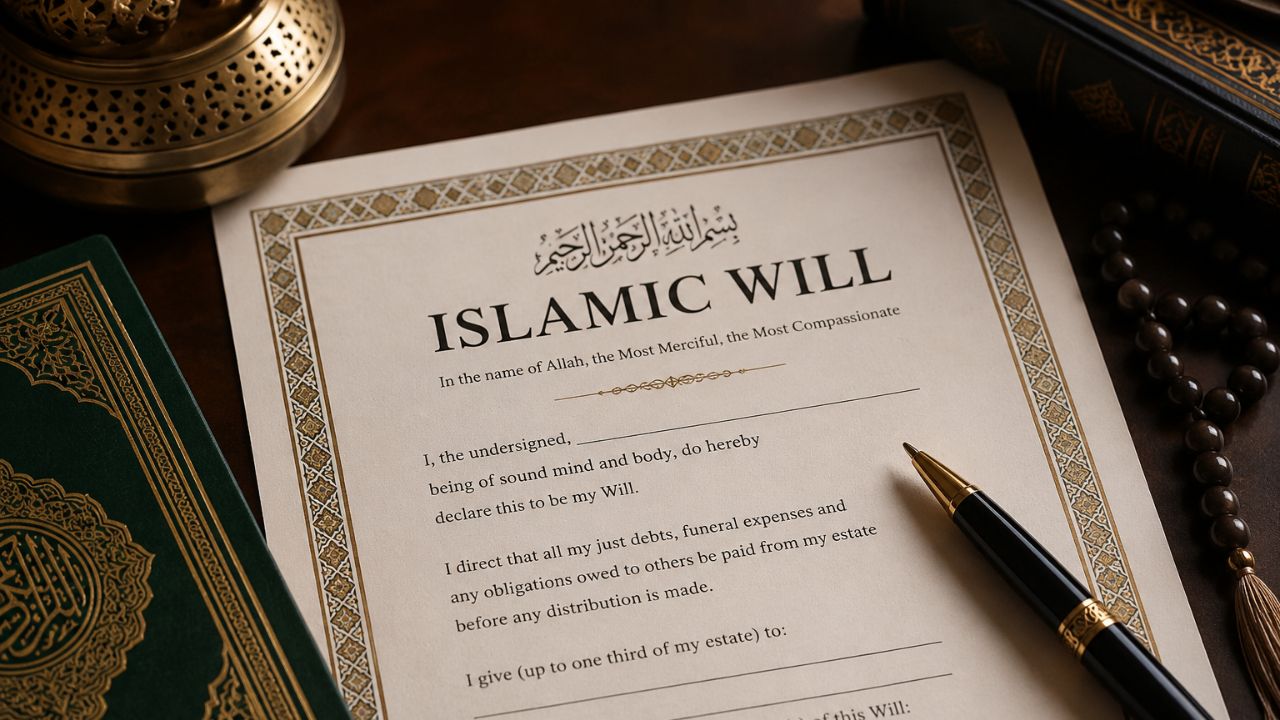
Why you should not delay in writing your will
Most people know they should have a will, yet many delay writing one. We assume there will be time later. We assume our family will know what to do. We assume everything will work itself out. However, the Quran and Sunnah have instructed us not to leave important matters to chance.
The Messenger of Allah ﷺ said:
“It is not right for a Muslim who has something to bequeath to stay for two nights without having his will written and kept ready with him.” (Bukhari and Muslim)
This hadith shows that preparing a will is part of being responsible and fulfilling the rights of others before we meet Allah.
A Will is about protecting rights
When a person dies, a number of rights immediately come into existence.
There is the right of Allah regarding any unpaid obligations. There are the rights of creditors if debts remain outstanding. There are the rights of family members who inherit from the estate. There are the rights of young children who may need guardians. There is also the right of the deceased to have their lawful burial wishes respected. A properly prepared will helps ensure that these rights are not disputed or neglected.
Many families experience unnecessary stress after a bereavement because important information was never recorded. Relatives may not know where assets are held, what debts exist, who should administer the estate or even what the deceased wanted regarding their burial.
A clear will removes uncertainty and provides guidance at a difficult time.
Protecting your burial wishes
For Muslims, one of the most important matters is ensuring that Islamic funeral arrangements are carried out promptly and correctly.
While many families naturally honour these wishes, difficulties can arise, particularly when relatives are unfamiliar with Islamic practices, where there are disagreements within the family, or where the deceased was a revert to Islam or part of a mixed-faith family.
A will should clearly state that you wish to have an Islamic burial and should include details of the funeral service. You may wish to add family members who should be contacted immediately after your death.
Although burial wishes are not automatically legally binding in every situation, a written statement provides strong evidence of your wishes and can be extremely important if disputes arise.
Make it easy for your family to find what you own
Writing a will is very important, but it is also important to leave clear information about what you own and where it can be found. Many people have bank accounts, property papers, pensions, policies, investments, business details and online accounts, but their family may not know where these are.
This can cause a lot of difficulty after someone passes away. Their family may not know what assets they had, which accounts they used, or how to access their phone, laptop or computer. Important documents may be locked behind passwords, emails, apps or two-factor authentication.
To avoid this, keep a simple and up-to-date list of your main assets, accounts, devices and important documents. Do not put passwords directly in your will. Instead, keep them safely in a secure password manager, or leave clear instructions with a trusted executor or solicitor.
You should also check the digital legacy options on your devices. For example, Apple allows you to add a Legacy Contact, which is someone you choose to access certain Apple Account data after your death. Apple says your Legacy Contact will need the access key and your death certificate to request access.
A will tells people what should happen. Good records help them actually carry it out.
Settling debts before distributing wealth
Islam places great emphasis on settling debts. Before inheritance is distributed, funeral expenses, debts and any valid bequests must first be settled.
عَنْ سَلَمَةَ بْنِ الأَكْوَعِ ـ رضى الله عنه ـ قَالَ كُنَّا جُلُوسًا عِنْدَ النَّبِيِّ صلى الله عليه وسلم إِذْ أُتِيَ بِجَنَازَةٍ، فَقَالُوا صَلِّ عَلَيْهَا. فَقَالَ ” هَلْ عَلَيْهِ دَيْنٌ ”. قَالُوا لاَ. قَالَ ” فَهَلْ تَرَكَ شَيْئًا ”. قَالُوا لاَ. فَصَلَّى عَلَيْهِ ثُمَّ أُتِيَ بِجَنَازَةٍ أُخْرَى، فَقَالُوا يَا رَسُولَ اللَّهِ، صَلِّ عَلَيْهَا. قَالَ ” هَلْ عَلَيْهِ دَيْنٌ ”. قِيلَ نَعَمْ. قَالَ ” فَهَلْ تَرَكَ شَيْئًا ”. قَالُوا ثَلاَثَةَ دَنَانِيرَ. فَصَلَّى عَلَيْهَا، ثُمَّ أُتِيَ بِالثَّالِثَةِ، فَقَالُوا صَلِّ عَلَيْهَا. قَالَ ” هَلْ تَرَكَ شَيْئًا ”. قَالُوا لاَ. قَالَ ” فَهَلْ عَلَيْهِ دَيْنٌ ”. قَالُوا ثَلاَثَةُ دَنَانِيرَ. قَالَ ” صَلُّوا عَلَى صَاحِبِكُمْ ” . قَالَ أَبُو قَتَادَةَ صَلِّ عَلَيْهِ يَا رَسُولَ اللَّهِ، وَعَلَىَّ دَيْنُهُ. فَصَلَّى عَلَيْهِ.
Salama bin Al-Akwa (may Allah be pleased with him) narrated:
Once, while we were sitting in the company of Prophet, a dead man was brought. The Prophet (ﷺ) was requested to lead the funeral prayer for the deceased. He said, “Is he in debt?” The people replied in the negative. He said, “Has he left any wealth?” They said, “No.” So, he led his funeral prayer. Another dead man was brought and the people said, “O Allah’s Messenger (ﷺ)! Lead his funeral prayer.” The Prophet (ﷺ) said, “Is he in debt?” They said, “Yes.” He said, “Has he left any wealth?” They said, ”Three Dinars.” So, he led the prayer. Then a third dead man was brought and the people said (to the Prophet (ﷺ) ), Please lead his funeral prayer.” He said, “Has he left any wealth?” They said, “No.” He asked, “Is he in debt?” They said, (“Yes! He has to pay) three Diners.’, He (refused to pray and) said, “Then pray for your (dead) companion.” Abu Qatada said, “O Allah’s Messenger (ﷺ)! Lead his funeral prayer, and I will pay his debt.” So, he led the prayer. (Bukhari)
Many people spend years building wealth but leave behind confusion because no record was kept of what they owed. A will helps protect the rights of those to whom money is due.
Seeking professional legal, shariah compliant and tax advice when preparing your will can help ensure your estate is distributed in the legally most tax-efficient way.
Allah has already decided the shares of inheritance
One of the greatest misconceptions is that a will allows a person to decide who receives their estate after death. Islamically, this is largely not the case.
Allah Himself has allocated shares of inheritance to certain relatives in the Quran. These shares are not recommendations. They are divine rulings revealed by Allah.
For this reason, a Muslim should not use a will to favour one child over another, exclude daughters, give everything to a spouse or distribute wealth according to personal preference.
The Prophet ﷺ said:
إِنَّ اللَّهَ قَدْ أَعْطَى كُلَّ ذِي حَقٍّ حَقَّهُ أَلاَ لاَ وَصِيَّةَ لِوَارِثٍ.
“Allah has given each person who has a right their right, so there is no bequest for an heir.” (Abu Dawud, al-Tirmidhi and Ibn Majah)
A Muslim will should therefore work alongside Islamic inheritance law, not replace it. The purpose of the will is not to rewrite Allah’s distribution. Rather, it is to ensure that Allah’s distribution is actually carried out.
The one-third bequest
Islam does allow a person to leave up to one-third of their estate to non-heirs. This may include charities, good causes, relatives who are not entitled to inherit, or other beneficiaries. For many Muslims, this is an opportunity to continue supporting beneficial causes even after they have left this world.
Amir bin Sa’d reported on the authority of his father (Sa’d ibn Abi Waqqas): Allah’s Messenger (may peace be upon him) visited me in my illness which brought me near death in the year of Hajjat-ul-Wada’ (Farewell Pilgrimage). I said: Allah’s Messenger, you can well see the pain with which I am afflicted and I am a man possessing wealth, and there is none to inherit me except only one daughter. Should I give two-thirds of my property as Sadaqa? He said: No. I said: Should I give half (of my property) as Sadaqa? He said: No. He (further) said: Give one-third (in charity) and that is quite enough. To leave your heirs rich is better than to leave them poor, begging from people; that you would never incur an expense seeking therewith the pleasure of Allah, but you would be rewarded therefor, even for a morsel of food that you put in the mouth of your wife. (Muslim)
Other important matters
A will should also address practical issues such as:
- appointing trustworthy executors;
- nominating guardians for minor children;
- listing significant assets and investments;
- recording important documents and account details; and
- providing information that will help those administering the estate.
The easier you make things for your family, the less burden they will carry at an already difficult time.
Do not delay
Writing a will is often postponed because it forces us to think about death. Yet death comes whether we prepare for it or not.
The Prophet ﷺ encouraged believers not to leave this matter unattended. Therefore, every Muslim should take the time to review their affairs, prepare a will and ensure that it remains up to date.
The seriousness of ignoring Allah’s shares
After mentioning the inheritance portions, Allah says:
تِلۡكَ حُدُودُ ٱللَّهِۚ وَمَن يُطِعِ ٱللَّهَ وَرَسُولَهُۥ يُدۡخِلۡهُ جَنَّـٰتٖ تَجۡرِي مِن تَحۡتِهَا ٱلۡأَنۡهَٰرُ خَٰلِدِينَ فِيهَاۚ وَذَٰلِكَ ٱلۡفَوۡزُ ٱلۡعَظِيمُ
“These are the limits set by Allah. Whoever obeys Allah and His Messenger, He will admit him to Gardens beneath which rivers flow, abiding therein forever. That is the great success. But whoever disobeys Allah and His Messenger and transgresses His limits, He will admit him to the Fire, abiding therein forever, and he will have a humiliating punishment.” (Surat al-Nisa 4:13–14)
This shows how serious the matter is. A Muslim should not write a will that deliberately deprives rightful heirs, excludes daughters, favour one child over another, or distributes the estate according to culture, emotion or convenience instead of the shares Allah has revealed.
Converts and mixed-faith families
For converts to Islam, and for those whose close family members are not Muslim, having a will is particularly important.
Many families naturally wish to honour the deceased’s wishes, but sometimes relatives are unaware of Islamic funeral practices or do not appreciate how important they are to the deceased. In some cases, family members may arrange a non-Islamic funeral or even cremation because no clear instructions were left behind.
For this reason, converts should clearly record their wish for an Islamic burial, inform trusted family members and friends, and ensure that those most likely to be involved after their death know who should be contacted. Taking these simple steps can prevent confusion, distress and disputes at an already difficult time.
A conversation that feels uncomfortable today may spare your loved ones from difficult decisions tomorrow.
Further help and resources
If you are concerned about ensuring your Islamic burial wishes are respected, particularly if you are a convert to Islam or come from a mixed-faith family, it is advisable to record your wishes clearly and discuss them with those closest to you.
The National Burial Council provides guidance, resources and a Letter of Wishes that can help families and individuals plan ahead:
National Burial Council – Statutory Regulation and Guidance
Organisations such as the National Burial Council have highlighted cases where funeral arrangements became disputed because wishes had not been clearly documented or communicated beforehand.
The NBC document is not a substitute for a will. Everyone should have a:
- A Shariah-compliant will.
- Clear burial instructions.
- Communicate their wishes to their family.
Together these provide the strongest protection for both burial wishes and inheritance rights.