
What is Islam?
Explaining Islam to non-Muslims – beyond the myths and misconceptions
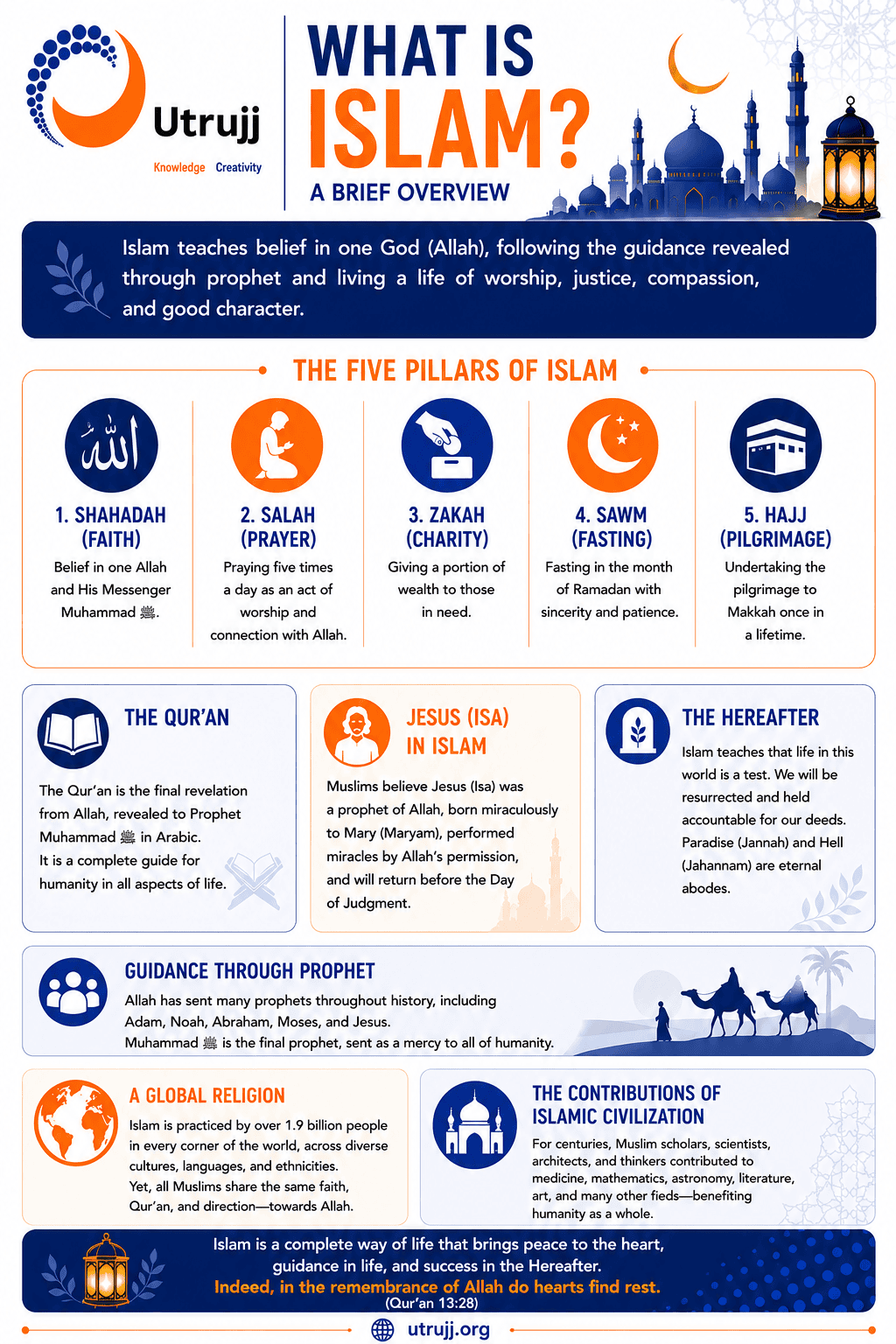
Two billion people, (about a quarter of the globe) are Muslim. Muslims believe in one God, who is called Allah, the Arabic word for God, which is also used by Arabic-speaking Christians. Muslims believe that God is the Creator of everything, including the universe, and time, as well as humans and angels. He is unlike anything within creation. He is not part of creation, nor is creation part of Him. Nothing resembles Him. He has no partner, no children, no parents and no equal.
God is close to every person and knows what is carried within every heart. Muslims believe God’s most prominent attribute is His mercy and that He is completely just. Anyone can turn to Him directly, at any time and in any language.
The word Islam means to willingly submit oneself to God. It comes from the same Arabic word as salam, meaning peace. Muslims believe that inner peace is found when human beings recognise their Creator and live according to His guidance.
Muslims believe that true freedom only comes when man can free himself from the pulls of desire, and other pressures from culture and society which take him away from what is pleasing to God.
Muslims believe that every human life has purpose. People were not created by accident or without aim. They were created to know God and worship Him. Worship includes prayer and giving charity, but reaches far beyond religious rituals. Caring for another person can be an act of worship when it is intended to be so. Even earning honestly or showing patience counts as worship.
Muslims believe that God did not leave mankind without guidance. Indeed, He sent prophets and messengers from the time of Adam’s creation, until the final messenger, who was Muhammad ﷺ, and was born in 571 CE in Makkah, Saudi Arabia. Muslims believe in all the prophets sent by God from the Jewish and Christian traditions, such as Noah, Abraham, Moses, David and Job (peace be upon them all).
Muslims honour Jesus (peace be upon him), as the Messiah and one of God’s greatest prophets. They believe in his miraculous birth and hold his mother Mary in great respect. However, they do not believe that Jesus is God or part of a Trinity. They believe that at the time of crucifixion, he did not die, but was raised alive by God, and will return towards the end of time, as a just ruler. He will re-establish peace and justice, and his return will be one of the major signs that the Day of Judgement is near.
Muslims believe that the Qur’an is the word of God, which was revealed to Prophet Muhammad ﷺ over twenty three years, and remains unchanged today. It has been preserved in its original Arabic for over 1,400 years and continues to be memorised by people across the world and recited in daily prayer. The Qur’an invites people to reflect on creation and consider the meaning of their lives.
The purpose of the Qur’an is to connect people to God, and to help people improve their conduct and develop their human potential. The wrongdoing of some Muslims should not be confused with the teachings of Islam itself
Prayer is at the heart of Muslim life. Five times each day, Muslims pause and turn back to God. These moments create space for gratitude and reflection. Muslims also give zakat (charity) to support those in need. They fast from dawn to sunset during the month of Ramadan, and if they are able and can afford it, they perform a pilgrimage to Makkah, known as Hajj, once in their life.
Islam teaches that all people come from one human family. Race does not make one person better than another, and wealth does not determine human worth. Every person has dignity and will be held accountable before God for how they lived.
Muslims believe that this life is temporary, and will be followed by judgement, when the truth will become clear and all matters will be resolved with perfect justice. No suffering will be unredressed or ignored. No act of kindness will be overlooked, even if nobody noticed it, as God is all-knowing. God’s love and mercy extends to all creatures, and He accepts the repentance of anyone who turns to Him with sincerity.
For Muslims, Islam is not a set of beliefs, but a way of living with awareness of God and a sense of purpose. The Qur’an and the example of Prophet Muhammad ﷺ provide the template for how to live the best life, extend kindness to others, as well as cope with the difficulties and challenges that are part and parcel of life.
On the Day of Judgement, humanity will be sorted into those who had true belief and did good deeds. These will be rewarded with a new life of eternal bliss in Paradise, whilst those who rejected faith and committed evil deeds will doomed to Hell for eternity.
The Five Pillars
The Five Pillars provide the basic structure of Muslim worship. The first is the shahadah, through which a person affirms that Allah alone deserves worship and that Muhammad ﷺ is His messenger.
Muslims pray five times each day. Prayer interrupts the rush of ordinary life and turns the worshipper back towards Allah. Muslims stand before Him, then bow and place their foreheads on the ground. This physical act expresses humility before the Creator. The form of Muslim prayer has remained unchanged since the birth of Islam.
Muslims who possess sufficient wealth give zakat (charity). This is an obligatory contribution from those who have wealth, to those who are in need. Zakat teaches that wealth is a trust from Allah and that the poor have recognised rights within society.
During Ramadan, Muslims fast from dawn until sunset. The fast is intended to develop self-control and gratitude. It also reminds Muslims of people who experience hunger without choosing it. Muslims who are physically and financially able perform the pilgrimage to Makkah. Pilgrims gather in simple clothing before God. Differences of wealth or social standing become insignificant.
These practices are not intended to be empty rituals. Prayer should make a person more conscious of wrongdoing. Fasting should strengthen the ability to resist harmful desires. Charity should weaken selfish attachment to wealth.
Revelation and the prophets
Muslims believe that God did not leave humanity without guidance. He sent prophets throughout history to remind people of their Creator and call them back to moral living. Over time, corruption and injustice spread through society and people turned away from God and morality. Prophets and messengers came to bring reform. These prophets included Adam, Noah, Abraham, Moses, David and Jesus (peace be upon them all). Their circumstances were different, but their essential message was the same: worship one God and follow His guidance.
Muslims believe that Allah revealed the Torah to Moses and the Psalms to David. Jesus received the original Gospel, known in Arabic as the Injil. Muslims believe that these revelations came from God, while the Qur’an is His final revelation and the criterion by which earlier religious claims are judged.
Muhammad ﷺ is believed to be the final prophet. Muslims love him and seek to follow his example, but they do not worship him. Islam therefore understands itself as the continuation and completion of the message taught by the earlier prophets.
Values at the heart of Islam
Islam connects worship with moral conduct. A person’s relationship with Allah should change the way they treat other people.
Truthfulness is central to the Islamic way of life. A Muslim should be honest in personal relationships and faithful to promises. The same principle applies to business and public responsibility. The Qur’an commands believers to uphold justice even when doing so is against their own interests.
Sincerity is equally important. An outwardly good action may lose its spiritual value when it is performed to gain praise. Islam therefore asks a person to examine the intention behind what they do.
Mercy is another defining quality. The Qur’an describes Prophet Muhammad ﷺ as a mercy to the beings. He taught that people should show compassion towards the vulnerable and kindness towards animals. Mercy does not remove justice, but it prevents justice from becoming cruelty.
Islam also encourages forgiveness. This does not mean ignoring serious wrongdoing or denying the rights of someone who has been harmed. It means resisting the desire for personal revenge and leaving space for repentance.
Trust is treated as a serious responsibility. Property placed in a person’s care must be protected. Confidential information should not be misused. Public authority is also a trust rather than a personal privilege.
Islam encourages cooperation in what is good, while forbidding cooperation in injustice. Muslims are expected to contribute positively to their communities and seek solutions rather than adding to harm.
Quality is also valued. The Prophet ﷺ taught Muslims to carry out their work with care. Excellence is not limited to explicitly religious acts. It should be visible in craftsmanship and professional duties.
Wisdom shapes the way Islam is shared. The Qur’an says:
“Call to the way of your Lord with wisdom and good instruction, and debate with them in the most courteous manner.” (The Qur’an, 16:125)
This means that religious conversation should not be driven by humiliation or the desire to win an argument. It should be honest while remaining respectful.
Islam also teaches moderation. Human beings have spiritual needs, but they also have physical responsibilities. A Muslim is not expected to abandon family life or withdraw entirely from society. The aim is to live within a balanced framework that gives every right its proper place.
Islamic principles have a vertical dimension, concerning the relationship with God, alongside a horizontal dimension governing relationships within society. Justice and dignity are therefore not additions to faith. They are among its necessary expressions.
Islamic principles
Islam also teaches that belief must become visible through conduct. Faith that never affects behaviour has failed to achieve its purpose.
Truth
Islam requires courage in upholding truth, even if that means conveying the truth to a tyrannical leader. The Qur’an commands believers to be witnesses for justice even when the truth is uncomfortable. At the same time, Muslims are taught that truth should be communicated wisely. Honesty does not require harshness.
Simplicity
Islam does not forbid comfort or lawful enjoyment. It does warn against extravagance and waste. A Muslim may own possessions without allowing those possessions to control the heart.
Prayer interrupts constant activity. Fasting limits consumption for part of the day. Zakat (charity) prevents wealth from circulating only among those who already possess it.
Equality
Islam teaches that every person comes from the same human origin and was created by the same God.
“O humanity, We created you from a male and a female and made you into peoples and tribes so that you may know one another.” (The Qur’an, 49:13)
Race does not make one person better than another. Wealth is not a measure of worth before Allah. Men and women are equally accountable to Him.
In his farewell sermon, delivered a few months before his death, Prophet Muhammad ﷺ rejected racial superiority and reminded his listeners that their Lord was one and their human origin was one. Utrujj presents this as a universal principle of human equality.
Peace
Islam also gives peace a central place. Muslims greet one another with assalamu alaykum, meaning “peace be upon you”. Reconciliation is praised, and aggression is forbidden.
There is an important difference. Islam permits proportionate defence against aggression, so it does not generally teach absolute pacifism. However, the use of force is morally restricted. Innocent people may not be deliberately harmed. Hatred must not lead to injustice.
Muslims are committed to resisting cruelty and seeking a peace founded upon justice.
Jesus in Islam
Jesus, known in Arabic as Eesa, is deeply honoured in Islam.
Muslims believe he was the Messiah and one of Allah’s greatest prophets. They believe he was born miraculously to Mary without a human father. He performed miracles by Allah’s permission and called the Children of Israel to worship God.
Muslims do not believe that Jesus is God or the son of God. They also reject the doctrine of the Trinity. The Qur’an states:
“The Messiah, Jesus son of Mary, was only a messenger of God and His Word conveyed to Mary, and a spirit from Him. So believe in God and His messengers, and do not say, ‘Three.’” (The Qur’an, 4:171)
Muslims believe Jesus was not killed or crucified, but was raised by God. The Qur’an does not identify another individual who was crucified in his place. It says that the event was made to appear so to those involved. Muslims also believe Jesus will return before the end of time.
These teachings differ from the beliefs of many Christians. Respectful dialogue allows both communities to state their beliefs clearly without caricaturing the other.
Passages from the Qur’an for reflection
The Qur’an frequently addresses people of earlier scripture. At times it identifies theological differences, while elsewhere it calls for common ground:
“Say, ‘Followers of Scripture, let us arrive at a statement that is common to us all: that we worship none but God.’” (The Qur’an, 3:64)
The Qur’an also explains the purpose of human diversity:
“We made you into peoples and tribes so that you may know one another.” (The Qur’an, 49:13)
It affirms the breadth of God’s mercy:
“My mercy encompasses all things.” (The Qur’an, 7:156)
It offers hope to those who have made mistakes:
“Do not despair of the mercy of Allah. Allah forgives all sins. He is truly the Most Forgiving, the Most Merciful.” (The Qur’an, 39:53)
The Qur’an also stresses the sanctity of human life. It teaches that unjustly killing one person is comparable to killing all humanity, while saving a life is comparable to saving humanity as a whole.
A short history of Islam
Islam began in Makkah in 610 CE, when Prophet Muhammad ﷺ received the first verses of the Qur’an. Muslims believe that he was descended from Prophet Abraham (peace be upon him), through his son Ishmael (Ismail). The message he brought called people back to the worship of the one God. It also challenged the injustice and tribal arrogance found in Makkah at the time.
The early Muslims faced years of persecution. In 622, the Prophet ﷺ and his followers migrated to Madinah. This journey, known as the Hijrah, marks the beginning of the Islamic calendar. Madinah became home to the first organised Muslim community, where Islam was expressed not only through prayer but through family life and public responsibility. By the death of the Prophet ﷺ in 632, most of the Arabian Peninsula had entered the Muslim community.
Over the following century, Muslim rule extended rapidly. By the early eighth century, it reached Spain in the west and Central Asia in the east. Islam later became deeply established across North Africa and parts of the Indian subcontinent. From the fourteenth century onwards, it also spread through the Balkans under the Ottoman Empire.
Sicily became a flourishing centre of Islamic civilisation and a bridge between the Muslim world and Europe, when Islam reached it in the ninth century. Palermo became the capital of Muslim Sicily and developed into one of the great cities of the Mediterranean. Muslim communities improved irrigation and expanded the cultivation of crops such as citrus fruits and sugar cane. The island became connected to the wider commercial world of North Africa and the eastern Mediterranean.
Although Norman forces completed their conquest of Sicily in 1091, the island’s Islamic heritage did not disappear. Norman rulers continued to employ Arabic-speaking administrators and Muslim craftsmen. Arabic remained important within the royal court, while Islamic artistic forms shaped some of Sicily’s most celebrated buildings. UNESCO describes Arab-Norman Palermo as a remarkable cultural synthesis in which Islamic and Byzantine traditions were woven into a Latin Christian setting.
The Muslim geographer al-Idrisi worked at the court of King Roger II and produced one of the most important geographical works of the medieval period. His maps drew upon knowledge gathered from across Europe and Asia, showing how Sicily had become a meeting point between different worlds.
Thus the influence of Islamic civilisation often continued even after Muslim political rule had ended. Its scholarship and architecture enriched medieval Europe, while its agricultural legacy remains visible in Sicilian life today.
This expansion was not one single process. In some regions, Muslim political rule arrived through military conquest. In many others, Islam spread without Muslim armies. Merchants carried it across the Indian Ocean, while teachers and travelling scholars introduced it to new communities. Through these peaceful networks, Islam became rooted along the East African coast and throughout South-East Asia. The process was often gradual, with local people adopting Islam while retaining many of their languages and customs.
This worldwide reach reflects an important Islamic belief. Muslims believe that many earlier prophets were sent to particular nations, while Prophet Muhammad ﷺ was sent with a message for all humanity. Islam was therefore never intended to belong to one race. It was not confined to Arabia, nor did becoming Muslim require someone to become culturally Arab.
As Islam reached new lands, it connected peoples who had previously been separated by great distances. Trade routes linked Europe with Africa and Asia. Merchants moved goods across this vast network, but they also carried ideas and books. Arabic became an international language of scholarship, allowing knowledge to be shared across many regions.
Under Muslim civilisation, cities such as Baghdad and Cordoba became renowned centres of learning. Libraries gathered works from earlier cultures, including Greek writings and knowledge inherited from Persia and India. Muslim scholars did not merely preserve this material. They studied it closely and added discoveries of their own. Islamic civilisation made important contributions to medicine and mathematics. It also advanced the study of astronomy and the natural world. UNESCO describes the richness of this civilisation and its immense contribution to human knowledge.
Learning was supported through schools and charitable endowments known as awqaf (plural of waqf). These endowments also funded hospitals and services for travellers. Some provided food or clean water for local communities. The waqf made public welfare a continuing act of worship, allowing wealth to benefit people long after the original donor had died.
Muslim trade encouraged the growth of cities and created links across continents. Goods from China could pass through Muslim commercial centres towards the Mediterranean, while African and Indian products travelled in the opposite direction. These networks supported economic prosperity and gave people from very different societies opportunities to meet.
Muslim rule also brought long periods of stability to many regions. Shared laws helped regulate trade and protect property. Roads became safer in many periods, allowing scholars and pilgrims to travel across enormous distances. Muslim societies included Christian and Jewish communities, who retained their places of worship and communal institutions under Islamic rule. Their experience was not identical in every country or century. Nevertheless, the Islamic world frequently provided a level of religious coexistence that was uncommon in much of the medieval world.
The history of Muslim civilisation was not perfect. Muslim rulers sometimes acted unjustly, just as other rulers have done. There were wars and political struggles. Islamic principles were not always upheld. Yet wherever Islam took root, it carried a vision greater than political power. It taught that knowledge was sacred and that wealth brought responsibility. It encouraged the building of communities in which worship shaped public life.
Islamic civilisation gave the world beautiful architecture and thriving centres of learning. It established hospitals where the sick could be treated and developed institutions through which charity could continue across generations. It brought together people from many backgrounds under belief in one Creator.
Today, Islam is practiced in almost every part of the world. Muslims may be Arab or African. They may come from Europe or the Far East. Their languages and customs differ widely, yet they are united by the same Qur’an and face the same direction in prayer.
The extent of Islam’s spread shows that it is not the property of one nation. It is a universal faith that has found a home in many cultures. At its best, Islamic civilisation brought people order after instability and learning where knowledge had been neglected. It connected distant societies and created opportunities for peaceful exchange.
Islam is a major world religion, that is frequently misrepresented in the media or misunderstood. Yet it is a source of hope and comfort, a direction, a guidance and a way of living with compassion and responsibility. Its history demonstrates the power of a faith that can unite people without requiring them to become culturally identical.