
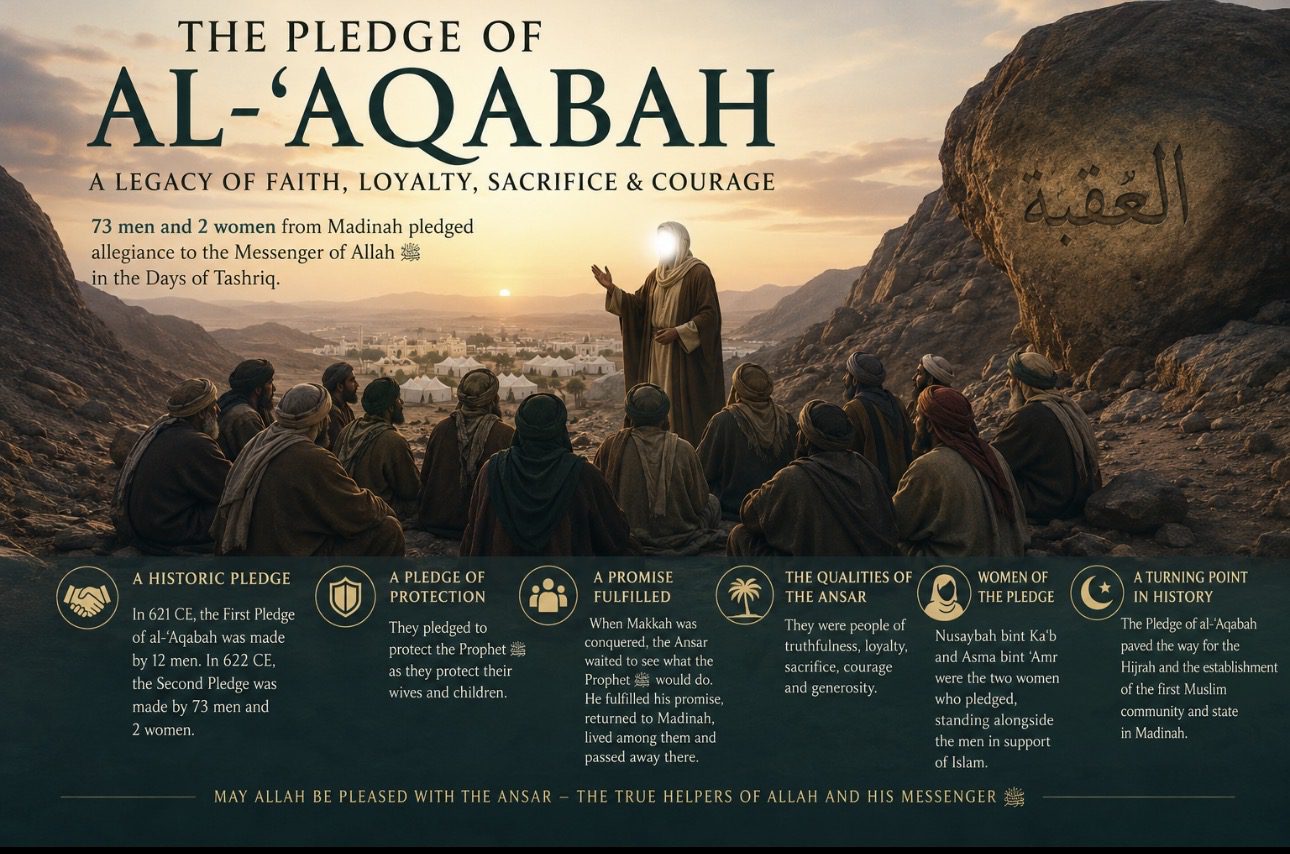
The pledge that changed the history of humanity
The pledge of al-‘Aqabah in the days of Tashriq
We are still in the blessed days of Eid al-Adha. These days are known as the Days of Tashriq. When we think about Eid al-Adha, we naturally think about the sacrifice of Prophet Ibrahim (peace be upon him), the rites of Hajj, and the remembrance of Allah. Yet many people are unaware that one of the most significant events in the Seerah also took place during these very days: the Second Pledge of al-‘Aqabah.
The pledge became known as the Pledge of al-‘Aqabah because it took place at al-‘Aqabah, a secluded mountain pass in Mina near Makkah. The location was carefully chosen for secrecy, hidden amongst the valleys and pathways of Mina, away from the eyes of Quraysh during the Hajj season.
The story of al-‘Aqabah is also the story of the people of Madinah. The people of Madinah became known for their truthfulness, their incredible loyalty, their huge sacrifices, as well as their courage and tremendous generosity. These qualities would soon transform the course of Islamic history.
Not to forget the sacrifices of Al Muhajireen may Allah be pleased with them.
In the twelfth year of Prophethood, corresponding to 621 CE, the First Pledge of al-‘Aqabah took place. Twelve prominent men from the tribes of Aws and Khazraj accepted Islam and pledged allegiance to the Messenger of Allah (peace be upon him). One year later, in the thirteenth year of Prophethood, corresponding to 622 CE, seventy-three men and two women travelled from Yathrib, later known as Madinah, to meet the Prophet (peace be upon him) once again.
The meeting took place during the Days of Tashriq, in days just like these. The delegation gathered secretly at al-‘Aqabah in the middle of the night. They knew that if Quraysh discovered the meeting, there could be serious consequences. Yet their desire to support the Messenger of Allah (peace be upon him) was greater than their fear.
Ka‘b ibn Malik (may Allah be pleased with him) described the scene:
“We set out for Hajj and arranged to meet the Messenger of Allah (peace be upon him) at al-‘Aqabah during the middle days of Tashriq. We slept among our people in their camps until a third of the night had passed. Then we quietly slipped away from our camps, moving stealthily, until we gathered at the valley near al-‘Aqabah. We were seventy-three men and two women.”
At the end of the night, they waited with anticipation. They knew that something great was about to happen, something that would change their lives and the future of the Ummah. Though they pretended to sleep, they lay awake. They were waiting to meet the Messenger of Allah (peace be upon him), to give him their pledge, and to hear directly from him what would be required of them.
The Prophet (peace be upon him) did not come alone. He came with his uncle al-‘Abbas ibn ‘Abd al-Muttalib. Although al-‘Abbas had not yet embraced Islam publicly, he cared deeply for the safety of his nephew and wanted to ensure that those inviting him to Madinah fully understood the responsibility they were undertaking.
Al-‘Abbas addressed the delegation and reminded them that Muhammad (peace be upon him) still enjoyed protection amongst his people in Makkah. If they were inviting him to leave that protection and come to Madinah, they had to be prepared to defend him and stand by him no matter what challenges lay ahead. If they thought they might abandon him after bringing him to their city, then they should say so now.
It is noteworthy that al-‘Abbas addressed them by saying, “O people of Khazraj,” even though members of both Aws and Khazraj were present. The Arabs would often refer to all the Ansar collectively as Khazraj, even when both tribes were included. In reality, the delegation represented both Aws and Khazraj, whose long history of conflict had been replaced by unity through Islam. He said:
‘People of Khazraj, you know the position of Muhammad among us. We have protected him from our people who share our view regarding him. He enjoys honor and protection among his people and in his homeland. Yet he insists on joining you and settling among you. If you believe that you can fulfill the promises you have made to him and protect him from those who oppose him, then proceed and bear the responsibility. But if you think you may abandon him and fail him after he comes to you, then leave him now, for he remains honoured and protected among his people and in his land.’
After hearing al-‘Abbas, Kaʿb bin Malik replied,
“We have heard what you have said. Speak, O Messenger of Allah, and take for yourself and for your Lord whatever pledge you wish.”
The Messenger of Allah (peace be upon him) then said:
‘I pledge allegiance with you on the condition that you protect me as you protect your own women and children.’
At that moment, al-Bara ibn Ma‘rur took the Prophet’s hand and declared:
“By the One who sent you with the truth as a Prophet, we shall protect you just as we protect our own families.”
His words reflected the spirit of the Ansar. They were not making a temporary alliance or a political agreement. They were committing themselves completely to the protection of the Messenger of Allah (peace be upon him) and the message he carried.
Then Abu al-Haytham ibn al-Tayyihan asked a remarkable question. He said:
‘O Messenger of Allah, there are ties between us and certain men (meaning the Jews), and we will sever them. If we do that and Allah grants you victory, might you then return to your people and leave us?’
The Messenger of Allah ﷺ smiled and replied:
‘Rather, Your blood is my blood, and your cause is my cause. I am of you and you are of me. I will fight those whom you fight and make peace with those with whom you make peace.’
Then he said:
‘Choose for me twelve leaders from among yourselves to be responsible for their people.’
They selected twelve leaders: nine from Khazraj and three from Aws.” (Ahmad)
In another narration, Jabir (may Allah be pleased with him) said:
“We asked: ‘O Messenger of Allah, upon what shall we pledge allegiance to you?’
He replied:
‘Upon hearing and obeying in times of eagerness and reluctance; upon spending in charity in times of hardship and ease; upon enjoining what is right and forbidding what is wrong; upon speaking for Allah without fearing the blame of any critic; and upon supporting and protecting me when I come to you, as you protect yourselves, your wives, and your children. In return, you shall have Paradise.’ (Ahmad)
This pledge marked a turning point in Islamic history, laying the foundation for the Prophet’s (peace be upon him) migration (Hijrah) to Madinah and the establishment of the first Muslim community and state.
Years later, when Allah granted the Prophet (peace be upon him) victory and Makkah was conquered, the Ansar remembered that promise. They watched carefully to see what he would do. Makkah was his birthplace, his homeland, and the most beloved land to him. Now that it had been opened by Allah, would he remain there with his own people, or would he return to Madinah?
The Messenger of Allah (peace be upon him) fulfilled his promise. He did not abandon the Ansar. He returned with them to Madinah, lived among them, and eventually passed away there. This was the fulfilment of his words: “I am from you and you are from me.” It showed his loyalty, his faithfulness, and the depth of the covenant made at al-‘Aqabah.
Then he gave them the greatest promise imaginable:
“And for you is Paradise.”
This was not a pledge based on worldly gain. It was a pledge built upon faith. It reflected sacrifice and certainty in the promise of Allah.
After the pledge was completed, the Prophet (peace be upon him) instructed them to appoint twelve representatives from among themselves. Nine were chosen from Khazraj and three from Aws. These representatives would help organise and guide their communities and prepare the way for what was to come.
Among those who attended the pledge were some of the greatest figures of the Ansar, including As‘ad ibn Zurarah, Ka‘b ibn Malik, Sa‘d ibn Mu‘adh, Sa‘d ibn ‘Ubadah, al-Bara ibn Ma‘rur, ‘Abdullah ibn Rawahah, Abu al-Haytham ibn al-Tayyihan, Sa‘d ibn al-Rabi‘, ‘Ubadah ibn al-Samit, Rifa‘ah ibn ‘Abd al-Mundhir and Usayd ibn Hudayr (may Allah be pleased with them all).
What distinguished the men of al-ʿAqabah was their pledge to the Prophet ﷺ to hear and obey, to spend in times of hardship and ease, and to support and protect him as they protected themselves and their families.
Two remarkable women were also present: Nusaybah bint Ka‘b and Asma bint ‘Amr (may Allah be pleased with them both). Their participation in this historic event reminds us that Muslim women also played an important role in supporting the da‘wah and establishing the Muslim community in Madinah. Nusaybah bint Ka‘b would later become famous for her courage at the Battle of Uhud, where she defended the Prophet (peace be upon him) with extraordinary bravery.
The Second Pledge of al-‘Aqabah was one of the most important turning points in Islamic history. It laid the foundations for the Hijrah and prepared the way for the establishment of the first Muslim community and state in Madinah.
More importantly, it revealed the extraordinary character of the people of Madinah. They were willing to sacrifice anything for the Prophet (peace be upon him). They fulfilled their pledge – they fought in the battles that occured within Madinah and outside it. They showed courage and commitment and in return the Prophet (peace be upon him) made dua for their rizq to be blessed as much as Makkah and more. This is why Madinah was prosperous and you could even sell sand in Madinah and prosper because of his dua!
Anas ibn Malik (may Allah be pleased with him) reported that the Messenger of Allah (peace be upon him) said:
عن أنس بن مالك رضي الله تعالى عنه قال: قال رسول الله صلّى الله عليه وسلم: “اللهُمَّ اجعَلْ بالمَدينةِ ضِعفَي ما جَعَلتَ بمَكَّةَ مِنَ البَرَكةِ”.
رواه البخاري.
“O Allah, place in Madinah twice the blessing that You have placed in Makkah.” (Bukhari)
They were people of truthfulness, loyalty, sacrifice, courage and generosity. They were willing to risk their safety, their wealth and even their lives for the sake of Allah and His Messenger (peace be upon him).
As we reflect during these Days of Tashriq, we should remember that these blessed days are connected not only to the sacrifice of Ibrahim (peace be upon him), but also to the sacrifice of the Ansar and Al Muhajireen. On those nights at al-‘Aqabah, seventy-three men and two women pledged themselves to the cause of Islam, and through their sincerity Allah changed the course of history.
One of the greatest achievements of Islam in Madinah was that it united the Aws and Khazraj after decades of conflict and warfare, bringing them together as one community in support of the Messenger of Allah (peace be upon him).
When you live for Allah, everything you have belongs to Him so you can sacrifice it for Him and for His pleasure.
We also see that women were present and participated in the pledge. Right from the beginning, women were present and active. This was one of the most important events in Islamic history – and they were key in delivering the message of Islam to their families and communities and showed their love for the Prophet (peace be upon him). The Prophet (peace be upon him) did not dismiss them as insignificant or send them away because they were women.
It was the deep love they carried for the Prophet (peace be upon him) that enabled them to carry the divine message which is a heavy burden. Allah said:
إِنَّا سَنُلۡقِی عَلَیۡكَ قَوۡلࣰا ثَقِیلًا
We will reveal to you a heavy message. (73:5)
You cannot carry any load unless you are committed and sincere. With Allah’s love in your heart, you can carry mountains. The Muhajireen also showed deep love and commitment. They left their beloved city, families and belongings to support the Prophet (peace be upon him).
The Prophet (peace be upon him) stood and delivered his speech to the 75 companions, whose hearts were pumping with love for him, whose faces were shining with light because of their imaan. Allah did not let them down. Allah made them victorious and mentioned in the Quran that He is pleased with them.
We envy them in a good way – they were able to shake his hand, hear his voice, hug him and smell his fragrance. They were blessed to be able to walk with him, talk with him, eat with him and learn from him. Their hearts were full of imaan and Allah increased their imaan because of their obedience to Him and His Messenger (peace be upon him).
If we want Allah to increase our imaan, we need to increase our obedience and commitment to Him. We were not present at that pledge but we can pledge to follow his footsteps, carry his teachings and emulate his kindness, mercy and wise approach and be his messenger. If we keep this pledge in our hearts, it will be a new opening for us. We remember the sacrifices of those who brought this message to the world.
We are indebted to the companions whose pledge opened the way for the message of Islam to take root and grow. And indebted first to Allah and His Messenger (peace be upon him).
We ask Allah to be pleased with us and increase our closeness and sincerity, Ameen.
Based on the Khutbah of Shaykh Haytham Tamim on 29th May 2026