

ADHD and Islam
In recent years, ADHD has become much more widely discussed. For some people, this has brought relief. They finally have language for struggles they have carried for years. For others, the term is used so casually online that it can feel as though every distraction, bad habit, or lack of discipline is now being called ADHD. Both extremes are unhelpful.
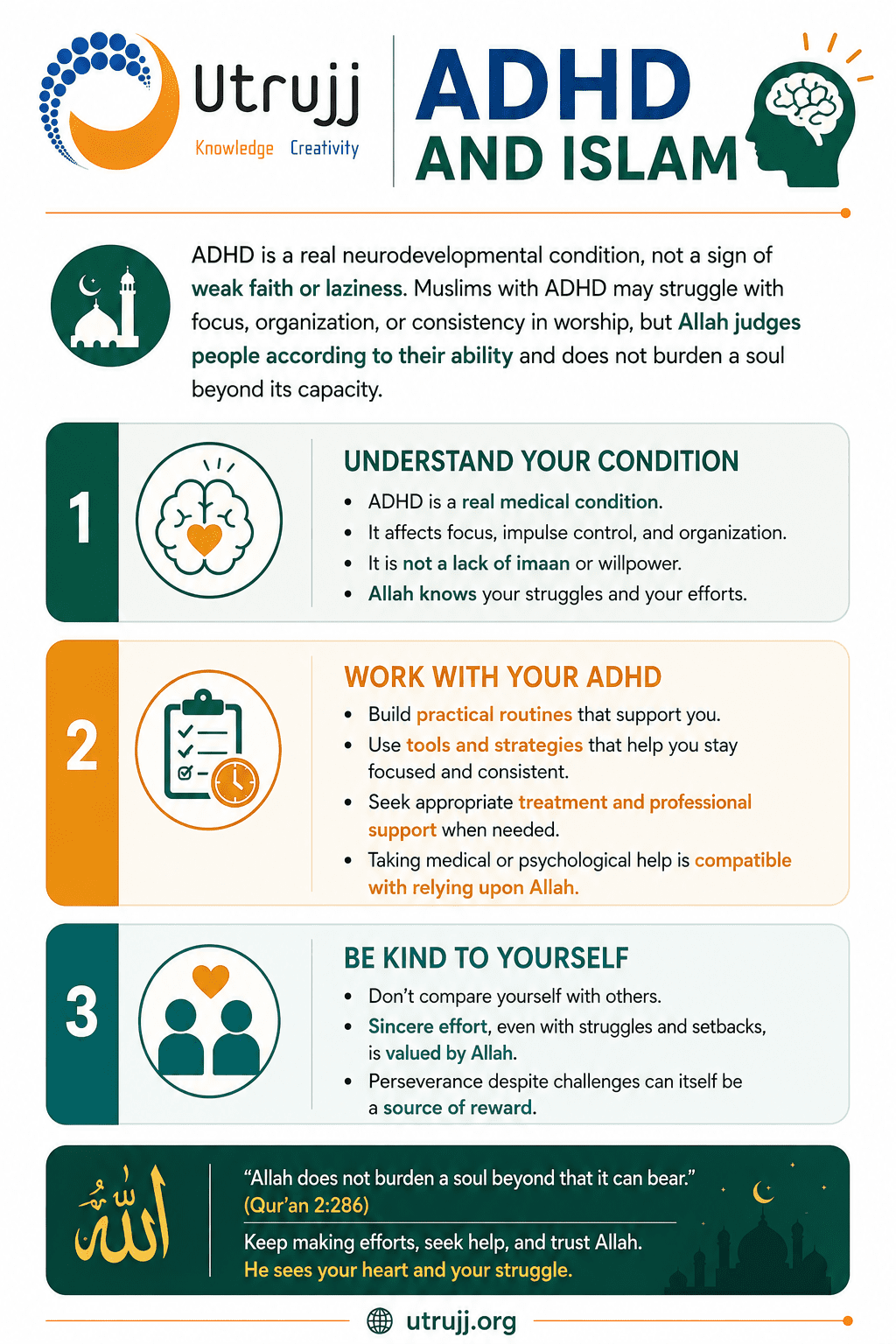
ADHD is recognised in clinical guidance as a neurodevelopmental condition that can affect children, young people and adults. It commonly involves persistent patterns of inattention, hyperactivity, impulsivity, and difficulties with self-regulation. At the same time, not every difficulty with focus, prayer, motivation, or organisation is ADHD.
Anxiety, depression, trauma, stress, poor sleep, excessive phone use, grief, burnout, and ordinary human weakness can all create similar struggles. This is why self-awareness is important, but casual self-diagnosis is not enough. Where ADHD is suspected and it is significantly affecting daily life, a person should seek proper assessment from a qualified professional.
In Islam, compassion does not cancel out accountability. A diagnosis may explain certain struggles, but it does not remove the responsibility to seek help, improve, and fulfil one’s obligations as best as possible.
This article is therefore not about excusing every weakness or dismissing ADHD as laziness. It is about understanding a real struggle.
What is ADHD?
ADHD stands for Attention Deficit Hyperactivity Disorder. Despite the name, it is not simply a problem of “not paying attention.” Many people with ADHD can focus intensely on certain things, especially when they are urgent, stimulating, interesting, or emotionally engaging. The difficulty is often regulating attention consistently.
ADHD may affect:
- concentration
- impulsivity
- organisation
- time management
- emotional regulation
- memory
- motivation
- starting and finishing tasks
One useful concept is executive functioning. Executive functions are the brain’s management skills. They help a person plan, begin tasks, switch between tasks, control impulses, manage time, and follow things through.
In ADHD, these processes may be harder to regulate. This does not mean the person has no choice or no responsibility. It means that ordinary tasks may require much more effort, structure, and support than they appear to require from the outside.
This is why someone with ADHD may sincerely intend to do something but still delay it, forget it, avoid it, or feel overwhelmed by it. Afterwards, they may feel ashamed and wonder why something simple felt so difficult.
ADHD also looks different in different people. Some are visibly restless and impulsive. Others are quiet outwardly but mentally overwhelmed. Some do well academically or professionally while privately struggling with disorganisation, exhaustion, emotional reactivity, or constant anxiety about forgotten responsibilities.
How ADHD can affect daily life
For some people, ADHD affects far more than productivity. It can affect confidence, relationships, worship, studies, work, and emotional wellbeing.
A person may lose track of time easily, forget tasks despite caring about them deeply, or struggle to begin something until it becomes urgent. They may feel overwhelmed by routines that others seem to manage naturally. Some speak impulsively, react emotionally, or begin many things but struggle to complete them.
Many people with ADHD also describe difficulty prioritising tasks based purely on importance. Attention may drift towards whatever feels stimulating, urgent, emotionally engaging, or interesting, even when another task is objectively more necessary. This does not mean the person does not care. Often, they care deeply but struggle with regulation and consistency.
Over time, some people fall into a repeated cycle of intention, delay, panic, guilt, renewed motivation, and exhaustion. This can lead to deep shame, especially when others only see the outward behaviour: lateness, distraction, forgetfulness, mess, or inconsistency. They may not see the inner effort, frustration, or mental exhaustion behind it.
Still, ADHD should not be used to explain everything. A person can have ADHD and also need discipline. They can struggle sincerely and still need to apologise. They can need support and still need accountability.
ADHD and worship
For many Muslims with ADHD, worship can become an area of deep guilt.
A person may want to pray early but repeatedly delay until the last minute. They may stand in salah and find their thoughts jumping from one thing to another. They may open the Qur’an with sincerity but lose focus after a few minutes. They may start adhkar, study plans, or voluntary worship with enthusiasm, then struggle to maintain them.
Some may miss prayers because of sleep problems, time blindness, disorganisation, or emotional overwhelm. Others may feel that their worship is never “good enough” because they cannot maintain focus as they wish. However, not every struggle in worship is ADHD. Every believer experiences distraction, laziness, waswasa, low motivation, and fluctuation in iman. But for some people, ADHD can make consistency, focus, and routine significantly harder.
Islam does not dismiss human limitation. Allah Almighty says:
لَا يُكَلِّفُ اللَّهُ نَفْسًا إِلَّا وُسْعَهَا
“Allah does not burden a soul beyond its capacity.”
(Surah al-Baqarah 2:286)
Allah Almighty also says:
فَاتَّقُوا اللَّهَ مَا اسْتَطَعْتُمْ
“So fear Allah as much as you are able.”
(Surah at-Taghabun 64:16)
The Prophet ﷺ said:
إِنَّ الدِّينَ يُسْرٌ
“The religion is ease.”
(Bukhari)
And he ﷺ said:
إِذَا أَمَرْتُكُمْ بِأَمْرٍ فَأْتُوا مِنْهُ مَا اسْتَطَعْتُمْ
“When I command you with something, do of it what you are able.”
(Bukhari and Muslim)
These texts do not mean a person stops trying. They mean Allah knows the reality of each servant. He knows the effort behind actions that may look small to others. He knows the hidden struggle behind consistency.
A Muslim with ADHD should not despair of Allah’s mercy. They should also not surrender to the struggle completely. They continue striving, repenting, adjusting, and seeking the means that help them worship better.
ADHD is not a free pass
Compassion should not become denial of responsibility. ADHD may help explain why someone struggles with focus, impulsivity, time management, emotional regulation, or consistency. But it does not automatically excuse every missed duty. It does not absolve one of saying hurtful words, making broken promises, or harmful patterns.
A person may need to say: “I struggle with this, but I still need to work on it.” This is the Islamic middle path. We do not crush people with shame, but we also do not remove accountability altogether.
If ADHD contributes to anger, impulsive speech, addiction, neglect, or repeated disorganisation, then the person should seek help, build systems, apologise when needed, and take practical steps to reduce harm. Understanding the cause of a struggle should increase responsibility, not remove it.
Seeking treatment and support
Some Muslims feel ashamed about seeking help for ADHD. They may fear being judged, dismissed, or told that they simply need more discipline or stronger iman.
Qur’an, dhikr, dua, tawbah, salah, and closeness to Allah bring strength and healing to the heart. But Islam does not teach us to ignore practical means. Seeking support is not a lack of tawakkul. Tawakkul means relying on Allah while also using the means He has placed in creation.
The Prophet ﷺ said:
تَدَاوَوْا عِبَادَ اللَّهِ
“Seek treatment, O servants of Allah.”
(Tirmidhi)
For ADHD, support may include proper assessment, psychoeducation, behavioural strategies, therapy, coaching, better routines, sleep regulation, exercise, environmental changes, and, where clinically appropriate, medication.
Medication is not weakness, and it is not required for everyone. Some people benefit greatly from it. Others manage through different forms of support. The best approach depends on the individual and should be discussed with qualified professionals.
ADHD – context and strengths
ADHD does not exist in a vacuum. A person’s level of struggle may depend greatly on their environment, relationships, work, sleep, stress, support, and daily structure. Someone may function well in a role that suits their strengths, but struggle deeply in an environment that demands constant administration, stillness, routine paperwork, or rigid 9-to-5 productivity. This does not make ADHD unreal. It shows that impairment is often shaped by context.
This is why treatment and support should be individual. Some people benefit from medication, while others may manage well through structure, coaching, therapy, lifestyle changes, supportive relationships, or work that suits their natural strengths. For many, the best approach is a combination of these.
ADHD can also overlap with other difficulties, including anxiety, depression, burnout, overwhelm, trauma, and sometimes bipolar disorder. These should not all be collapsed into one label. Proper assessment matters because each condition may need its own support and treatment.
It is also important to speak about strengths. Many people with ADHD are creative, intuitive, energetic, responsive in emergencies, quick at problem-solving, and able to think in unusual or imaginative ways. They may struggle with routine systems but thrive when work is meaningful, stimulating, relational, practical, urgent, or creative.
Some writers describe this through the “hunter-farmer” idea: the suggestion that traits now seen as difficult in modern classrooms or offices may once have been useful in more alert, mobile, risk-aware, and responsive environments. This remains a theory rather than settled science, but it is a helpful reminder that modern life is not the only measure of human ability.
Islam gives structure without reducing human beings to machines. Salah, fasting, halal food, sleep, cleanliness, dhikr, community, and routine all help regulate the self. Wholesom (tayyib), balanced nutrition and regular movement also support emotional and mental functioning. These are not replacements for clinical help where it is needed, but they are part of the wider Islamic way of caring for the body, mind, and soul.
A Muslim with ADHD should not only ask, “What is wrong with me?” They can also ask, “What environment helps me function? What gifts has Allah given me? How can I build a life where my strengths are used in service of something good?”
Practical advice for Muslims with ADHD
The aim is not to build a perfect routine overnight. The aim is to make worship and responsibility easier to return to. Small, realistic systems often work better than intense bursts of motivation.
The Prophet ﷺ said:
أَحَبُّ الْأَعْمَالِ إِلَى اللَّهِ أَدْوَمُهَا وَإِنْ قَلَّ
“The most beloved deeds to Allah are those done consistently, even if small.”
(Bukhari and Muslim)
A person may benefit from attaching habits to salah times. For example, reading one page of Qur’an after Fajr, making morning adhkar after brushing teeth, or reviewing tasks after Maghrib. Linking worship to an existing routine makes it easier to remember.
Reduce friction before worship. Keep a prayer mat visible. Place a Qur’an where you will actually see it. Set adhan reminders. Prepare clothes for Fajr. Keep wudu easier by organising the space around it.
Use written reminders rather than relying on memory alone. A person with ADHD should not feel ashamed of using alarms, notes, calendars, checklists, apps, or accountability. These are tools, not failures.
Break tasks into smaller steps. “Read Qur’an every day” may feel too vague. “Read five lines after Fajr” is clearer and easier to begin.
Avoid all-or-nothing thinking. Missing one prayer on time, one day of Qur’an, or one routine does not mean everything has collapsed. Return quickly. Shaytan often uses one slip to push a person into giving up entirely.
Protect sleep as much as possible. Poor sleep can worsen attention, mood, and impulse control. For some people, fixing sleep is one of the most important steps towards improving worship and daily functioning.
Exercise can also help regulate mood, energy, and restlessness. It is not a cure for ADHD, but it can be a powerful support.
Most importantly, do not build your religious life only on emotion. Motivation rises and falls. Systems, reminders, habits, and supportive people help carry you when motivation is low.
Supporting someone with ADHD
Families, teachers, spouses, and community leaders should try to understand before judging. A child or adult with ADHD may already feel ashamed of their inconsistency. Constant humiliation, comparison, or being called lazy can make things worse. It may increase hopelessness rather than change behaviour.
This does not mean removing expectations. Many people with ADHD benefit from clear structure, predictable routines, gentle reminders, and consequences that are fair and consistent.
The Sunnah teaches us that people are not all the same, and wisdom requires adjusting our approach according to their capacity. The Prophet ﷺ instructed imams to shorten the prayer when leading others because among the congregation may be the weak, the sick, the elderly and those with needs. He also corrected Mu‘adh (may Allah be pleased with him) when he prolonged the prayer and caused difficulty for people. This shows that mercy is practical. It requires noticing people’s different situations and responding with wisdom.
In the same way, supporting someone with ADHD means recognising their struggle while still helping them grow. Encouragement, structure, patience, and realistic expectations often work better than shame.
ADHD can make life feel scattered, frustrating, and exhausting. For some Muslims, it affects worship, relationships, study, work, and self-esteem. Many carry years of guilt because they think every difficulty is simply a spiritual failure. No sincere effort is wasted with Allah Almighty. A deed that looks small to others may be heavy on the scale because of the struggle behind it.
Understanding neurodiversity and dysregulation
People with ADHD may be more prone to certain patterns of emotional or mental dysregulation, and these difficulties can sometimes become part of a repeated cycle of overwhelm, impulsivity, shame, exhaustion, and frustration. However, a person should not minimise the suffering of others simply because their own struggles feel intense, nor should they magnify every weakness through over-identification or casual self-diagnosis.
Productivity and modern expectations
In today’s world, productivity, speed, and constant efficiency are heavily valued. Yet human beings have always differed in temperament, focus, energy, and patterns of thinking. Indeed, in certain contexts, neurodiverse traits can make huge contributions to creativity, craftsmanship, exploration, problem-solving, or highly specialised forms of work.
Why does ADHD appear more visible today
In the past, people were often less likely to seek help, speak openly about such struggles, or receive formal diagnosis. Modern life also places heavy demands on sustained concentration, deadlines, and constant adaptability across many areas at once, so certain difficulties become far more noticeable within modern systems and expectations.
Sensitivity to rejection
Some people with ADHD may also experience rejection or criticism more intensely than others. They may carry years of shame from being repeatedly labelled lazy, careless, immature, or inconsistent despite sincere effort. This is why compassion matters. But compassion should lead a person towards self-understanding and growth. They should not build their identity entirely around a diagnosis or viewing themselves as permanently broken.
Ultimately, every human being has strengths, weaknesses, tests, and areas of struggle. The believer’s task is not to compare themselves endlessly to others, but to understand themselves honestly, seek beneficial means, and continue striving towards Allah with patience, sincerity, and hope.
By Ayesha Khan. Reviewed by and contributed to by Abu Shama and Dr Saania Bhatti.
Check out our resources on neurodiversity