
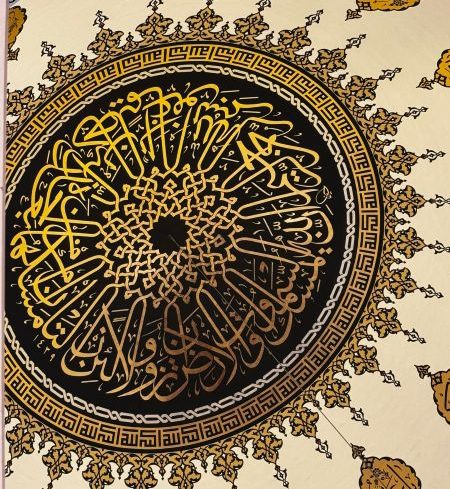
Is it permissible to display Islamic calligraphy as decoration?
It is permissible to put Islamic calligraphy on walls as decoration, as long as it is treated with respect.
Many scholars have said that there is nothing wrong with hanging Qur’anic verses, hadiths, or Islamic reminders in the home, office, or other suitable places if the aim is to remember Allah and benefit from the words.
We can see that calligraphy has also been used in many mosques throughout Islamic history. This shows that writing Qur’anic verses or Islamic words in a beautiful way is not something blameworthy in itself. If calligraphy reminds people of Allah, softens the heart, and keeps Qur’anic meanings visible in the environment, then that is a valid and meaningful benefit, not an abuse of sacred words.
However, there are a few important conditions. The calligraphy should be placed in a clean and honourable place. It should not be hung somewhere disrespectful, neglected, or treated carelessly. It should also not be used with the belief that the writing itself protects the home or brings blessings by itself, because protection comes from Allah, not from a frame on the wall.
Some scholars disliked excessive decoration in mosques, especially if it distracts people from salah. But this is a different issue. The concern is distraction and over-decoration, not the basic permissibility of Islamic calligraphy itself.
The balanced view is that Islamic calligraphy is permissible as decoration, provided it is displayed respectfully and not used as a charm or superstition. If it also reminds people of Allah and brings beneficial meanings into the home, then that is something good.