
Who are the biggest losers? Dissecting the causes of loss
Allah talks about loss in Surat Az-Zumar, stating:
قُلْ إِنَّ الْخَاسِرِينَ الَّذِينَ خَسِرُوا أَنْفُسَهُمْ وَأَهْلِيهِمْ يَوْمَ الْقِيَامَةِ أَلَا ذَٰلِكَ هُوَ الْخُسْرَانُ الْمُبِينُ
Say, ‘The true losers are those who lost themselves and their families on the Day of Resurrection. Undoubtedly, that is the evident loss.’ (Surah al-Zumar 39:15)
The language of profit and loss
The stock market goes up and down. Those who bought shares in Nvidia thinking they will rise, saw them fall 30% and the same corrupt person re-instated at the top. The people of Makkah understood the language of profit and loss very well. They were people of trade and business. During the Makkan years of revelation, the Qur’an spoke in terms they understood from daily life. They knew what it meant to make a profit and what it meant to lose. So when Allah spoke to them about loss, it caught their attention. And then He reframed their understanding, and told them what the greatest loss really is.
The Qur’an uses the words al-khasirun (الخاسرون) and al-khasireen (الخاسرين), meaning ‘the losers’, 24 times across 15 surahs. Including the forms without the definite article brings the count to 32. The root kh-s-r (خ س ر) occurs 65 times in its various forms.
I went through these verses asking what led people to lose in each case. It is not just loss in dunya, it is everlasting loss. I found around sixteen reasons, which can be grouped into five broad categories.
What leads us to loss?
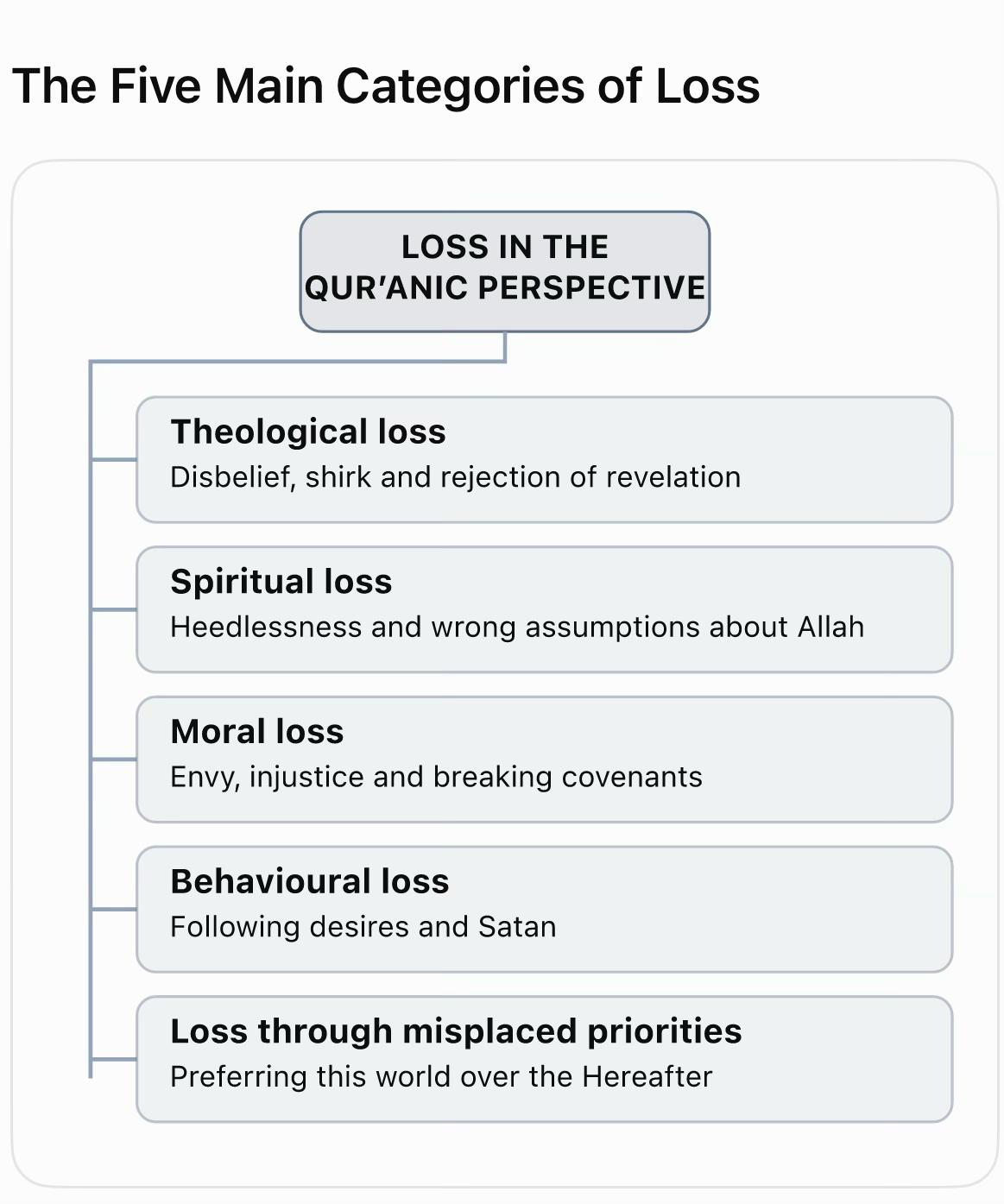
1. Loss in matters of belief
One of the gravest causes of loss is rejection of belief. And associating partners with Allah (shirk). In Surah al-Zumar, Allah warns that shirk can bring a person’s deeds to nothing (39:65). The Qur’an speaks in the same terms about rejecting Allah’s revelation (2:121, 39:63), accepting falsehood and disbelieving in Allah (29:52), and seeking a religion other than Islam (3:85).
Look at the people of Shu‘ayb (peace be upon him). Their leaders told them that if they followed him, they would be losers. Allah calls those who denied Shu‘ayb the losers. The very people who thought they knew where success lay had measured it by the wrong thing (7:90–92).
2. Heedlessness and the state of the heart
Heedlessness, or ghaflah, is a serious loss. Allah describes people who have hearts with which they fail to understand, eyes with which they fail to see and ears with which they fail to hear (7:178–179). They have the means to recognise the truth, yet they let it pass them by.
Some become so comfortable in their blessings that they imagine they are safe from Allah’s punishment (7:99). Others assume that Allah does not know much of what they do, as Surah Fussilat describes. That very assumption brings them to ruin (41:22–23).

3. Loss through our character
Allah describes moral loss. People who fall into envy, commit oppression, break their promises, sever family ties are losers. Allah commands us to uphold justice, not spread corruption on earth (2:27). Yet, a person may think they have got away with something when actually they have done damage to themselves and those around them.
4. Following our whims and desires
In the account of the two sons of Adam, Allah describes what happened before one brother killed the other.
فَطَوَّعَتْ لَهُ نَفْسُهُ قَتْلَ أَخِيهِ فَقَتَلَهُ فَأَصْبَحَ مِنَ الْخَاسِرِينَ
His own soul made killing his brother seem easy to him, so he killed him and became one of the losers. (Surah al-Ma’idah 5:30)
The Qur’an also speaks about those who spend their wealth to turn people away from Allah’s path (8:36–37), those who indulge themselves and follow others into wrongdoing (9:69), and those over whom Shaytan gains such a hold that they forget Allah (58:19). When you keep giving in to what you want, it becomes easier to justify whatever you do next.
5. Putting this world before the Hereafter
In Surah al-Nahl, Allah speaks of people mis-prioritise their priorities. They keep preferring the life of this world to the Hereafter (16:107–109). In Surah al-Munafiqun, the warning is addressed directly to believers.
يَا أَيُّهَا الَّذِينَ آمَنُوا لَا تُلْهِكُمْ أَمْوَالُكُمْ وَلَا أَوْلَادُكُمْ عَنْ ذِكْرِ اللَّهِ وَمَنْ يَفْعَلْ ذَٰلِكَ فَأُولَٰئِكَ هُمُ الْخَاسِرُونَ
O you who believe, do not let your wealth or your children distract you from the remembrance of Allah. Whoever does so, those are the losers. (Surah al-Munafiqun 63:9)
Your wealth and your children are blessings. The danger comes when those very blessings absorb you to the point that you forget the One who gave them to you.
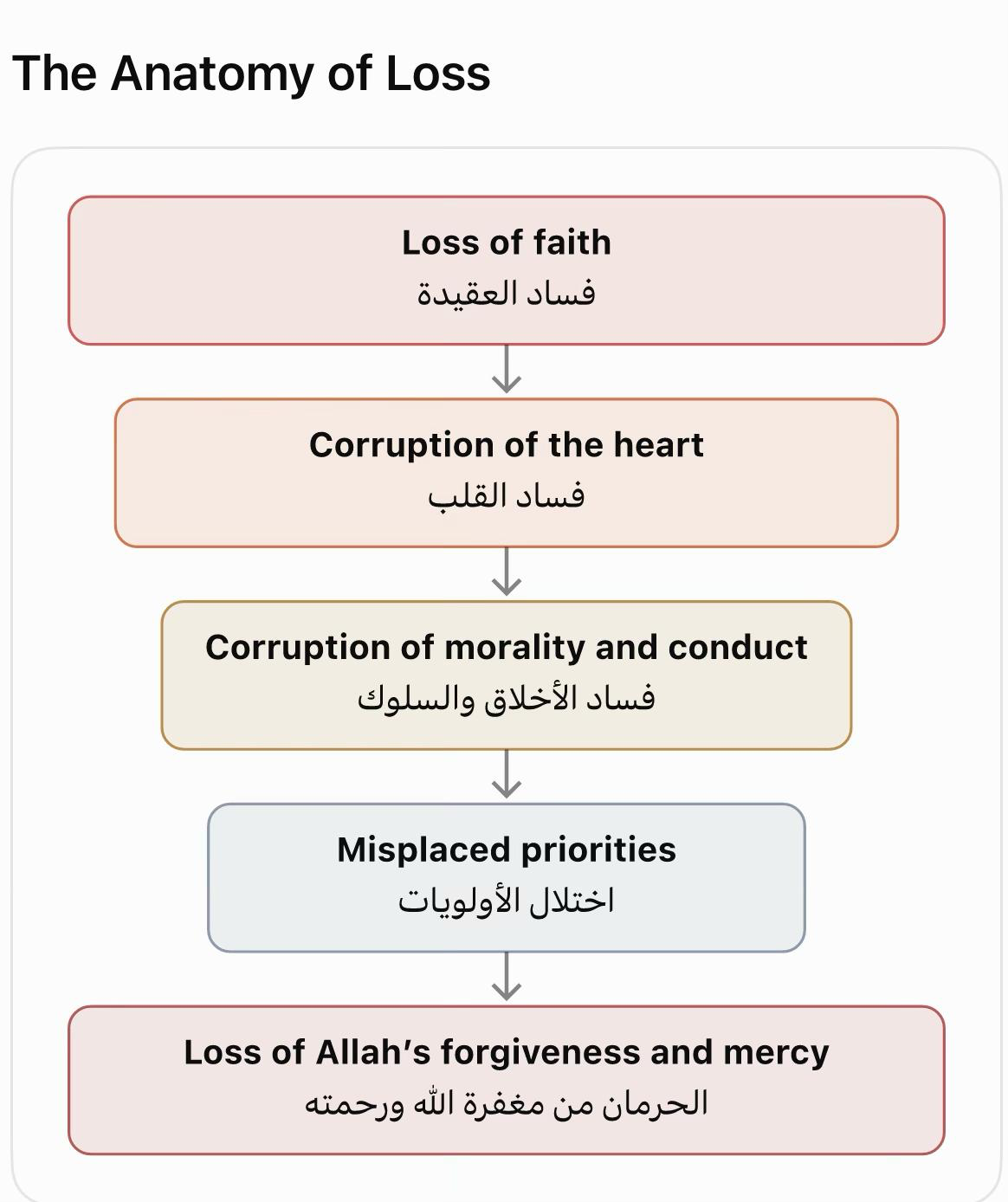
How can you lose yourself?
All sixteen reasons for loss mentioned in the Quran are covered by these five categories. Broadly, you can lose yourself by being heedless, by following your desires and by letting your ego decide what you will and will not accept. Even though your family may look up to you, or your community may take you as an example, if you are taking yourself towards ruin, where might you be taking the people who follow you? Think again about the opening verse. A person can lose themselves and the very people they love out of their ego and arrogance.
Allah shows us how to avoid loss in Surah al-‘Asr
We recite this short surah in our salah frequently. In three verses Allah tells us about the disease and gives us the cure.
وَالْعَصْرِ إِنَّ الْإِنْسَانَ لَفِي خُسْرٍ إِلَّا الَّذِينَ آمَنُوا وَعَمِلُوا الصَّالِحَاتِ وَتَوَاصَوْا بِالْحَقِّ وَتَوَاصَوْا بِالصَّبْرِ
By time. Surely humanity is in loss, except those who believe, do righteous deeds, urge one another to uphold the truth and urge one another to persevere. (Surah al-‘Asr 103:1–3)
Allah gives us four things to hold on to: having faith, doing good deeds, encouraging others to do good, and perserving with sabr (patience). This is why the Quran is infallible! It mentions the disease and the remedy. If you do not want to lose, follow the path of the winners.
Who are the successful (al-muflihoon)?
Then I asked myself, who are the opposite of al-khasirun? The Qur’an calls them al-muflihun (المفلحون), the successful. The word appears twelve times in this form, with one further occurrence as al-mufliheen (المفلحين).
At the beginning of Surah al-Baqarah, Allah describes people who believe in the unseen, establish prayer and give from what He has provided. They believe in what He has revealed and are certain of the Hereafter. Allah says of them:
أُولَٰئِكَ عَلَىٰ هُدًى مِنْ رَبِّهِمْ وَأُولَٰئِكَ هُمُ الْمُفْلِحُونَ
They are upon guidance from their Lord, and they are the successful. (Surah al-Baqarah 2:5)
Who are the victorious (al-fa’izun)?
In addition to the successful, we have the victorious (al-fa’izun). The Qur’an shows us who they are, what they do and how they attain victory.
Fawz (الفوز) means escaping harm and attaining goodness. The greatest victory is to be saved from the Fire, admitted into Paradise and granted Allah’s pleasure.
Al-fa’izun (الفائزون) appears four times across four surahs. These four occurrences account for every use of the plural, whose other case form is al-faʾizeen (الفائزين). The root f-w-z (ف و ز) occurs 29 times across 27 verses in its various forms.
Who are the victorious?
1. The believers who migrate and strive in Allah’s cause
الَّذِينَ آمَنُوا وَهَاجَرُوا وَجَاهَدُوا فِي سَبِيلِ اللَّهِ بِأَمْوَالِهِمْ وَأَنْفُسِهِمْ أَعْظَمُ دَرَجَةً عِنْدَ اللَّهِ وَأُولَٰئِكَ هُمُ الْفَائِزُونَ
Those who believe, migrate and strive in Allah’s cause with their wealth and their lives are higher in rank with Allah. They are the victorious. (Surah al-Tawbah 9:20)
The verse brings together belief, migrating, striving and sacrifice.
2. The patient believers
إِنِّي جَزَيْتُهُمُ الْيَوْمَ بِمَا صَبَرُوا أَنَّهُمْ هُمُ الْفَائِزُونَ
Today I have rewarded them for their patience. They are the victorious. (Surah al-Mu’minun 23:111)
The preceding verses tell us what their patience looked like. They believed, asked Allah for forgiveness and mercy, and remained steadfast when people ridiculed them (23:109–111).
3. Those who obey Allah and remain mindful of Him
وَمَنْ يُطِعِ اللَّهَ وَرَسُولَهُ وَيَخْشَ اللَّهَ وَيَتَّقْهِ فَأُولَٰئِكَ هُمُ الْفَائِزُونَ
Those who obey Allah and His Messenger, fear Allah with reverence and remain mindful of Him are the victorious. (Surah al-Nur 24:52)
Allah mentions four qualities here. They obey Allah, obey His Messenger ﷺ, have reverential fear of Allah and live with taqwa.
4. The people of Paradise
لَا يَسْتَوِي أَصْحَابُ النَّارِ وَأَصْحَابُ الْجَنَّةِ أَصْحَابُ الْجَنَّةِ هُمُ الْفَائِزُونَ
The people of the Fire and the people of Paradise are unequal. The people of Paradise are the victorious. (Surah al-Hashr 59:20)
Here Allah shows us where true victory leads.
Fourteen means of attaining victory
| No. | Means of victory | Qur’anic reference |
| 1 | Faith in Allah | 9:20 |
| 2 | Obedience to Allah | 24:52 |
| 3 | Obedience to the Messenger ﷺ | 33:71 |
| 4 | Reverential fear of Allah (khashyah) | 24:52 |
| 5 | God-consciousness (taqwā) | 78:31 |
| 6 | Righteous deeds | 64:9 |
| 7 | Truthfulness | 5:119 |
| 8 | Patience | 23:111 |
| 9 | Migration (hijrah) | 9:20 |
| 10 | Striving and sacrifice | 61:10–12 |
| 11 | Fulfilling one’s covenant with Allah | 9:111 |
| 12 | Observing Allah’s prescribed limits | 4:13 |
| 13 | Seeking forgiveness and mercy | 23:109–111 |
| 14 | Following the early believers with excellence | 9:100 |
These are among the means of victory that emerge from the Qur’anic verses and their contexts.
Five pillars of victory
| Pillar | What it encompasses |
| Faith | Belief and certainty |
| Spiritual integrity | Reverence and God-consciousness |
| Righteous conduct | Obedience, truthfulness and righteous deeds |
| Sacrifice and steadfastness | Patience, migration, striving and sacrifice |
| Allah’s grace | Forgiveness, mercy and divine pleasure |
What does true victory mean?
Being saved from the Fire and admitted into Paradise
فَمَنْ زُحْزِحَ عَنِ النَّارِ وَأُدْخِلَ الْجَنَّةَ فَقَدْ فَازَ
Whoever is kept away from the Fire and admitted into Paradise has truly attained victory. (Surah Al ‘Imran 3:185, excerpt)
Receiving Allah’s mercy
فَيُدْخِلُهُمْ رَبُّهُمْ فِي رَحْمَتِهِ ذَٰلِكَ هُوَ الْفَوْزُ الْمُبِينُ
Their Lord will admit them into His mercy. That is the clear victory. (Surah al-Jathiyah 45:30, excerpt)
Attaining Allah’s pleasure
وَرِضْوَانٌ مِنَ اللَّهِ أَكْبَرُ ذَٰلِكَ هُوَ الْفَوْزُ الْعَظِيمُ
Allah’s pleasure is greater. That is the supreme victory. (Surah al-Tawbah 9:72, excerpt)
Loss, success and victory in the Qur’an
| Qur’anic term | Qur’anic use |
| Khusran (الخسران), loss | Losing oneself, one’s family and one’s Hereafter |
| Falah (الفلاح), success | Attaining goodness and escaping harm |
| Fawz (الفوز), victory | In the Hereafter, attaining eternal bliss and escaping punishment |
Faith is the foundation. Obedience is the path. Taqwa is the provision, and patience keeps us steadfast. Falah is the goal, and attaining Allah’s pleasure is the supreme victory.
Come to success
With each adhan, we are invited to success. The adhan tells us unequivocally that putting Allah above our own desires, following Allah’s commands and performing salah is the key to success.
حَيَّ عَلَى الْفَلَاحِ
Come to success.
We hear this invitation every day. When the call to prayer comes, what are we prepared to put aside to answer it? If you want to make a profit rather than a loss on the Day of Resurrection, look at the good deeds you are sending ahead.
When Adam and Hawwa realised they had sinned, they asked Allah for forgiveness and mercy.
قَالَا رَبَّنَا ظَلَمْنَا أَنْفُسَنَا وَإِنْ لَمْ تَغْفِرْ لَنَا وَتَرْحَمْنَا لَنَكُونَنَّ مِنَ الْخَاسِرِينَ
They said, ‘Our Lord, we have wronged ourselves. If You do not forgive us and have mercy on us, we will surely be among the losers.’ (Surah al-A‘raf 7:23)
Nuh (peace be upon him) made the same appeal for forgiveness and mercy (11:47). We need that mercy however much good we do.
اللَّهُمَّ اجْعَلْنَا مِنَ الْمُفْلِحِينَ وَلَا تَجْعَلْنَا مِنَ الْخَاسِرِينَ
We ask Allah to make us among the successful and keep us from being among the losers. Ameen.
Based on the Khutbah of Shaykh Haytham Tamim on 27th November 2026.