
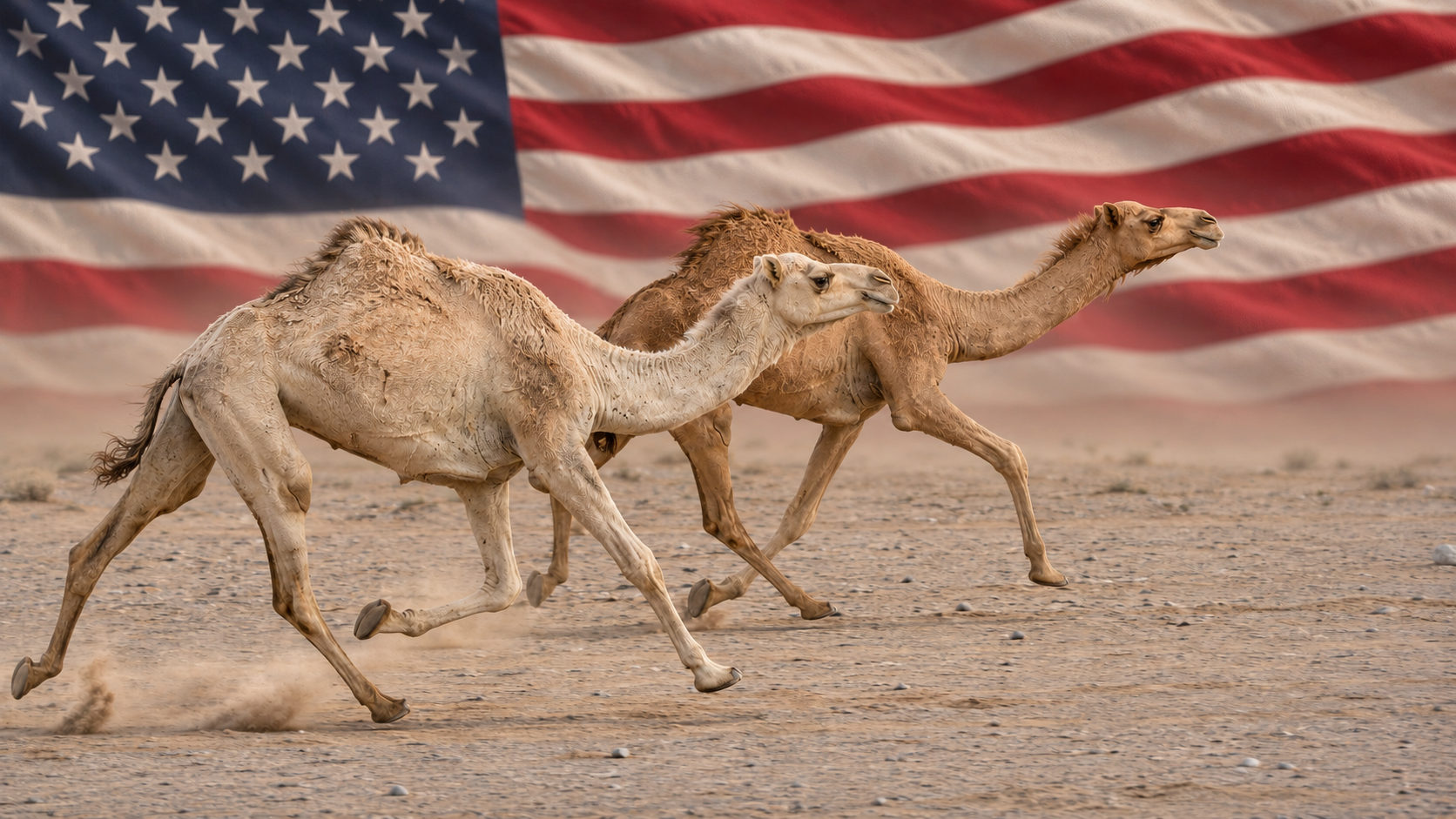
When power changes hands
In Surat Al Imran, Allah gives us words with which to turn to Him when we see power change hands:
قُلِ اللَّهُمَّ مَالِكَ الْمُلْكِ تُؤْتِي الْمُلْكَ مَنْ تَشَاءُ وَتَنْزِعُ الْمُلْكَ مِمَّنْ تَشَاءُ وَتُعِزُّ مَنْ تَشَاءُ وَتُذِلُّ مَنْ تَشَاءُ بِيَدِكَ الْخَيْرُ إِنَّكَ عَلَىٰ كُلِّ شَيْءٍ قَدِيرٌ
“Say, ‘O Allah, Master of all sovereignty, You give authority to whom You will and take it away from whom You will. You honour whom You will and humiliate whom You will. All goodness is in Your hand. You have power over all things.’” (Surat Ale Imran, 3:26)
In this ayah, Allah is using his Beautiful Names to show the manifestation of His power. Among His Divine Names, (asma al husna) is Al-Khafid and Ar-Rafi – the One who lowers and the One who raises. Some times, we do not give a second thought to what we see before our eyes, but at others, we see His divine names in action.
However, after watching the American elections this week, we can’t help but see them in action! We saw some politicians were raised while others were spectacularly humiliated. We see the same thing on a smaller scale in our own lives.
Why we mention these Names together
Among the Beautiful Names we have some that are contrasting pairs. Scholars such as Ibn al-Qayyim have discussed this, and we do not mention these names without mentioning the other half of the pair, as they go together.
For instance, Al-Khafid and Ar-Rafi‘ (الخافض الرافع), the One who lowers and raises, and Al-Mu‘ti and Al-Mani‘ (المعطي المانع), the One who gives and withholds. We speak of Al-Mu‘izz and Al-Mudhill (المعز المذل), the One who grants honour and brings low, Al-Qabid and Al-Basit (القابض الباسط), the One who constricts and expands, and Al-Muqaddim and Al-Muakhkhir (المقدم المؤخر), the One who brings forward and holds back.
Ibn al-Qayyim explains that when we praise Allah, we mention these Names in pairs. For example, we call Allah both the Giver and the Withholder. As Imam al-Sadi explains, the two Names together express the full meaning of our praise. The same Allah who gives us what we ask for may, in His wisdom, withhold something we dearly want. He knows and cares for every one of His creatures, and He governs them with wisdom, justice and mercy. It is easy to thank Him when He gives us what we want. Can we also trust His wisdom when He withholds it?
Mentioning some of these Names on their own may give an impression of imperfection. Taken together, they show Allah’s complete power, His all-encompassing Lordship and His perfect wisdom in governing His creation.
(Ibn al-Qayyim, Badai al-Fawaid, rule seventeen, and Al-Nuniyyah. Al-Sadi, Tafsir Asma Allah al-Husna.)
The day Al-Adba lost the race
There is a lovely example from the life of the Messenger of Allah ﷺ. He had a very strong she-camel called Al-Adba. In those days people gave names to their animals and even to their possessions. Imam al-Bayhaqi records details like these about the Prophet’s ﷺ mounts and belongings. What the companions particularly remembered about Al-Adba was how fast she was. Whenever there was a race, they expected her to win.
Anas ibn Malik (may Allah be pleased with him) related:
كَانَ لِلنَّبِيِّ ﷺ نَاقَةٌ تُسَمَّى الْعَضْبَاءَ لَا تُسْبَقُ، قَالَ حُمَيْدٌ: أَوْ لَا تَكَادُ تُسْبَقُ، فَجَاءَ أَعْرَابِيٌّ عَلَى قَعُودٍ فَسَبَقَهَا، فَشَقَّ ذَلِكَ عَلَى الْمُسْلِمِينَ حَتَّى عَرَفَهُ، فَقَالَ: «حَقٌّ عَلَى اللَّهِ أَنْ لَا يَرْتَفِعَ شَيْءٌ مِنَ الدُّنْيَا إِلَّا وَضَعَهُ».
“The Prophet ﷺ had a she-camel called Al-Adba who was never beaten in a race, or, as Humayd recalled, hardly ever beaten. Then a Bedouin came on a young riding camel and overtook her. The Muslims were so upset that the Prophet ﷺ noticed. He said, ‘Allah has decreed that whatever rises in this world, He will bring it down.’” (Sahih al-Bukhari)
The Bedouin’s mount is described as a qa‘ud (قَعُود), a young riding camel. It was the new generation – like the AI generation. For the companions it was quite something. Al-Adba has been beaten! They loved the Messenger of Allah ﷺ and had taken such pleasure in seeing his camel come first. Now they were upset and their disappointment was written all over their faces. The Prophet ﷺ could have let the moment pass. Instead, he used a camel race to cheer them up and teach them it wasn’t the end of the world, rather something they would see throughout their lives. Today you are the one out in front. Someone else may be ahead of you tomorrow. Be prepared for that day.
Whatever goes up has to come down. Think of the things Allah gives people. One person has wealth, another has beauty, another has knowledge, and someone else has a high position. In this situation, you can become so accustomed to people coming to you, listening to you and asking your opinion that you begin to imagine it will always be like this. Sometimes the change comes gradually. Sometimes everything you have grown used to is swept away at once. So don’t be cocky about what you have.
A person may be at the peak of their power and imagine that nothing can bring them low. Yet when the change comes, it can be overwhelming, like a tsunami. This is one of the manifestations of Allah’s Name Al-Khafid, the One who lowers. Firawn – the most powerful person of his time, was debased and defeated despite all his power. His authority could not protect him from Allah.
Allah warns us:
يَا أَيُّهَا النَّاسُ إِنَّ وَعْدَ اللَّهِ حَقٌّ فَلَا تَغُرَّنَّكُمُ الْحَيَاةُ الدُّنْيَا وَلَا يَغُرَّنَّكُمْ بِاللَّهِ الْغَرُورُ
“O people, Allah’s promise is true. Do not let the life of this world deceive you, and do not let the Deceiver deceive you about Allah.” (Surat Fatir, 35:5)
Be careful of the dunya when it is going well for you. It is easy to recognise a test when you lose your position. It takes more awareness to recognise that you were already being tested while you held it. Allah tells us that He created death and life “to test you as to which of you is best in deed” (لِيَبْلُوَكُمْ أَيُّكُمْ أَحْسَنُ عَمَلًا, Surat Mulk, 67:2). What did you do with the authority you had? How did you treat people when they depended on you? And how do you treat the person who has now taken your place?
What gave me hope in the American elections
Allah says, in a verse revealed in the context of battle:
وَتِلْكَ الْأَيَّامُ نُدَاوِلُهَا بَيْنَ النَّاسِ
“Such days We alternate among people.” (Surat Ale Imran, 3:140)
People who were in a position of strength yesterday can find themselves in a very different position today. On 3 November 2026, the Democrats won majorities in both houses of Congress. Even Texas and South Carolina, where Republicans had long been strong, elected Democratic senators. The cost of living weighed heavily with voters. Those votes have consequences. A president can still be in the White House and find that the people whose support he needs to pass a law have changed.
Think here of Al-Qabid and Al-Basit. One party now has greater scope to pass legislation, while the other has less. We can trace how that happened through the decisions voters made and the way the constitution distributes power. As believers, we also recognise that the outcome lies within Allah’s will. Think, too, of Al-Muizz and Al-Mudhill. How easy it is to confuse the applause a winner receives with honour before Allah. A candidate can lose a seat and come away with their integrity intact. Equally, someone who wins may go on to betray the people who trusted them. The election tells us whom the voters chose. Allah alone knows each person’s standing before Him.
We recognise Allah’s sovereignty over political events, but we cannot claim to know His specific intention behind a particular outcome. We should not say that Allah defeated one party because He disapproved of it, or granted another victory because He favoured it. That would be to claim knowledge of the unseen which we do not possess.
What interested me particularly was what happened in Michigan. Abdul El-Sayed became the first Muslim elected to the US Senate. Consider what he faced along the way. Millions of dollars were spent on advertisements attacking him, Islamophobic tropes, scaremongering and fabricating allegations against him. We have seen attacks on other Muslims in public life, including Ilhan Omar. However, if you are a person of dignity, transparency, principles and you have a clean record, rather than different dealings under the table and over it, different messages in private and in public, you fear nothing but Allah. Despite the fact they paid millions (even, according to some, half a billion) to smear him, they could not succeed in defeating him. It gives us hope! Not all people are corrupt, not everyone can be bought. Though there are filthy people who have no conscience, there are still well-respected people who stick to their principles and have dignity.
We learn that even if it is difficult and it seems everyone is against you, stick to your principles, be proud of who you are, and represent the prophetic message in the best way. Abdul El-Sayed did not change his name to fit in, he did not change his religion or hide his identity. People love him because he is honest. Similarly, Zohran Mamdani in New York, he demonstrates Islam through kindness, honesty and compassion. He spoke openly about being Muslim. People could hear from him directly what he believed and what he hoped to do for them.
Success did not come easily. It has never been that way. The Prophet ﷺ did not have an easy ride. He experienced endless challenges and attacks on his personality and propaganda and on the social media of the time. For thirteen years in Makkah the Prophet ﷺ continued to call people to Allah. Quraysh ridiculed him, tried to discredit him in public and persecuted his followers. They wanted to get rid of him. Eventually, there was a plot to kill him, and he left the city he loved and began again in Madinah. Throughout his prophethood, he never gave up, he always tried his best. Eventually, he achieved victory. He had the opportunity then to crush those who had persecuted him, but he choose forgiveness over revenge. He is our role model. So do your best and rely on Allah.
The test of power
Allah is Al-Muqaddim and Al-Muakhkhir – the One who brings forward, and the One who holds back or delays. A candidate spends years preparing for office and sees the opportunity pass to somebody else. Another advances sooner than anyone expected. Allah says:
وَمَا تَشَاءُونَ إِلَّا أَنْ يَشَاءَ اللَّهُ رَبُّ الْعَالَمِينَ
“You cannot will except by the will of Allah, Lord of all worlds.” (Surat Takwir, 81:29)
We still answer for what we choose. The candidate answers for the accusation he repeats about his opponent, the voter for the choice she makes, and the person who takes office for what they do with it.
When Allah gives someone authority, what has that person actually received? The opening ayah calls Allah Malik al-Mulk, the Master of all sovereignty. A human being receives a share of authority for a time. In Surat al-Anam, Allah tells us what that gift requires of us:
وَهُوَ الَّذِي جَعَلَكُمْ خَلَائِفَ الْأَرْضِ وَرَفَعَ بَعْضَكُمْ فَوْقَ بَعْضٍ دَرَجَاتٍ لِيَبْلُوَكُمْ فِي مَا آتَاكُمْ
“It is He who made you successors on earth and raised some of you above others in rank, to test you in what He has given you.” (Surat al-Anam 6:165)
The words to pause over are “in what He has given you”. Here we see the meaning of Al-Mu‘ti and Al-Mani‘. If Allah gives you a position, the people whose lives your decisions will affect have a claim on you. If that position goes to someone else, there is a test in how you respond to that person. To see what it means to pass through both circumstances, look at the life of the Messenger of Allah ﷺ.
The pearls at the bottom of the sea
Nothing stays as it is. This is the nature of life. We do not stay as we are. We grow older. What should never change is our belief. Cling to the truth and know that Allah will find a way out for us. The elections in the US, have shown the sceptics, who said “you cannot change anything”, and “you can’t fight big power”, that you can!
Imam al-Shafi’i, who was not just a scholar, but also a great poet, said:
الدَّهْرُ يَوْمَانِ ذَا أَمْنٌ وَذَا خَطَرُ
وَالْعَيْشُ عَيْشَانِ ذَا صَفْوٌ وَذَا كَدَرُ
أَمَا تَرَى الْبَحْرَ تَعْلُو فَوْقَهُ جِيَفٌ
وَتَسْتَقِرُّ بِأَقْصَى قَاعِهِ الدُّرَرُ
وَفِي السَّمَاءِ نُجُومٌ لَا عِدَادَ لَهَا
وَلَيْسَ يُكْسَفُ إِلَّا الشَّمْسُ وَالْقَمَرُ
“Life has its days of safety and its days of danger, its times of serenity and its times of trouble. Do you see how carcasses float on the surface of the sea, while pearls lie in its very depths? In the sky are stars beyond counting, yet it is the sun and the moon that undergo an eclipse.”
If you stood on the shore, which of the two would you see? A pearl can lie there for years, hidden from your sight, and still be precious. Remember that when somebody else is raised above you, and remember it when you are the one people look up to. Positions change, the things for which people once admired us may pass.
Allah says in Surat al-Rahman:
يَسْأَلُهُ مَنْ فِي السَّمَاوَاتِ وَالْأَرْضِ كُلَّ يَوْمٍ هُوَ فِي شَأْنٍ
“All who are in the heavens and the earth ask of Him. Every day He is engaged in an affair.” (Surat Art-Rahman, 55:29)
Even the person to whom everyone else brings their requests is among those who depend on Allah. Elections reveal who holds power today. The Beautiful Names of Allah remind us who holds power eternally. When Allah gives you authority, remember the people He has entrusted to your care. One day somebody else may sit where you sit now, and you will still have to answer to Allah for what you did while you were there.
O Allah, You who raise and lower, who give and withhold, who grant honour and bring low, who bring forward and hold back, grant honour to our ummah. Give victory to the truth and to those who stand by it. We ask You in the words of Your Messenger ﷺ:
اللَّهُمَّ إِنِّي أَسْأَلُكَ الْهُدَى وَالتُّقَى وَالْعَفَافَ وَالْغِنَى
“O Allah, I ask You for guidance, mindfulness of You, chastity and freedom from need.” (Sahih Muslim)
O Allah, relieve those in distress and lift the worries of those weighed down by them. Grant relief to our brothers and sisters in Palestine and wherever they are suffering. O Ever-Living, O Sustainer of all, we seek help through Your mercy. Make us among those who listen to what is said and follow the best of it. Let us live as Muslims and die as Muslims, and join us with the righteous. Amin.
إِنَّ اللَّهَ يَأْمُرُ بِالْعَدْلِ وَالْإِحْسَانِ وَإِيتَاءِ ذِي الْقُرْبَىٰ وَيَنْهَىٰ عَنِ الْفَحْشَاءِ وَالْمُنْكَرِ وَالْبَغْيِ يَعِظُكُمْ لَعَلَّكُمْ تَذَكَّرُونَ
“Allah commands justice, excellence and generosity towards relatives. He forbids indecency, wrongdoing and oppression. He instructs you so that you may take heed.” (Surat An-Nahl, 16:90)
Remember Allah and He will remember you. Thank Him for His blessings, and He will give you more.
Based on the khutbah of Shaykh Haytham Tamim on 6th November 2026