
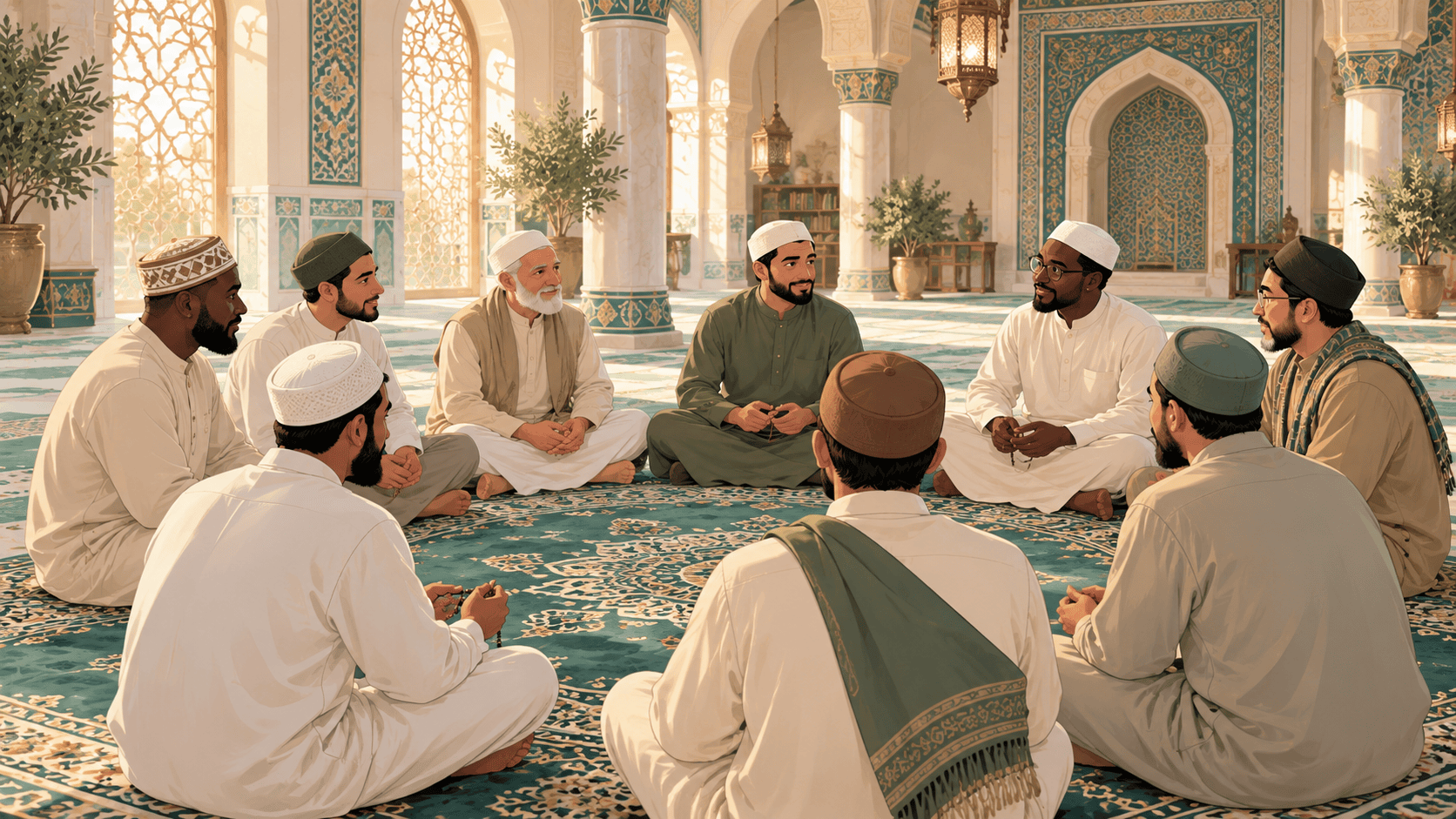
Is group dhikr permissible?
Gathering to remember Allah is encouraged in Islam. However, people mean different things when they say “group dhikr”. Sometimes they mean sitting together while each person remembers Allah. At other times, they mean everyone saying the same words together, in one voice. The first has a clear basis in the Sunnah. Scholars differ over the second: recognised scholars have allowed it, while others have considered it an innovation. Understanding this difference helps us discuss the subject fairly.
Allah Almighty says:
يَا أَيُّهَا الَّذِينَ آمَنُوا اذْكُرُوا اللَّهَ ذِكْرًا كَثِيرًا
“O you who believe, remember Allah abundantly.” (33:41)
Dhikr helps us keep our connection with Allah when the demands of life distract us. As we discuss how to perform it, we should keep its purpose in mind: remembering Allah sincerely and becoming more aware of Him.
The Prophet ﷺ once came upon a circle of his Companions and asked why they were sitting together. They explained that they had gathered to remember Allah and thank Him for guiding them to Islam. He then said:
أَتَانِي جِبْرِيلُ فَأَخْبَرَنِي أَنَّ اللَّهَ عَزَّ وَجَلَّ يُبَاهِي بِكُمُ الْمَلَائِكَةَ
“Jibril came to me and informed me that Allah, Mighty and Majestic, speaks of you with pride before the angels.” (Muslim)
This hadith clearly shows the virtue of gathering to remember Allah. However, it does not tell us whether the Companions were saying the same words at exactly the same time. It supports gathering for dhikr, but does not settle every question about how the gathering should be conducted.
The Prophet ﷺ also said:
لَا يَقْعُدُ قَوْمٌ يَذْكُرُونَ اللَّهَ عَزَّ وَجَلَّ إِلَّا حَفَّتْهُمُ الْمَلَائِكَةُ، وَغَشِيَتْهُمُ الرَّحْمَةُ، وَنَزَلَتْ عَلَيْهِمُ السَّكِينَةُ، وَذَكَرَهُمُ اللَّهُ فِيمَنْ عِنْدَهُ
“Whenever people sit remembering Allah, Mighty and Majestic, the angels surround them, mercy covers them, tranquillity descends upon them, and Allah mentions them among those with Him.” (Muslim)
These are great blessings. We should therefore be careful about condemning all dhikr gatherings when the Prophet ﷺ praised people who came together to remember Allah. Imam al-Nawawi included these narrations in Riyad al-Salihin in a chapter encouraging attendance at circles of remembrance. sunnah.com
There is also evidence for remembering Allah aloud. In a hadith qudsi, Allah says:
وَإِنْ ذَكَرَنِي فِي مَلَإٍ ذَكَرْتُهُ فِي مَلَإٍ خَيْرٍ مِنْهُمْ
“If he remembers Me in an assembly, I remember him in an assembly better than theirs.” (Bukhari)
Ibn Abbas reported that people raised their voices in dhikr after the obligatory prayers during the Prophet’s ﷺ lifetime. He could tell that the prayer had ended when he heard them. This shows that audible dhikr has a basis in the Sunnah, although the report does not say that everyone recited each phrase together. (Bukhari)
The disagreement concerns reciting in one voice. Scholars who allow this understand the general encouragement to remember Allah as including remembrance together. They consider it permissible as long as the gathering does not involve anything prohibited. Egypt’s Dar al-Ifta follows this view. www.dar-alifta.org
This view also has roots in earlier scholarship. Ibn Ata Allah al-Iskandari wrote about people remembering Allah together with their voices in harmony. Imam al-Suyuti wrote a treatise explaining the evidence for audible dhikr. These scholars show that collective remembrance has recognised support in the Islamic tradition, although this does not mean that every activity associated with a dhikr gathering is automatically acceptable.
Other scholars say that deliberately reciting every phrase together introduces a particular form of worship which needs its own evidence. Shaykh Ibn Baz, for example, allowed people to remember Allah aloud after prayer, each at their own pace, but prohibited deliberately coordinating their words. His concern was with that particular method of recitation.
The difference is therefore about how to apply the evidence. One group considers reciting together to be covered by the general permission for dhikr. The other considers it an added form which requires specific proof. We should explain both positions honestly, rather than suggest that all scholars agreed.
Ibn Taymiyyah also said that gathering for Quran recitation, dhikr and dua is good and recommended. However, he added that it should not become a fixed religious practice like the gatherings specifically prescribed in Islam, or include a blameworthy innovation. His permission and his conditions should be mentioned together. (Majmu al-Fatawa, 22:523)
The report about Ibn Masud is also relevant. Al-Darimi records that Ibn Masud saw people sitting in circles, with a leader telling them to repeat particular words of remembrance a hundred times. They used pebbles to count. He strongly criticised their practice, and when they said that they only intended good, he replied:
وَكَمْ مِنْ مُرِيدٍ لِلْخَيْرِ لَنْ يُصِيبَهُ
“How many people intend good yet fail to attain it!”
However, this report concerns a particular practice. It must be read alongside the authentic hadith in which the Prophet ﷺ praised gatherings of remembrance. Scholars who prohibit organised group repetition use it as evidence for their position. Those who permit collective dhikr do not understand it as a ban on every form of remembering Allah together. The disagreement concerns what Ibn Masud objected to and how widely his objection applies.
Those who follow the permissive view should observe its limits
We should use words of remembrance with sound meanings and avoid claiming that a particular arrangement was taught by the Prophet ﷺ without evidence. Being allowed to do something does not necessarily mean that the Prophet ﷺ practised it in that exact way. We should also avoid promising a particular reward for a chosen number of repetitions unless there is evidence for that promise.
Choosing a convenient time for a gathering is different from claiming that Allah has given that time a special virtue. Scholars differ over some regular arrangements, so organisers should understand the view they are following. Participation should remain voluntary, and someone who prefers individual dhikr should not be made to feel that their faith is lacking.
The gathering must also respect other people. When the Prophet ﷺ heard people raising their voices in Quran recitation, he said:
أَلَا إِنَّ كُلَّكُمْ مُنَاجٍ رَبَّهُ، فَلَا يُؤْذِيَنَّ بَعْضُكُمْ بَعْضًا، وَلَا يَرْفَعْ بَعْضُكُمْ عَلَى بَعْضٍ فِي الْقِرَاءَةِ
“Each of you is addressing his Lord, so do not cause one another distress or raise your voices over one another in recitation.” (Abu Dawud)
Our remembrance should not prevent someone else from concentrating in prayer. This is especially important when microphones are used in a mosque.
Quiet dhikr also has an important place in a believer’s life. Allah says:
وَاذْكُرْ رَبَّكَ فِي نَفْسِكَ تَضَرُّعًا وَخِيفَةً وَدُونَ الْجَهْرِ مِنَ الْقَوْلِ بِالْغُدُوِّ وَالْآصَالِ وَلَا تَكُنْ مِنَ الْغَافِلِينَ
“Remember your Lord within yourself, humbly and fearfully, without loud speech, in the mornings and evenings, and do not be among the heedless.” (7:205)
Scholars who allow audible dhikr understand this verse alongside the evidence for remembrance aloud. Al-Suyuti explained that we should consider sincerity and whether others will be disturbed. Joining a gathering should help us remember Allah in our own lives as well.
Gathering for dhikr is therefore encouraged, while saying the same words together is an area of scholarly disagreement. A Muslim who follows the recognised view allowing it should respect its conditions. A Muslim who follows the stricter view should recognise that the permissive position also has scholarly support.
Dhikr should make us more humble before Allah and more considerate towards others. We should not allow disagreement over its form to fill our hearts with contempt. May Allah make us sincere in remembering Him and help us treat one another with understanding.