

Facing the cost of living crisis: helping those in need
The Quranic principle of spending
Allah says in the Quran:
ويسألونك ماذا ينفقون قل العفو
“They ask you what they should spend. Say: what is beyond your needs.”
(Surah Baqarah, 2:219)
This ayah gives us a clear principle about spending, charity and responsibility. The Companions asked Prophet Muhammad (peace be upon him) what they should spend. Allah answered with one word: العفو.
العفو means what is extra. It is the surplus: whatever remains after a person has covered their essential needs and the needs of those who depend on them. It is not money that is needed for food, rent, bills, children, parents, debt, or basic household responsibilities. It is what a person can give without causing harm to themselves or their family.
This is especially important in a time when the cost of living is rising. Many people are under pressure. The cost of covering our daily needs are becoming more expensive. Some families are struggling openly, and others are struggling silently. Islam teaches us to give, but it also teaches us thst we should give with wisdom, in a clear order and responsibly.
Spending from what Allah has provided
At the beginning of Surah Baqarah, Allah describes the people of taqwa, the successful people, as those who believe, establish salah and spend from what He has provided for them:
الذين يؤمنون بالغيب ويقيمون الصلاة ومما رزقناهم ينفقون
“Those who believe in the unseen, establish prayer, and spend from what We have provided for them.”
(Surah Baqarah, 2:3)
When Allah says, “from what We have provided for them”, this reminds us that whatever we have is from the provision of Allah. We work, we make effort, we search for halal income, we try to manage our money, we save and we plan, but in the end, provision comes from Allah.
So when we spend for His sake, we are not really giving from something that belongs to us absolutely. We are giving from what He gave us. This is why spending in the right way brings us closer to Allah. It purifies the heart, purifies wealth and helps society.
People often ask practical questions about money. What should I do with my money? Should I save it? Should I invest it? Should I put it into an ISA? Should I keep it aside? Should I give it in charity? Islam does not ignore these questions. It gives us a clear way to think.
The first way to grow your wealth in the sight of Allah is to spend it for His sake. The second way is to make sure it is earned through halal means. Wealth must be clean – earned in a halal way and we have to be careful how it is spent.
The Quran gives the principle and the Sunnah gives the detail
The Companions did not ask too many unnecessary questions. They were not like previous nations who burdened themselves and their prophets with excessive questioning. Only a small number of questions from the Companions are mentioned in the Quran with the phrase, “They ask you.” This question about spending is one of them.
The Quran gives the general principle: spend from the surplus. The Sunnah gives the details. This is important because some people claim that they only follow the Quran and do not need the Sunnah. But the Quran often gives the main guidance, while Prophet Muhammad (peace be upon him) explains how to apply it in real life. Without the Sunnah, people may know that they should spend, but they may not know who comes first, how much to give, and how to balance different responsibilities.
The prophetic order of giving
Jabir ibn Abdullah (may Allah be pleased with him) reported that Prophet Muhammad (peace be upon him) said:
ابدأ بنفسك فتصدق عليها، فإن فضل شيء فلأهلك، فإن فضل عن أهلك شيء فلذي قرابتك، فإن فضل عن ذي قرابتك شيء فهكذا وهكذا
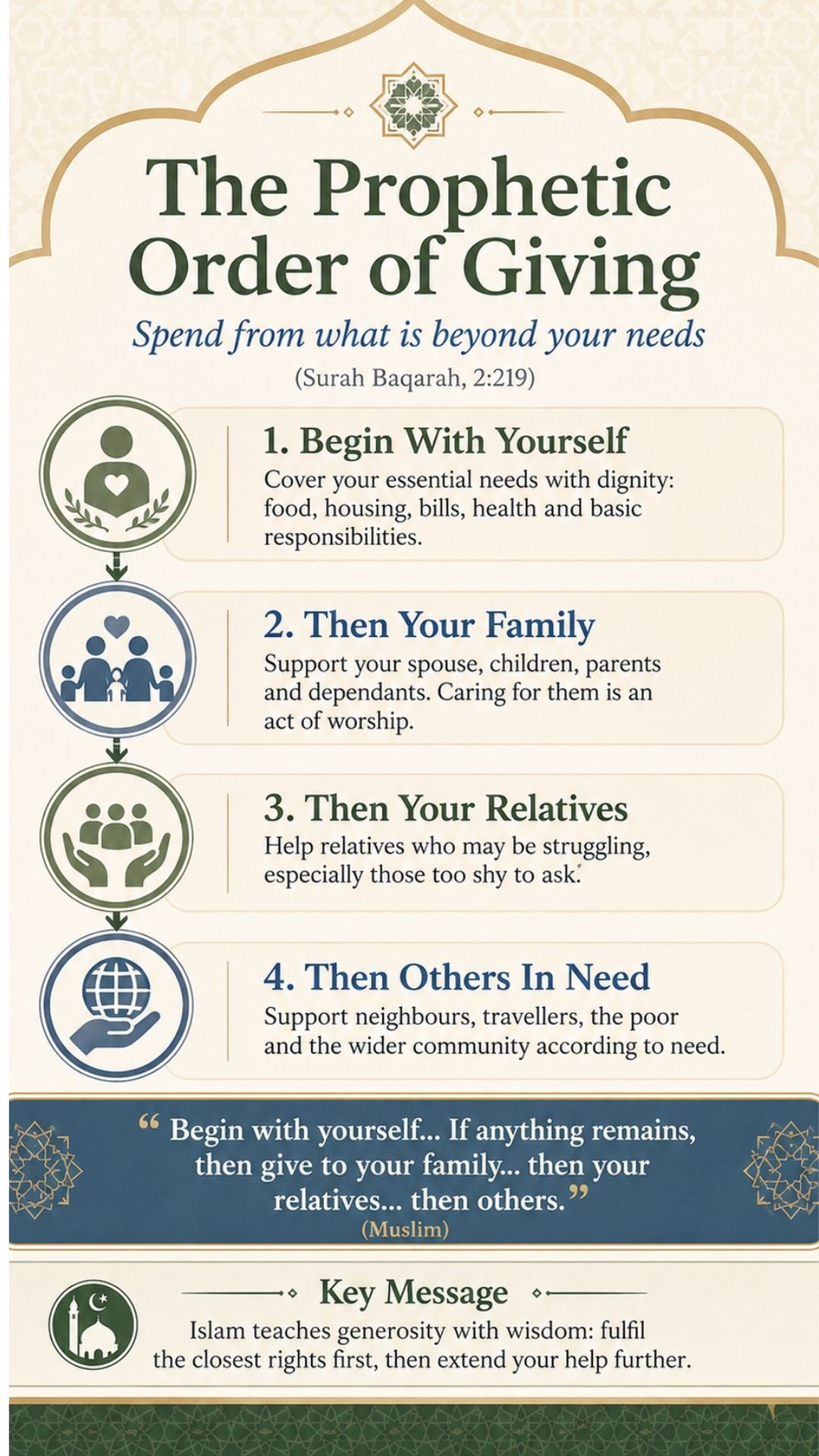
“Begin with yourself and give charity to yourself. If anything remains, then give to your family. If anything remains after your family, then give to your relatives. And if anything remains after your relatives, then spend it here and there.”
(Muslim)
This hadith gives us the order of spending.
First, begin with yourself. This does not mean being selfish. It means that you must fulfil your basic needs and preserve your dignity. You should not place yourself in unnecessary hardship, then become dependent on others. Your food, shelter, health, work, debts and essential responsibilities must be considered.
Then, if something remains, spend on your family. This includes your spouse, children, parents and those under your care. Spending on them is not just a normal household expense. With the right intention, it is an act of worship. It is not correct for someone to give generously to friends, public causes or distant people while their own family is in need. That is not the prophetic way.
Then, if something remains after your family, spend on your relatives. Relatives have a special right. Helping them brings the reward of charity and the reward of maintaining family ties. In a cost of living crisis, we should look carefully at our own relatives. Some may be struggling but too embarrassed to say anything.
Then, if something remains after relatives, spend more widely. Help neighbours, friends, community members, travellers, students, the poor, widows, refugees, single parents and anyone in genuine need. This is the meaning of the Prophet’s words (peace be upon him): “here and there.” In other words, spend in different directions according to need and benefit.
Giving with wisdom and balance
This order teaches us that when different rights compete, the strongest right comes first. The one closest in responsibility should not be ignored for someone further away. A person should not rush to help friends while their family is struggling. They should not look generous outside while neglecting those inside the home.
The best voluntary charity is not always to give everything to one place. It is often better to distribute charity according to need: some to family, some to relatives, some to the poor, some to community work, some to emergencies and some to other good causes.
There are some people who reach a higher level. They give even from what they need. They reduce their own comfort and share with others. They prefer others over themselves. This is a very high level of giving and it brings a great reward from Allah. This is known as eethar (altruism) in Arabic.
But not everyone can do this. Not every person has the same level of iman. Not every family can cope with that kind of sacrifice. If a person’s family is already struggling, or if they are not strong enough to bear the consequences, they should not force themselves into hardship just to appear generous. Otherwise, they may harm themselves, upset their family and create problems.
Prophet Muhammad (peace be upon him) gave everything for the sake of Allah because he was the Messenger of Allah. Some people may come close to that level of sacrifice, but most people need to follow the general guidance: begin with yourself, then your family, then your relatives, then those beyond them.
This also teaches us that charity is not judged only by the amount. Sometimes £100 given with sincerity, at the right time, to the right person, can be greater in the sight of Allah than £1 million given for fame, reputation or publicity. What matters is sincerity, and that the wealth is from a halal source. Then that you give with the right intention and to the right person or cause.
Noticing those who do not ask
The Prophet (peace be upon him) also taught the community how to notice people in need, even when they do not ask.
Abu Sa’id al-Khudri reported:
بينما نحن في سفر مع النبي صلى الله عليه وسلم إذ جاء رجل على راحلة له، قال: فجعل يصرف بصره يمينا وشمالا، فقال رسول الله صلى الله عليه وسلم: من كان معه فضل ظهر فليعد به على من لا ظهر له، ومن كان له فضل من زاد فليعد به على من لا زاد له. قال: فذكر من أصناف المال ما ذكر، حتى رأينا أنه لا حق لأحد منا في فضل
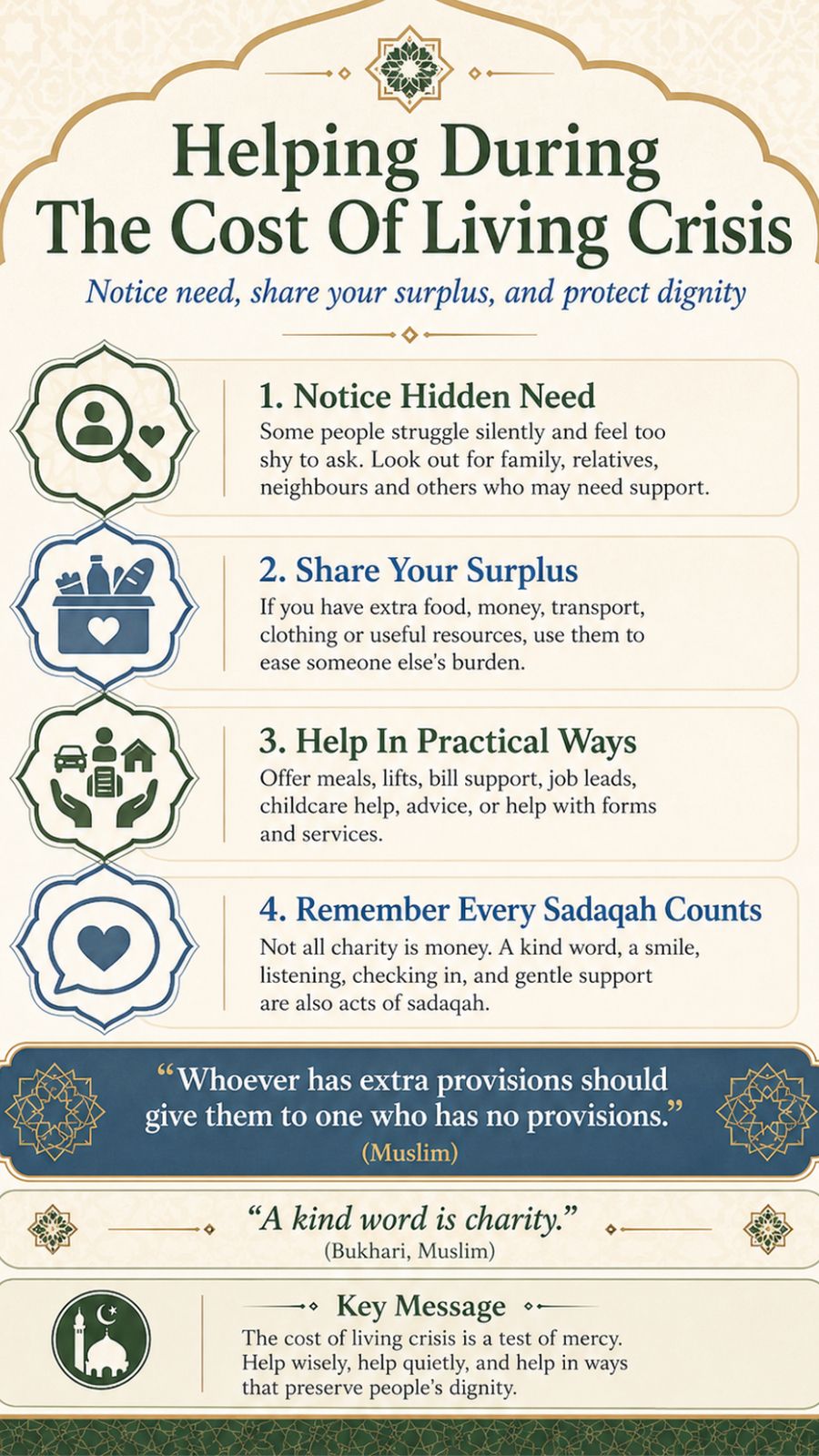
“While we were travelling with Prophet Muhammad (peace be upon him), a man came riding on his mount. He began looking to his right and left. The Messenger of Allah (peace be upon him) said: ‘Whoever has an extra mount should give it to one who has no mount, and whoever has extra provisions should give them to one who has no provisions.’”
Abu Sa’id said: “He mentioned different kinds of wealth until we thought that none of us had any right to keep what was beyond our needs.”
(Muslim)
This incident is very powerful. The man did not say, “I need help.” He did not openly ask. He simply looked to his right and left, and Prophet Muhammad (peace be upon him) understood that he was in need.
This is a lesson for us. Many people will never ask for help because of their dignity. They may feel shy. They may feel embarrassed. They may worry that people will judge them. They may be wearing decent clothes, have a car, or appear comfortable, but they may still be struggling.
The hadith shows that the man had a mount, but he was still looking around as someone who needed support. So we should not assume that someone is fine just because they have some visible means.
Sharing whatever surplus we have
Prophet Muhammad (peace be upon him) mentioned extra transport and extra provisions, but Abu Sa’id said that he went on mentioning different kinds of wealth. This can include food, clothing, shoes, water, tents, money, household items and anything useful. The principle is that whatever we have beyond our need can be used to help someone who does not have it.
This is part of مواساة, supporting others and sharing their burden. When there is hardship, famine, travel difficulty, poverty or crisis, Muslims should support one another with what is beyond their immediate needs.
The hadith also teaches us to look after travellers and those who are cut off from their normal means. A person may not be poor all the time, but they may be in need in that situation. Islam teaches us to respond to the need in front of us.
Responding to the cost of living crisis
This is exactly what we need in the cost of living crisis. We need to look around. We need to notice who is struggling. Some people would rather go hungry than tell others. Some would rather fall into debt than admit that they cannot manage. Some would rather disappear from gatherings than say they cannot afford to attend. If we know people like this, especially in our own families, we should check on them gently and help them in a way that protects their dignity.
Helping can take many forms. If you have extra food, share it. If you have spare transport, offer a lift. If you have usable clothes, pass them on. If you know someone needs help with bills, support them if you can. If you know of a job opportunity, connect them. If you know how to apply for support, grants, benefits or debt advice, guide them. If you have time, listen. If you have influence, use it for good.
Sadaqah is not only money
Not all charity is money. Prophet Muhammad (peace be upon him) said:
الكلمة الطيبة صدقة
“A kind word is charity.”
(Bukhari and Muslim)
He also said:
تبسمك في وجه أخيك لك صدقة
“Your smile in the face of your brother is charity.”
(Tirmidhi)
A kind word can lift someone. A smile can comfort someone. A message can reassure someone. A visit can make someone feel remembered. Helping with a form, carrying shopping, giving advice, making a phone call, checking in on someone, or simply listening can all be charity when done sincerely.
Sometimes people do not only need money. They need mercy. They need dignity. They need someone to notice them without embarrassing them. They need to feel that they are not alone.
Helping beyond our own circle
This care begins with our own families and relatives, but it should not stop there. After fulfilling those closest rights, we should help others too. This includes the Muslim community and also anyone else in need. If someone is hungry, vulnerable, lonely, struggling or desperate, and we are able to help, then helping them is a part of goodness.
A spiritual test for the community
The cost of living crisis is not only a financial test. It is a test of iman, mercy and community. It shows whether we only think about ourselves or whether we remember that our wealth is a trust from Allah. It shows whether we notice hidden hardship. It shows whether we honour family ties. It shows whether our communities are built on real care or only words.
We should ask ourselves: who in my family may be struggling silently? Which relative has become quiet or distant? Which neighbour may need help? Which friend is pretending to be fine? What surplus has Allah given me? Is it money, food, time, knowledge, transport, skills or contacts? How can I use it to help someone else?
The prophetic guidance is balanced and beautiful. Do not neglect yourself. Do not neglect your family. Do not forget your relatives. Do not ignore the wider community. Do not wait until people beg. Do not think charity is only for the rich. Do not underestimate a small amount given sincerely. Do not underestimate a kind word or a smile.
In times of ease, generosity is beautiful. In times of hardship, it becomes even more necessary. The believer looks around. The believer notices. The believer gives with wisdom. The believer protects the dignity of others. The believer spends from what Allah has provided, seeking His pleasure.
May Allah make us among those who spend in His path. May Allah accept our spending and our charity. May Allah place barakah in our wealth. May Allah protect our families from hardship. May Allah help us notice those who are struggling silently. May Allah make us people of mercy, generosity and sincerity. Ameen.
Based on the khutbah of Shaykh Haytham Tamim on 5th June 2026.
Money, money, money – wanting it, pinching it, spending it and repaying it
The prohibition on being wasteful and the command to be moderate in spending