
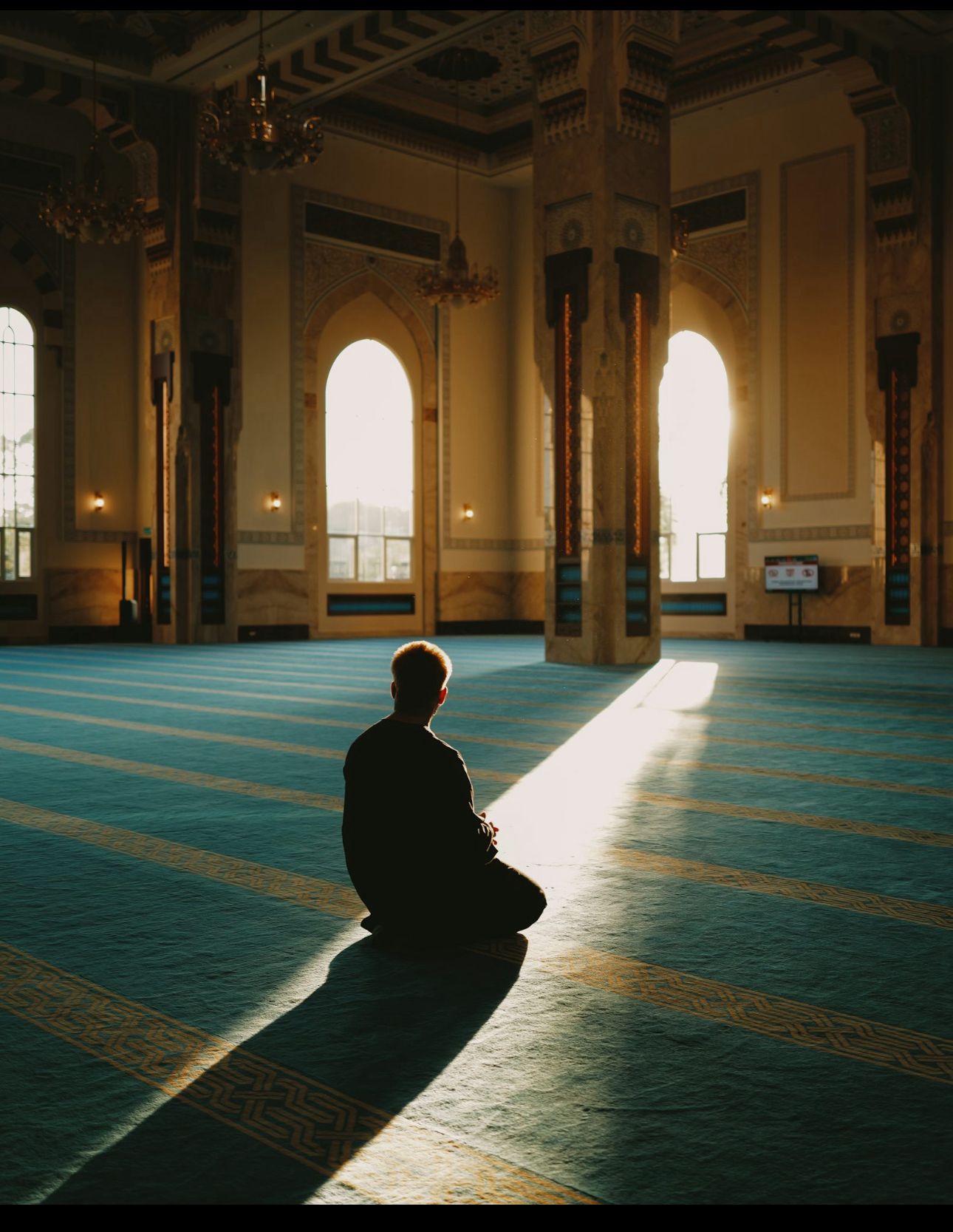
When faith feels overwhelming
Islam, certainty, and finding peace in faith
Some Muslims today describe a feeling of anxiety around religious practice. This can show itself as constant self-doubt, repeated checking of rulings, fear that worship is invalid, or a feeling of being mentally trapped by religion. Religious practice seems heavy and exhausting.
Yet this experience is not what Islam intends for the believer. Islam was never meant to create fear-driven obedience, paralysis, or chronic anxiety. When faith begins to feel overwhelming rather than a source of peace and guidance, the issue is not sincerity, but the approach being taken to the religion.
Islam, as taught in the Qur’an, the Sunnah, and the mainstream scholarly tradition, is a religion of moderation, ease, and certainty. These principles are not secondary; they are foundational.
Moderation is the Qur’anic norm
Allah describes the Muslim community as:
“And thus We have made you a balanced nation.”
Surah al-Baqarah (2:143)
Balance here means avoiding extremes. Islam does not push believers toward constant suspicion of themselves, nor does it require perfection in every detail. When religious practice consistently produces anxiety, guilt, or emotional distress, this signals a move away from balance, not toward it.
Allah does not want faith to feel unbearable
Allah clearly states His intent:
“Allah intends ease for you and does not intend hardship for you.”
Surah al-Baqarah (2:185)
Scholars explain that this is not limited to one act of worship. It reflects Allah’s overall approach to human wellbeing. Islam is meant to be lived with calmness. A religious mindset that feels suffocating or mentally imprisoning contradicts this divine intent.
The Prophet ﷺ warned against excess
The Prophet ﷺ was deeply concerned about people harming themselves spiritually through excess. He said:
“Beware of extremism in religion, for those before you were destroyed by extremism in religion.” (Ahmad, Nasa’i, Ibn Majah)
and
“The extremists are ruined.” (Muslim)
This includes not only public harshness, but also inner harshness toward oneself. Over-scrutiny, relentless self-criticism, and fear-based worship were never encouraged by the Prophet ﷺ.
The Sunnah chooses ease where possible
ʿAisha (may Allah be pleased with her) tells us:
“The Messenger of Allah ﷺ was never given a choice between two matters except that he chose the easier of the two, so long as it was not sinful.” (Bukhari and Muslim)
Ease is not weakness. It is prophetic wisdom. Where Allah has allowed flexibility, choosing the path that brings peace and sustainability is closer to the Sunnah than choosing unnecessary difficulty.
Certainty protects mental wellbeing
A key Islamic principle states:
Certainty is not removed by doubt.
This principle is especially important for those who struggle with religious anxiety. Islam does not require you to act on every doubt that enters your mind. If something is generally permissible, you are allowed to live with that certainty. Constant checking, re-checking, and questioning does not increase piety; it often increases distress.
Islam teaches believers to stand on what is clear, not to drown in what is uncertain.
Islam does not require constant questioning
Allah warns:
“Do not ask about things which, if made clear to you, would cause you harm.”
Surah al-Ma’idah (5:101)
Excessive questioning can damage peace of mind. Islam does not require answers to every hypothetical scenario or minor detail. Healthy faith involves knowing when to stop digging and when to trust what Allah has already made clear.
Dealing with intrusive religious thoughts
Classical scholars recognised intrusive doubts and referred to them as waswasa. They were clear that such thoughts should be ignored, not entertained. Engaging with every intrusive idea strengthens it. Letting it pass weakens it.
The Islamic response to waswasa is calm confidence, not constant correction.
Protecting your faith from harmful influences
In today’s digital environment, many people are exposed to extreme or hyper-literal voices that strip Islam of mercy and context. Constant exposure to such content can deeply affect mental and spiritual wellbeing.
Islam has always been preserved through qualified scholarship, which is characteristically balanced, and contains collective wisdom. Following a trusted scholarly path is not avoidance of truth; it is protection from confusion.
Moderation sustains faith long-term
Excessive religiosity often leads to burnout, resentment, or eventually stepping away from practice altogether. Moderation allows consistency and growth.
The Prophet ﷺ said:
“The most beloved deeds to Allah are those that are consistent, even if small.” (Bukhari and Muslim)
Consistency requires a faith that is liveable, not one that overwhelms the heart.
A healthier way forward
Islam invites the believer to worship with sincerity, not fear; to live with certainty, not constant doubt; to practice with balance, not rigidity; and to seek Allah with hope, not panic.
Peace in religion comes from knowing Allah as Merciful and Wise, not from constant self-surveillance.
Overcoming pressures and hesitations
Some rulings may feel especially burdensome in certain social contexts, not because of their intrinsic nature, but because of the pressures, narratives, and associations surrounding them. The obligation of hijab is one such example in many contemporary societies, where it is often framed through lenses of restriction, identity conflict, or social scrutiny rather than devotion and dignity. This can generate hesitation, guilt, or internal resistance, particularly for those already prone to religious anxiety. Islam, however, does not ask believers to negate their emotional reality, but to approach obedience with understanding, gradual growth, and sincerity.
Scholars have long recognised that hardship may arise from circumstances rather than the ruling itself, and that spiritual confidence develops through sound knowledge, companionship, and reframing intention. When acts of worship are understood as responses to divine wisdom rather than constant self-surveillance, the heart finds space to grow. Overcoming hesitation therefore lies not in harsh self-pressure, but in reconnecting rulings to their purposes, trusting Allah’s mercy, and allowing faith to mature without coercion.
At the same time, it is important to distinguish between ease and avoidance. Islam being a religion of ease does not mean that divine commands are set aside whenever they feel uncomfortable or counter-cultural. Rather, ease refers to the absence of undue hardship, rigidity, and obsessive burden, not the absence of obligation itself. The Qur’an repeatedly affirms that Allah does not burden a soul beyond its capacity, while also affirming that obedience is the path to spiritual clarity and growth. Classical scholars therefore warned against two extremes: harshness that fractures the heart, and negligence that hollows faith of commitment. True ease lies in submitting with trust, taking legitimate concessions where they exist, and carrying out obligations with sincerity rather than resistance. When commands are approached through knowledge, balance, and reliance upon Allah, they cease to feel like constraints and instead become acts of alignment with one’s purpose.
Faith should bring calm, not captivity
Islam is not a religion of rigidity, it is not all black and white, nor is it so unclear that one should be in constant doubt, or feel mental exhaustion. It is a religion of moderation, ease, and certainty. When faith feels heavy, the solution is not to tighten further, but to return to the Qur’an, the Sunnah, and the balanced path of the Prophet ﷺ.